

Commentary
Gwendolyn Sasse
{
  "authors": [
    "Gwendolyn Sasse"
  ],
  "type": "commentary",
  "blog": "Strategic Europe",
  "centerAffiliationAll": "",
  "centers": [
    "Carnegie Endowment for International Peace",
    "Carnegie Europe"
  ],
  "collections": [
    "Europe’s Eastern Neighborhood",
    "Transatlantic Cooperation",
    "EU Integration and Enlargement"
  ],
  "englishNewsletterAll": "",
  "nonEnglishNewsletterAll": "",
  "primaryCenter": "Carnegie Europe",
  "programAffiliation": "",
  "programs": [],
  "projects": [],
  "regions": [
    "Russia",
    "Europe",
    "North America",
    "Eastern Europe",
    "United States",
    "Ukraine"
  ],
  "topics": [
    "Foreign Policy",
    "Security",
    "EU"
  ]
}
Source: Getty
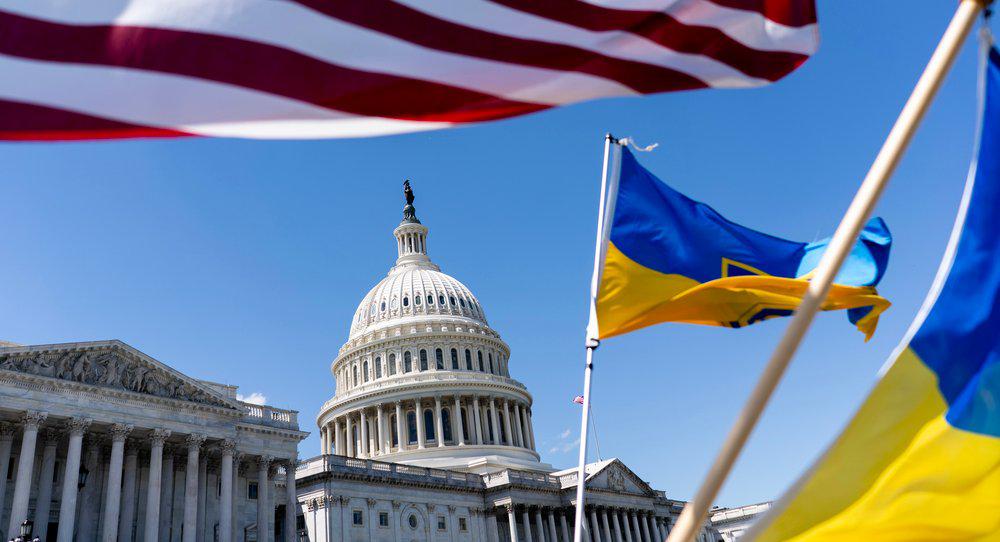
The release of U.S. aid to Ukraine is one of many steps necessary to contain Russian aggression. Western leaders must remind publics what is at stake and think ahead to avoid delays at every turn.
On April 21, the U.S. House of Representatives finally approved the $61 billion (€57 billion) Ukraine aid package. Today, the Senate is expected to follow suit, paving the way for President Joe Biden to sign it into law.
After long delays, the bill was passed in just a few minutes, with a clear majority made up of Democrats and a critical mass of Republicans voting in favor. The Speaker of the House Mike Johnson had engineered the vote so that it would be successful when tabled, though he himself had been a staunch critic of aid to Ukraine in the past and may yet forfeit his position as speaker.
The roughly $61 billion (€57 billion) include $23 billion (€22 billion) earmarked for replenishing U.S. military stockpiles, some of which could be transferred to Ukraine at a later stage, $14 billion (€13 billion) for the purchase of advanced weapons systems for Ukraine from U.S. defense contractors, $11 billion (€10 billion) for U.S.-Ukraine cooperation, including joint intelligence operations, and $8 billion (€7 billion) for financial aid. There are also provisions in the legislation allowing Russian assets in the West to be frozen and used for reconstruction purposes in Ukraine.
In recent months, the discussion about the future development of Russia’s war against Ukraine and potential endgames was dominated by the uncertainty around the U.S. aid package. Speculation was rife that Ukraine could soon be forced to negotiate with Russia at a time when there is evidently no political will in Moscow to negotiate.
The eventual passing of the Ukraine bill has been met with palpable relief in Europe. The vote was widely hailed as proof that the West is back and that U.S. commitment to Ukraine has not been captured by the Donald Trump campaign.
It is indeed of utmost importance for Ukraine that this impasse has been broken. U.S. military aid can be delivered faster than most European aid, which still lacks the production capacities required to be a reliable supplier of ammunition and other military assistance to Ukraine.
Continued U.S. military aid also sends a strong signal to Ukrainian soldiers and society at large—it boosts morale at a moment when the fighting is particularly tough and Russia is relentlessly targeting critical infrastructure in the city of Kharkiv while also keeping up the pressure in the Donbas region.
It is striking, however, how much wishful thinking finds its way into Western commentary. The release of U.S. aid is ultimately one step of many that will need to be taken. With the U.S. presidential election looming, the uncertainty over what a Trump victory would mean, including for Ukraine, remains.
The domestic political struggle over the release of U.S. aid is yet another case of the West just about turning the corner. In Europe, there are similar examples, such as the repeated vetoes of Hungarian Prime Minister Viktor Orbán who first blocked the opening of EU accession negotiations with Ukraine and then the EU’s Ukraine Facility, the financial package linking reconstruction and accession.
There is ample space for populist and polarized politics to derail support for Ukraine. So far, each time the path was cleared at the last moment, often by a fudge, making a repeat scenario—or an actual blockage—in the months and years to come highly likely. Moreover, it took massive lobbying by the Ukrainian and other European governments, NGOs, think tanks, and activists to prepare the ground for the vote on the U.S. bill.
Ukraine should focus on the good news for now, but Western powers need to think ahead more strategically to try and prevent cliffhangers at almost every essential turn. Even if the Trump argument did not win over the Congress vote this time around, the U.S. presidential election remains wide open—with a substantial part of Ukraine’s future at stake.
For the United States, the argument should be that not despite of but because of an “America first” policy, it matters whether the authoritarian regime in Russia is stopped. If it is not, other autocrats will feel empowered, the first among them being the Chinese political leadership. The United States sees China rather than Russia as its primary, long-term archrival, but if Russia can declare victory over Ukraine, the message to China is that Washington cannot stop autocrats with neo-imperial ambitions.
As the EU gears up for the European Parliament elections in June, the war and Ukraine’s reconstruction and EU accession will also prove sticky issues some leaders and parties will seek to exploit—in Hungary, Slovakia, the Netherlands, possibly Poland, France, and elsewhere. Support for Ukraine is not an issue that neatly divides the EU into east and west when it comes to elections where vocal constituencies and candidates try to capitalize on the war and its costs.
Ultimately, it comes down whether politicians across Europe—and Biden and the Democrats in the United States—manage to convey the message that the war is not as far away as it seems to many, and that it is directly tied to European, transatlantic, and U.S. security.
The Baltic states are the most explicit in conveying that Ukraine is defending their security. In other parts of Europe, there is some lip service to this, but the electorates mostly think differently. This is where the election cycles should provide a platform to renew awareness of the daily reality in Ukraine, what is at stake, and what kind of military and financial aid Ukraine needs in the coming months.
Gwendolyn Sasse is a nonresident senior fellow at Carnegie Europe and director of the Centre for East European and International Studies (ZOiS) in Berlin.
This blog is part of the Transatlantic Relations in Review series. Carnegie Europe is grateful to the U.S. Mission to the EU for its support.

Nonresident Senior Fellow, Carnegie Europe
Gwendolyn Sasse is a nonresident senior fellow at Carnegie Europe. Her research focuses on Eastern Europe, with a particular focus on Ukrainian politics and society, EU enlargement, and comparative democratization.
Recent Work
Gwendolyn Sasse
Gwendolyn Sasse
Carnegie does not take institutional positions on public policy issues; the views represented herein are those of the author(s) and do not necessarily reflect the views of Carnegie, its staff, or its trustees.

The EU can impose sanctions but struggles to enforce them without the United States. With Washington increasingly disinterested in backing European interests, the bloc must now fend for itself.


Nicu Popescu, Tiago Antunes

Russia is testing the waters of NATO’s mutual defense clause. What do strikes in Romanian territorial waters mean for the alliance’s posture toward Moscow?

Dimitar Bechev

With its public finances in shambles, the far right polling at 35 percent ahead of the 2027 presidential election, and a growing protest movement, is France’s crisis a threat to the EU’s geopolitical awakening?

Rym Momtaz, ed.

Ahead of a tough winter for Ukraine, Donald Trump’s swing back toward Russia bodes ill. But instead of panicking, Kyiv’s European allies are focusing on action.
Rym Momtaz

While the EU and European governments are embracing the much-lauded middle-power moment, this entails three difficult conundrums.

Richard Youngs