

Commentary
Peter Kellner
{
  "authors": [
    "Peter Kellner"
  ],
  "type": "commentary",
  "blog": "Strategic Europe",
  "centerAffiliationAll": "",
  "centers": [
    "Carnegie Endowment for International Peace",
    "Carnegie Europe"
  ],
  "collections": [
    "Transatlantic Cooperation",
    "Brexit and UK Politics"
  ],
  "englishNewsletterAll": "",
  "nonEnglishNewsletterAll": "",
  "primaryCenter": "Carnegie Europe",
  "programAffiliation": "",
  "programs": [],
  "projects": [],
  "regions": [
    "Europe",
    "North America",
    "Western Europe",
    "United Kingdom"
  ],
  "topics": [
    "Foreign Policy",
    "Political Reform",
    "EU"
  ]
}
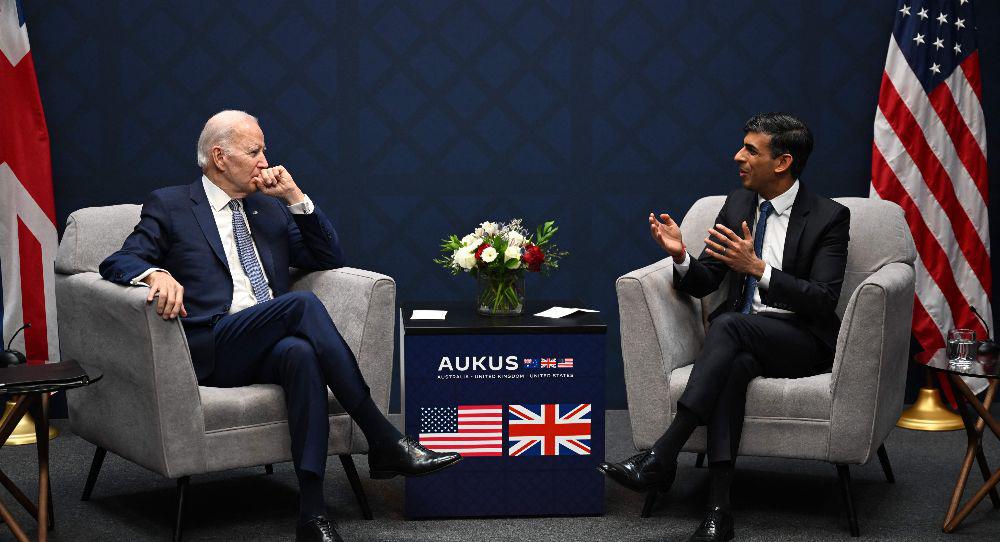
Source: Getty
Once an important bridge between the EU and the United States, the UK today has waning global influence and a weakening economy. Britons fear that the next election will make little difference.
I can exclusively reveal the results of a survey I have been conducting about British and American politics. Before readers get too excited, I should admit that this is far from scientific. But the results still tell us something.
The next British general election and U.S. presidential election are likely be held close together. The date for the latter is fixed: November 5, 2024. The British contest could be called at any time before January 2025, but October or November is most probable. I have been asking a selection of my pro-Labour British friends, if forced to choose, which would they prefer: (a) victories for the present incumbents, Joe Biden and Rishi Sunak—or (b) their replacement by Donald Trump and Labour’s Keir Starmer, respectively?
With one exception, everyone I asked said they would prefer Biden and Sunak, many of them adding: “obviously.” Friends who are active Labour supporters, most of them for many years, say it is more important to keep out Trump rather than to boot out Sunak.
In a way, we should not be surprised: Trump poses a danger on so many fronts. However, it is not just the fear of his return that is striking. There is a nagging anxiety, even among committed members of the Labour tribe, that even if their party sweeps to power, the future offers not so much jam tomorrow as paradise postponed. They worry that the result of the coming British election might make little difference to most Britons, and hardly any to the course of world events. Let us take those two dimensions, domestic and international, in turn.
There is a temptation to say that Britain’s two main parties are either much the same, or that they are utterly different. The first is most commonly heard from left-wing commentators, the second from party leaders and right-wing newspapers. The truth is in between. While the instincts of Labour and Conservative activists differ sharply, both parties are boxed in, and will have little freedom to convert their instincts into bold new measures.
Thus the Conservatives would love to cut taxes. These have risen to their highest share of the economy since the aftermath of the Second World War. Unfortunately, the size of the government’s debt makes significant tax cuts impossible any time soon.
Labour’s instinct is to increase spending significantly on public services. But it can’t without either taxing workers more, or adding further to the government’s debt. The first is electorally risky, and financial markets hate the second. So Labour is stuck. Whichever party runs Britain after the next election, the overall balance between taxes and spending is likely to be much the same.
On Europe, most Labour activists and voters would love to reverse Brexit and rejoin the EU if they could. In contrast, many Tories want an even more distant relationship with Brussels. The leaderships of both parties reject these instincts. Labour would try to tweak Britain’s Trade and Cooperation Agreement in order to make it easier for companies to trade with the EU—but not to do the things that would make a significant difference: rejoining the EU’s customs union and single market. It is Britain’s exclusion from these that has dented its economy badly and helped to limit both parties’ freedom of action; and polls show that most Britons now regard Brexit as a mistake. But Starmer fears a backlash from swing voters if he commits to any radical change in the UK’s relationship with the EU.
Meanwhile, Sunak has pretty well given up on Britain setting completely separate rules for business. He knows that this would damage exporters that will have to comply with EU rules anyway. They would hate to obey two completely different sets of rules depending on the destination of each consignment.
On defense, NATO, nuclear weapons, and Ukraine, there is no difference at all between Sunak and Starmer. Nor will either grant Scotland a fresh referendum on independence, however loudly its politicians demand one. Consensus reigns. On other issues, such as cuts in recent years to welfare benefits and overseas aid, Labour condemned the present government’s decisions at the time—but is careful not to promise their reinstatement.
On climate change, there is a difference, and the gap has widened in recent days. The plan until now has been to outlaw the sale of new petrol and diesel cars after 2030. This month, Sunak announced that he will put this back to 2035. Labour says it will reinstate the 2030 cut-off. Labour has also promised to invest £28 billion ($34 billion) a year in green energy within five years of coming to office; the Tories will spend far less. Yet both parties agree that climate change is an existential threat to humanity, and both remain committed to the UK to reaching net-zero carbon emissions by 2050. Both are also committed to nuclear power.
In terms of likely action in government, as distinct from their rival visions of an ideal society, the differences between Labour and Conservative are real but not fundamental. There is, however, another dimension to all this.
One of Britain’s functions before Brexit was to be a bridge between the United States and the EU. Who was in power in London mattered to both Washington and Brussels. The victories of Margaret Thatcher in 1979 and Tony Blair in 1997 made headlines around the world; UK membership of the EU amplified their influence.
Today, Britain can still claim its status as a member of the United Nations and as the owner of nuclear weapons. But it is questionable whether the Security Council would ever have decided anything differently had the UK not been a member. And the possession of nuclear weapons has little relevance to Ukraine, Europe’s first land war since 1945.
In 1962, Dean Acheson, America’s secretary of state under president Truman, famously said: “Great Britain has lost an empire and has not yet found a role.” Membership of the EU gave Britain that role. It did much to shape the union’s development. The national leader who did most to bring about the single market was Thatcher—the very leader that the Brexiters now lionise. Today, Britain’s influence has gone and its economy weakened. Acheson would be hard pressed to identify any significant role today, other than as a terrible warning to any country thinking of tearing up its relationships with its closest neighbors.
No wonder that even Britons who are keen to remove Sunak are more concerned about the prospect of Trump returning to the White House—and often add: “obviously.”

Former Nonresident Scholar, Carnegie Europe
Kellner was a nonresident scholar at Carnegie Europe, where his research focused on Brexit, populism, and electoral democracy.
Recent Work
Peter Kellner
Peter Kellner
Carnegie does not take institutional positions on public policy issues; the views represented herein are those of the author(s) and do not necessarily reflect the views of Carnegie, its staff, or its trustees.

With its public finances in shambles, the far right polling at 35 percent ahead of the 2027 presidential election, and a growing protest movement, is France’s crisis a threat to the EU’s geopolitical awakening?

Rym Momtaz, ed.

Ahead of a tough winter for Ukraine, Donald Trump’s swing back toward Russia bodes ill. But instead of panicking, Kyiv’s European allies are focusing on action.
Rym Momtaz

While the EU and European governments are embracing the much-lauded middle-power moment, this entails three difficult conundrums.

Richard Youngs

Much has been said of the changes Brussels is trying to make to the EU enlargement process. Here’s why gradual integration might—or might not—be the answer.

Dimitar Bechev

The European Commissioner for Trade is headed to China. But after President Xi’s bridge-building visit to Washington, can a more isolated EU overcome Beijing’s stranglehold on critical raw materials? Who will blink first?
Rym Momtaz, ed.