

Commentary
Judy Dempsey
{
  "authors": [
    "Judy Dempsey"
  ],
  "type": "commentary",
  "blog": "Strategic Europe",
  "centerAffiliationAll": "",
  "centers": [
    "Carnegie Endowment for International Peace",
    "Carnegie Europe"
  ],
  "englishNewsletterAll": "",
  "nonEnglishNewsletterAll": "",
  "primaryCenter": "Carnegie Europe",
  "programAffiliation": "",
  "programs": [],
  "projects": [],
  "regions": [
    "Ukraine",
    "Russia",
    "United States",
    "Europe"
  ],
  "topics": [
    "Military",
    "Security"
  ]
}
Source: Getty
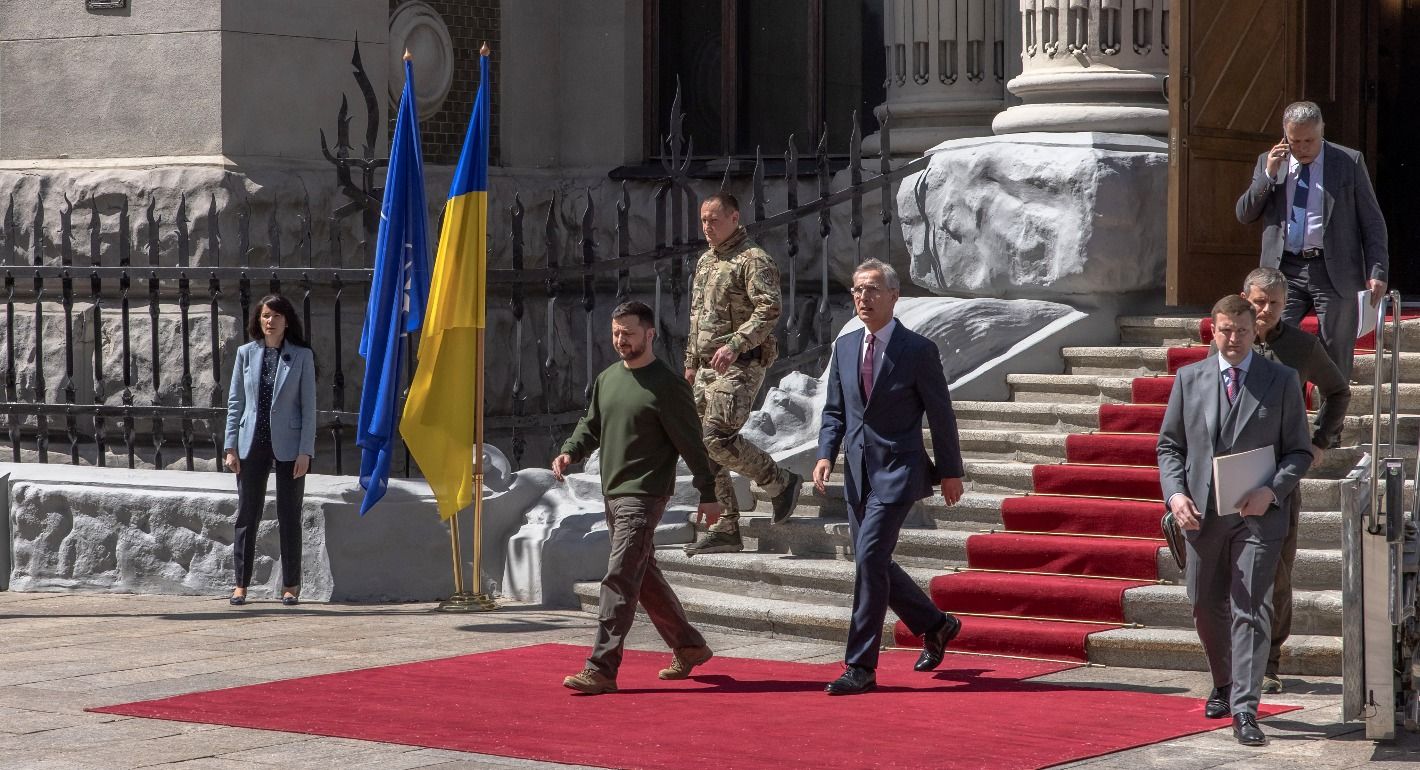
As NATO convenes in Washington, it faces internal tensions and Trump’s potential return as U.S. president. But it is the alliance’s approach to Russia that will determine the future of transatlantic security.
NATO has a few worries as its leaders meet on July 9-11 in Washington for a summit marking the alliance’s seventy-fifth anniversary.
It is the specter of Donald Trump returning to the White House after November’s U.S. presidential election. His views on NATO are well known: The alliance is free riding on the back of the American taxpayer and Washington’s security umbrella. The Europeans should cough up funds to defend themselves.
It is the perennial tensions between the political and military committees inside NATO, with the latter often taking the lead since Russia’s full-scale invasion of Ukraine in February 2022.
It is the fact that the United States, not NATO, is coordinating the delivery of military supplies to Ukraine via its big base in Ramstein, Germany. Several European allies would like NATO to take over that task.
But the biggest problem facing NATO is Ukraine. It is NATO’s Achilles’ heel for several reasons.
First, Russia’s war against Ukraine is a challenge for a transatlantic alliance that is struggling to reconcile interests, values, and deterrence.
Second, the war questions NATO’s mantra about making Europe whole, free, and united.
Third, Russia’s aggression challenges Europe’s own security. The war has unleashed a plethora of new threats from Moscow—from cyber and chemical attacks to pervasive disinformation campaigns. Russia’s war against Ukraine is a war against what the West stands for.
On a bilateral level, several member states are doing much to provide military, political, and financial support to Ukraine, not to mention helping the millions of refugees that have fled the war.
But ever since Ukraine became independent in 1991, one of its main ambitions was to join NATO. President Volodymyr Zelensky, who was bitterly disappointed at last year’s NATO summit in Vilnius when the alliance ducked the membership issue, instead establishing special NATO-Ukraine formats, knows his country will not be admitted anytime soon.
The reason is Russia.
NATO members can’t fob off Kyiv by saying Ukraine’s military is not ready. They cannot point to its lack of military interoperability as if the current member states were interoperable.
For NATO, Ukraine’s future relationship with the alliance is about the alliance’s relationship with—or rather its perception of—Russia. How NATO deals with Ukraine is predicated on how Russia will react.
Stoltenberg has repeatedly stated that “NATO is not at war with Russia.” As Paul Taylor recently wrote: “This strategic communication, intended to counter the Russian narrative of aggressive NATO expansion, may unintentionally have led Putin to conclude that the alliance would not intervene if he overran Ukraine.”
More than that. In several NATO countries, particularly Germany and the United States, there is the assessment that if NATO did adopt a more robust policy toward Ukraine, it would lead to escalation. Yet it is Russia that has escalated. It started two wars against Ukraine. Consider Russia’s July 8 attack on a children’s hospital in Kyiv in which dozens were killed and over 130 seriously injured. Consider the systematic bombing of the energy infrastructure.
Ukrainian officials with whom I recently spoke said it would be impossible to supply heating to many Ukrainians this coming winter. That could lead to more refugees seeking safety elsewhere in Europe. No doubt Vladimir Putin is counting on a backlash in some EU countries against another influx of war-weary refugees.
Yet if the consequences of the devastating damage of the energy infrastructure are known, why can’t NATO, as Zelensky has so often asked for, provide a no-fly zone over Ukraine or provide air defense missiles to defend the energy infrastructure?
The reason is Russia.
From the end of the Cold War until now, Russia has repeatedly tried to thwart Ukraine’s independence.
In the early 1990s, Germany, supported by the United States, was focused on negotiating with Moscow on a three-pronged strategy: the reunification of Germany, the withdrawal of all Russian troops from eastern Germany, and bringing the latter into NATO.
These goals crisscrossed with the goals of the Central Europeans who wanted to join NATO as quickly as possible. They overlapped too with Washington’s goals to pursue nuclear disarmament that would include the dismantling of nuclear weapons stockpiles in Ukraine and Kazakhstan.
Moscow, which was going through immense political and economic turmoil, first under Mikhail Gorbachev and later Boris Yeltsin, signed onto these plans and disarmament negotiations.
Ukraine wanted security assurances in return for giving up its nuclear stockpiles. In November 1994 in Budapest, the United States, the United Kingdom, and Russia gave Ukraine “long-promised security assurances of is territorial integrity.” A member of the U.S. delegation, according to M. E. Sarotte in her book “Not One Inch,” called the assurances “a worthless piece of paper.”
In short, the West let down Ukraine.
Sarotte implies that bringing Ukraine into NATO was a step too far for the alliance. Not just because Ukraine was too big and that it would mean defending it under the Article 5 commitment. It was because of Russia. It would have been a step too far for Russia—and the West.
Decades after the end of the Cold War, Ukraine is still fighting to defend its independence and right to be safe and secure. The bitter truth is that Ukraine is a country that neither the Europeans nor the Americans believe is a risk worth taking to defend via Article 5. And Putin knows that.

Nonresident Senior Fellow, Carnegie Europe
Judy Dempsey is a nonresident senior fellow at Carnegie Europe
Recent Work
Judy Dempsey
Judy Dempsey

The aftermath of the Ceuta crisis shows Europe has drawn the wrong lessons. Rather than doubling down on failed migration policies, the EU needs to address the underlying roots of such episodes.

Richard Youngs

An overwhelming victory by a far-right-wing party in a small state in eastern Germany will have major repercussions for Chancellor Friedrich Merz’s coalition.
Judy Dempsey

Canadian Prime Minister Mark Carney has twice inspired praise for standing up to U.S. President Donald Trump: at the 2026 World Economic Forum in Davos and on Canada-U.S. trade negotiations. Is Carney showing a third way better than the EU has in dealing with the Trump administration?

Rym Momtaz, ed.

The EU’s responses to two recent incidents expose the gulf between European perceptions and capabilities. Unless the union can bridge that gap, it will never become a real geostrategic power.
Rym Momtaz

In supporting Europe’s far-right, MAGA and Russia both want the same thing: a weaker EU. Europe must defend itself without abandoning the openness these forces exploit.

Armida van Rij