

Commentary
Thomas de Waal
{
  "authors": [
    "Thomas de Waal"
  ],
  "type": "commentary",
  "blog": "Strategic Europe",
  "centerAffiliationAll": "",
  "centers": [
    "Carnegie Endowment for International Peace",
    "Carnegie Europe"
  ],
  "collections": [
    "Aso Tavitian Initiative"
  ],
  "englishNewsletterAll": "",
  "nonEnglishNewsletterAll": "",
  "primaryCenter": "Carnegie Europe",
  "programAffiliation": "",
  "programs": [],
  "projects": [],
  "regions": [
    "Armenia",
    "Azerbaijan",
    "Europe"
  ],
  "topics": [
    "Foreign Policy",
    "Security",
    "EU Foreign Policy"
  ]
}
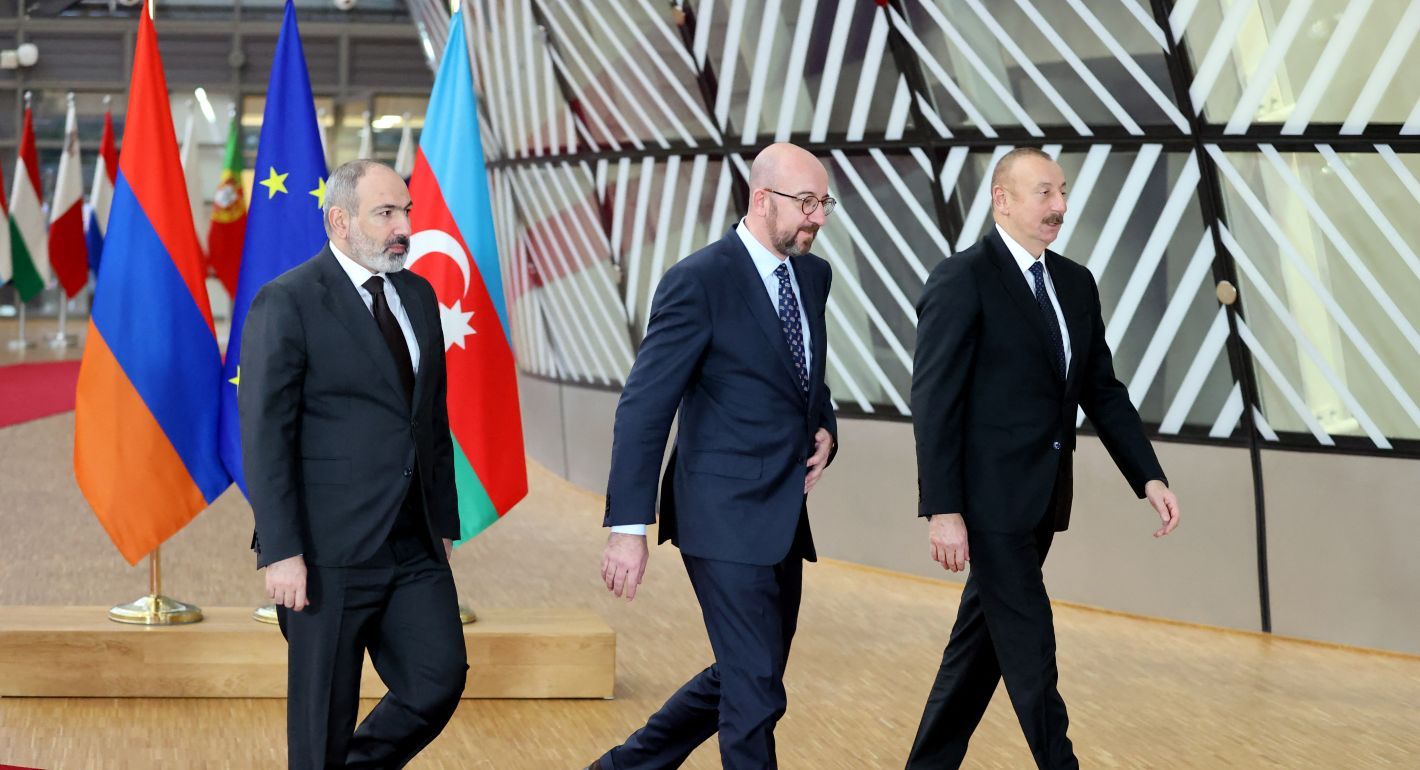
Source: Getty
Azerbaijan is in a dominant position as negotiations drag on with Armenia on normalizing relations. To advance a meaningful and sustainable settlement, the West must prioritize engagement with the region.
One year after Azerbaijan captured the long-disputed province of Nagorny Karabakh, forcing the expulsion of the entire Armenian population, Baku still holds almost all the cards in its dealings with Yerevan. It has done so since the war of 2020.
The long and tragic story of Karabakh leaves many open wounds. Azerbaijan was the clear aggressor in 2023, but over the long duration of the conflict, its military operation was the last round of a cycle of ethnic cleansing committed by both sides.
The question remains whether Armenia and Azerbaijan can normalize relations after so much bitterness. Azerbaijan has played the dynamics of the post-Ukraine invasion multipolar world skilfully, reaping the rewards of its military win in Karabakh and Russia’s strategic tilt away from Armenia. Baku has paid little to no price for its military action and has been granted the honor of hosting dozens of countries at the COP-29 climate conference in November.
Azerbaijan’s President Ilham Aliyev remains the key arbiter and decisionmaker, possessing a number of options. He seems to be in no hurry and to be playing for time. He has not softened his rhetoric toward Armenians, and continues to play on Azerbaijan’s grievances from the 1990s and repeat claims that Armenia is in fact “western Azerbaijan.”
For Armenians, the end of Nagorny—or Nagorno or Mountainous—Karabakh was a humanitarian disaster, as 100,000 people lost their homes and it marked a loss of an Armenian-populated land that will reverberate for generations. Yet it received less attention internationally than it should have, because of Russia’s war on Ukraine and the Israel-Gaza war which erupted shortly afterward. The world moved on to other issues fairly quickly.
Even Armenian Prime Minister Nikol Pashinyan, still on the back foot, is barely raising the Karabakh issue. He makes it clear that his number one priority is reaching an agreement that normalizes relations with Azerbaijan and Turkey. His calculation is that the republic of Armenia will not be able to survive and free itself of a dangerous over-dependence on Russia unless it prioritizes “real” over “historical” Armenia and does a deal with its adversaries. He has therefore made a series of concessions to Azerbaijan in the last year in order to secure a deal.
The peace talks are in something of a lull. Over the next few months Aliyev will wait to see how the COP summit goes in Baku, what is the outcome of the U.S. election, and what he can expect from Russia, Turkey, and the EU.
In the last few months, Aliyev has raised a new issue, demanding that Armenia change its constitution on the grounds that it references Armenia’s 1990 Declaration of Independence, which in turn refers to a 1989 resolution declaring the union of Armenia and Karabakh. Whatever the merits of this claim, it will be very hard for any Armenian leader to deliver a constitutional referendum that is seen to be dictated by Azerbaijan.
International diplomacy is also quite muted. Since the 1990s, two generations of Western diplomats have borne the scars of trying to mediate the conflict. But for more than a year the negotiations have been a bilateral process. The EU has not mediated directly between the parties since the summer of 2023, in large part because Azerbaijan accused France of interfering on the Armenian side.
There is no reason why Westerners need to be in the room. An ideal peace process is one without mediators. But there are some serious issues of concern as to how sustainable the agreement being negotiated is.
One is that the draft text allegedly resembles a framework document of a few pages and some seventeen articles. Some of the most important issues have been stripped out and postponed for later discussion. In particular, the all-important question of connectivity and the modalities of the so-called Zangezur Corridor, a road and rail link across southern Armenia to Azerbaijan’s exclave of Nakhchivan, is not in the text.
More broadly, it is hard to call this document a peace agreement when there is so little societal involvement and almost no effort to deal with the traumas, myths, and historical distortions that have perpetuated the conflict. In fact, Azerbaijan is doing the reverse: relentlessly clamping down on independent voices and critics of the regime engaged in dialogue with Armenians.
Disturbingly, in August the Azerbaijani authorities arrested Bahruz Samadov, an Azerbaijani PhD student based in Prague, who had been active in dialogue projects with Armenians and criticized his government’s authoritarian practices.
The third issue is that Russia still has its agenda. In August Vladimir Putin made his first state visit to Baku in six years, underlying the importance he attaches to Azerbaijan. He again stated the importance of Azerbaijan for Russia’s North-South connectivity plans. Those plans are closely tied to the geography of an Armenia-Azerbaijan agreement. Putin has not given up on the objective of Russian security forces controlling the corridor, and Azerbaijan has thus far publicly not opposed this.
Even if European countries are not at the Armenia-Azerbaijan negotiating table, they will have a key role in making any agreement work on the ground.
For many years, a flaw in Western strategy was neglecting or compartmentalizing the Armenia-Azerbaijan conflict, leaving it to a small group of diplomats while other officials pursued other—generally easier—business with Baku and Yerevan.
A durable Armenian-Azerbaijani settlement which societies can invest in and which begins to detoxify the legacy on both sides should be at the heart of Western engagement with the region. COP could be an occasion to pursue this agenda. Pashinyan may even surprise everyone and decide to attend.
Without a proactive policy by Western actors to deter more violence and incentivize the parties to reach a deal, the unresolved conflict could be allowed to drift and is all too likely to return with a vengeance in the future.

Senior Fellow, Carnegie Europe
Thomas de Waal is a senior fellow at Carnegie Europe, specializing in Eastern Europe and the Caucasus.
Recent Work
Thomas de Waal
Thomas de Waal
Carnegie does not take institutional positions on public policy issues; the views represented herein are those of the author(s) and do not necessarily reflect the views of Carnegie, its staff, or its trustees.

Before the next wave of EU enlargement takes place, the union needs to grapple with thorny questions of how power is distributed among its members.


Emil Sondaj Hansen, Ditte Brasso Sørensen

A summer of escalation in the Black Sea has hurt Ukraine economically and is exacerbating world food security. A truce is needed—as is a broader reframing of Europe’s Ukraine strategy.
Thomas de Waal

Are Germany’s economic, industrial, and political struggles becoming a liability for the EU’s ability to rise to the geopolitical moment?

Rym Momtaz, ed.

European Commission President Ursula von der Leyen is about to give her annual address on the state of the EU. Here’s what she won’t—but should—say.
Rym Momtaz

The aftermath of the Ceuta crisis shows Europe has drawn the wrong lessons. Rather than doubling down on failed migration policies, the EU needs to address the underlying roots of such episodes.

Richard Youngs