

Commentary
Dimitar Bechev
{
  "authors": [
    "Dimitar Bechev"
  ],
  "type": "commentary",
  "blog": "Strategic Europe",
  "centerAffiliationAll": "",
  "centers": [
    "Carnegie Endowment for International Peace",
    "Carnegie Europe"
  ],
  "collections": [
    "EU Integration and Enlargement"
  ],
  "englishNewsletterAll": "",
  "nonEnglishNewsletterAll": "",
  "primaryCenter": "Carnegie Europe",
  "programAffiliation": "",
  "programs": [],
  "projects": [],
  "regions": [
    "Western Balkans",
    "Western Europe"
  ],
  "topics": [
    "Political Reform",
    "EU",
    "Foreign Policy"
  ]
}
Source: Getty
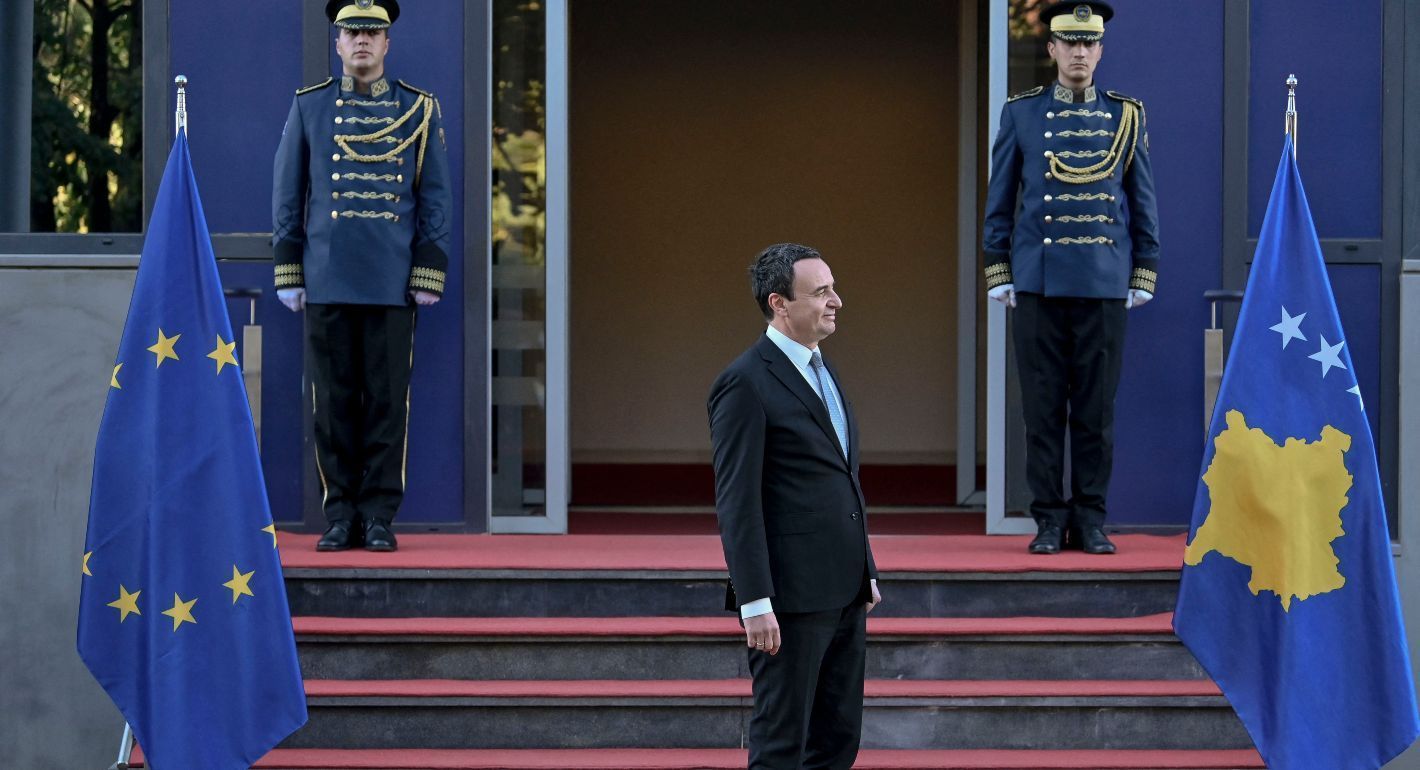
The leaders of Kosovo and Serbia have learned how to play the West. To restore credibility, the EU and the United States should draw clear red lines and respond firmly when these are crossed.
The promise of EU membership was once the silver bullet for resolving all territorial and security issues in the Balkans. That is less and less the case these days. And there is no better proof than the continuing drama involving Kosovo and Serbia.
Back in March 2023, Kosovo’s Prime Minister Albin Kurti and Serbia’s President Aleksandar Vučić adopted—sort of—an EU-proposed roadmap, the Ohrid Agreement, toward settling the dispute around Kosovo’s status. But since then, the pretend deal has all but unraveled. What was supposed to be a major achievement for the outgoing EU foreign policy supremo Josep Borrell may turn into a major headache for his successor.
Diplomats and policymakers in Brussels and Washington fault one person: Kurti. The combative prime minister has taken a great deal of criticism for clamping down on parallel institutions operating in Serb-populated northern Kosovo. This includes the closure of four municipalities loyal to Belgrade, including the one in Mitrovica, the region’s main urban center. Kosovo authorities have likewise imposed a ban on Serb imports, ignoring the pleas of Germany’s special envoy for the Western Balkans, Michael Sarrazin. Pristina has acted unilaterally, ignoring the so-called normalization talks overseen by Borrell’s office as well as the advice of Western capitals.
But as far as Kurti is concerned, heavy-handed tactics pay off and the onus is on the Europeans and the Americans. In Kosovo’s view, the West has been applying double standards: punishing Pristina for enforcing its sovereignty while indulging Vučić, who has refused to cut ties with Russia and join the Western sanctions. Belgrade has been let off the hook over a violent incident at the Banjska monastery in September 2023, when paramilitaries linked to the Serbian security services attacked Kosovar police, killing one officer and injuring two others. And so, Kurti has learned the lesson and applied it. While Western dignitaries were wringing hands when earlier this year Kosovo authorities prohibited the use of the dinar, Serbia’s currency, in the north or when in 2022 they required cars to switch Kosovar licence plates, they did not really push back against those moves. On both occasions, Kurti got what he wanted.
Surprisingly enough, Vučić has not gone for a tit for tat. On past occasions, he hadn’t been averse to playing the Kosovo card, even threatening to send the troops back into what Belgrade considers its province to prevent the “ethnic cleansing” of local Serbs. Chances are that Vučić is calculating that Kurti’s heavy-handed actions will benefit him. Serbia is going through a honeymoon with the EU. First came the agreement on lithium mining co-signed with the German chancellor Olaf Scholz back in July. More recently, Belgrade rolled out the red carpet for French President Emmanuel Macron, whose visit saw, among other things, the inking of a deal to acquire twelve French-made Rafale fighters. Vučić is also in Washington’s good books because of the supply—through third countries—of ammunition to Ukraine. So much so, that both the EU and the United States are willing to cut Serbia slack over refusing to implement sanctions against Russia. A crisis in Kosovo might jeopardize this positive momentum. For the time being, Vučić is perfectly happy to see Kurti turning into the West’s bête noire in the Balkans.
The Kosovo deadlock highlights the deficiency of the EU’s enlargement strategy. Fast-track the accession of countries like Kosovo and Serbia and you risk importing an unresolved sovereignty issue, not to mention a second Hungary run by Prime Minister Viktor Orbán’s lookalike Vučić. Delay it, and the dispute starts to fester. Vučić and Kurti know that their countries will not be joining the EU anytime soon. Their priority is retaining power at home rather than abiding by Brussels’s demands.
Balkan leaders have learned how to play the West. Vučić has been haggling with the big guys—Germany, France, the Biden administration—to some success. Kurti has opted for a policy of faits accomplis in Kosovo. By any objective yardstick, both politicians have enjoyed success.
The trouble, however, is that things can get out of hand. While we should not be overly alarmist about Kosovo, complacency is not advisable either. Last year’s Banjska clash has shown us that escalation could be in the cards, with people getting killed. Assuming that local leaders would act rationally and step over the brink, consciously or not, is not a safe policy. Indeed, dropping the ball on Kosovo could raise risk. Especially now that the guard in the EU institutions is changing and the U.S. presidential election is injecting even more uncertainty.
The West’s priority should be regaining credibility. To this end, the EU and the United States should draw clear red lines and react robustly when the latter are crossed. Restarting the normalization talks between Serbia and Kosovo should be high on the priority list of incoming EU high representative Kaja Kallas. Though Kosovo might not loom as large as other challenges, such as the wars in Ukraine and Gaza, it continues to be a top litmus test for EU foreign policy.

Senior Fellow, Carnegie Europe
Dimitar Bechev is a senior fellow at Carnegie Europe, where he focuses on EU enlargement, the Western Balkans, and Eastern Europe.
Recent Work
Dimitar Bechev
Dimitar Bechev
Carnegie does not take institutional positions on public policy issues; the views represented herein are those of the author(s) and do not necessarily reflect the views of Carnegie, its staff, or its trustees.

The European Commissioner for Trade is headed to China. But after President Xi’s bridge-building visit to Washington, can a more isolated EU overcome Beijing’s stranglehold on critical raw materials? Who will blink first?

Rym Momtaz, ed.

The domestic impacts of how long it is taking to end the war in Ukraine have pushed the French electorate to the political extremes and compromised the country’s diplomatic capacity.
Rym Momtaz

Before the next wave of EU enlargement takes place, the union needs to grapple with thorny questions of how power is distributed among its members.


Emil Sondaj Hansen, Ditte Brasso Sørensen

A summer of escalation in the Black Sea has hurt Ukraine economically and is exacerbating world food security. A truce is needed—as is a broader reframing of Europe’s Ukraine strategy.

Thomas de Waal

Are Germany’s economic, industrial, and political struggles becoming a liability for the EU’s ability to rise to the geopolitical moment?
Rym Momtaz, ed.