

{
  "authors": [],
  "type": "event",
  "centerAffiliationAll": "dc",
  "centers": [
    "Carnegie Endowment for International Peace"
  ],
  "collections": [],
  "englishNewsletterAll": "ctw",
  "nonEnglishNewsletterAll": "",
  "primaryCenter": "Carnegie Endowment for International Peace",
  "programAffiliation": "NPP",
  "programs": [
    "Nuclear Policy"
  ],
  "projects": [],
  "regions": [],
  "topics": [
    "Security",
    "Nuclear Policy"
  ]
}
Can the U.S.-Russia Summit Reduce the Risk of Nuclear Terrorism?
Tue, May 14th, 2002
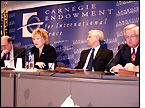
8:30 to 9:30 am: "Can the U.S.-Russia Summit Reduce the Risk of Nuclear Terrorism?" with Representative Ellen Tauscher (D-CA) and Representative Curt Weldon (R-PA): Talked about recent congressional actions and debates on these issues; their expectations for the summit; and the new U.S.-Russian strategic relationship.
9:30 to 10:30 am: "Agreements and Impact" with former assistant secretary of state Karl F. Inderfurth of the Nuclear Threat Reduction Campaign and Rose Gottemoeller and Joseph Cirincione, senior associates from the Carnegie Endowment: Discussed the agreements possible at the summit and their impact on international security.
For more information, visit Path to the Summit. For more on the Nuclear Threat Reduction Campaign, visit www.nuclearthreatreduction.org.
Additional Resouces:
- "U.S.-Russia Partnership, A New Time A New Beginning," Report by Rep.Curt Weldon (R-PA) 2001 (pdf)
- "Russian Test Flap," by Jon Wolfsthal, Carnegie Analysis, 13 May 2002
- "Nuclear Terrorism and Warhead Control in Russia," by Jon Wolfsthal and Tom Collina, Arms Control Today, April 2002
- "Arms Control in a New Era," by Rose Gottemoeller, Washington Quarterly, Spring 2002
- "Russia's Nuclear Risk," Carnegie Proliferation Brief, Vol 5, No. 2, 27 February 2002
- "What if the New Strategic Framework Goes Bad?" by Joseph Cirincione and Jon Wolfsthal, Arms Control Today, November 2002
- Russia Country Resouce Page
Carnegie does not take institutional positions on public policy issues; the views represented herein are those of the author(s) and do not necessarily reflect the views of Carnegie, its staff, or its trustees.