

{
  "authors": [
    "Ahmed Hashim",
    "Judith Yaphe"
  ],
  "type": "event",
  "centerAffiliationAll": "dc",
  "centers": [
    "Carnegie Endowment for International Peace"
  ],
  "collections": [],
  "englishNewsletterAll": "democracy",
  "nonEnglishNewsletterAll": "",
  "primaryCenter": "Carnegie Endowment for International Peace",
  "programAffiliation": "DCG",
  "programs": [
    "Democracy, Conflict, and Governance",
    "Middle East"
  ],
  "projects": [],
  "regions": [
    "Middle East",
    "Iraq"
  ],
  "topics": [
    "Political Reform",
    "Democracy",
    "Security",
    "Foreign Policy"
  ]
}
Complex Warfare in Iraq: Understanding the Insurgency
Wed, February 28th, 2007
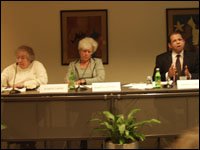
IMGXYZ650IMGZYXPresenter:
Ahmed Hashim, Associate Professor, Naval War College
Commentator:
Judith Yaphe, Distinguished Research Fellow, National Defense University
Moderator:
Marina Ottaway, Director, Middle East Program, Carnegie Endowment
Drawing on his extensive experience in the country, Ahmed Hashim commented on the complex nature of the insurgency in Iraq, stressing that it presents ongoing military and peace efforts in Iraq with unique challenges. Tracing both the historical roots of modern insurgent movements as well as the evolution of the Iraqi insurgency, Hashim explained how the insurgency has developed and transformed in distinct phases since 2003. The insurgency is now multifaceted in nature, with nationalistic, historical, and religious forces shaping the insurgency’s character.
Judith Yaphe further elaborated that the Iraqi insurgency is diverse, with distinct participating groups that show little inter-group unity. Above all else, confronting this insurgency demands national unity which no group in Iraq has been able to muster thus far. Violence in the country is further exacerbated by governmental and local leaders being unable or unwilling to look beyond local grievances, interests, and constituencies.
During the subsequent question-answer period, participants raised questions concerning the role of neighboring states in the insurgency, the legitimacy and accuracy of the term “insurgency” in the Iraq discourse, the possibility of political progress emerging from the grassroots level, and the prospect for an independent Kurdistan to emerge from Iraq’s civil war.
Carnegie does not take institutional positions on public policy issues; the views represented herein are those of the author(s) and do not necessarily reflect the views of Carnegie, its staff, or its trustees.
Event Speakers
Ahmed Hashim
Judith Yaphe