

{
  "authors": [
    "Tariq Fatemi"
  ],
  "type": "event",
  "centerAffiliationAll": "dc",
  "centers": [
    "Carnegie Endowment for International Peace"
  ],
  "collections": [],
  "englishNewsletterAll": "ctw",
  "nonEnglishNewsletterAll": "",
  "primaryCenter": "Carnegie Endowment for International Peace",
  "programAffiliation": "SCP",
  "programs": [
    "Sustainability, Climate, and Geopolitics"
  ],
  "projects": [],
  "regions": [
    "South Asia",
    "Pakistan",
    "North America"
  ],
  "topics": [
    "Political Reform",
    "Security",
    "Military",
    "Foreign Policy"
  ]
}
Pakistan's New Civillian Government: Managing a Dificult Democratic Transition
Tue, May 6th, 2008
Washington, D.C.
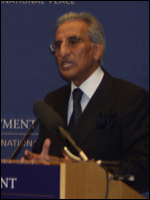
IMGXYZ893IMGZYX Pakistani President Pervez Musharraf was unsuccessful at routing out militants in Pakistan in part because he did not have popular support, and because the war on terror was seen as “America’s war,” said Tariq Fatemi, former Pakistani ambassador to the United States, at the Carnegie Endowment. The new civilian administration will be more effective at fighting terrorists because it is not seen as beholden to the United States, Fatemi said. Fatemi stressed that the civilian administration will rely more on dialogue with moderate groups and less on military operations, and urged the United States to be patient.
Fatemi praised Pakistan’s parliament, elected in February, for showing significant political savvy in negotiating Pakistan’s first-ever coalition government. Parliamentary leaders did well by deciding to release the jailed Supreme Court justices, Fatemi said. But the two parties in the ruling coalition have yet to decide whether or not to reinstate to the judges to the court. Fatemi said reinstating the judges and overturning Musharraf’s actions of November 3—when the emergency was declared and the constitution suspended—were crucial steps to moving Pakistan back toward constitutional rule.
Carnegie does not take institutional positions on public policy issues; the views represented herein are those of the author(s) and do not necessarily reflect the views of Carnegie, its staff, or its trustees.
Event Speaker
Tariq Fatemi