

{
  "authors": [
    "David Mulford",
    "Stephen Cohen"
  ],
  "type": "event",
  "centerAffiliationAll": "dc",
  "centers": [
    "Carnegie Endowment for International Peace"
  ],
  "collections": [],
  "englishNewsletterAll": "ctw",
  "nonEnglishNewsletterAll": "",
  "primaryCenter": "Carnegie Endowment for International Peace",
  "programAffiliation": "SAP",
  "programs": [
    "South Asia"
  ],
  "projects": [],
  "regions": [
    "North America",
    "United States",
    "South Asia",
    "India"
  ],
  "topics": [
    "Economy",
    "Foreign Policy",
    "Nuclear Policy",
    "Nuclear Energy"
  ]
}
India and the United States: Looking Backward, Looking Forward
Thu, February 26th, 2009
Washington, D.C.
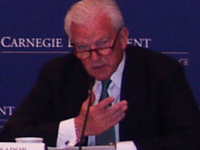
IMGXYZ1143IMGZYX Relations between India and the United States have improved in recent years, thanks in part to a “building block” approach that aims to build trust and confidence from the bottom-up. Carnegie hosted Dr. David Mulford, current U.S. Ambassador to India, to discuss this relationship in a conversation moderated by Stephen Cohen of the Brookings Institution.
Looking Back
Ambassador Mulford began by discussing the evolution of Indo-U.S. relations over the past five years, since his appointment as ambassador in 2003. He noted that distrust, suspicion, and sanctions traditionally plagued relations between the two countries, but great progress toward cooperation has been made in recent years. He stressed that India’s broad relationship with the United States is heavily linked to the private sector, where successful partnerships and rising trust have formed the foundation for high-level cooperation on many fronts. At the diplomatic level, he cited the U.S.-India nuclear deal, the Open Skies Agreement, and a number of other dialogues on technology and economic cooperation as examples of the multi-faceted “building block” approach. “This is how the relationship was built,” he said, “and this is how it will have to continue.”
Looking Forward
As India’s economic and political influence continue to grow, Ambassador Mulford believes the Indo-U.S. relationship will be one of the most important for both countries. Bilateral trade, military exchanges, counter-terrorism efforts, economic development, and exchange of ideas on environmental issues, among other issues, will be important areas for cooperation. He highlighted the civil nuclear energy deal and said that both countries must continue to work together as India develops a major civil nuclear industry that will draw investment from around the world. This and other successes have made great progress toward building the trust that will make the U.S.-India relationship durable and productive in the coming years.
Questions & Answers
After his remarks, Ambassador Mulford responded to wide range of audience questions. Addressing the global economic crisis, he remarked that India is likely to weather the crisis better than most countries and may end up in a position to help lead a global recovery. He noted that the possibilities for cooperation with the United States are “infinite” on a variety of issues including global warming, water management, and other environmental challenges. Finally, he stressed that the Obama administration understands the great importance of Indo-U.S. relations and will continue to build on the existing foundations of this strong relationship.
Carnegie does not take institutional positions on public policy issues; the views represented herein are those of the author(s) and do not necessarily reflect the views of Carnegie, its staff, or its trustees.
Event Speakers
David Mulford
Stephen Cohen