

{
  "authors": [
    "Arvind Virmani",
    "Ashley J. Tellis"
  ],
  "type": "event",
  "centerAffiliationAll": "dc",
  "centers": [
    "Carnegie Endowment for International Peace"
  ],
  "collections": [],
  "englishNewsletterAll": "asia",
  "nonEnglishNewsletterAll": "",
  "primaryCenter": "Carnegie Endowment for International Peace",
  "programAffiliation": "AP",
  "programs": [
    "Asia",
    "South Asia"
  ],
  "projects": [],
  "regions": [
    "North America",
    "United States",
    "South Asia",
    "India",
    "East Asia",
    "China"
  ],
  "topics": [
    "Economy"
  ]
}
Tri-Polar World: India, China, and the United States in the 21st Century
Wed, February 9th, 2011
Washington, D.C.
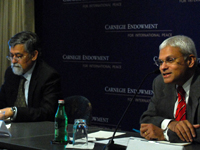
IMGXYZ2913IMGZYXChina and India are poised to join the United States as the world’s largest economies. Arvind Virmani, India’s representative to the International Monetary Fund, discussed whether a tri-polar global system is likely to replace the unipolar status of the United States and the factors underlying India and China’s growth in power. Carnegie’s Ashley J. Tellis moderated.
The Foundations of National Power
Virmani spoke about the economic foundations of national power, examining how the strength of a country’s economy affects its potential for international influence.
- Growth Theory: National economic growth does not necessarily correspond to a growth in per-capita income as growth theory would predict, Virmani said. On the contrary, gains in per-capita GDP become more difficult to achieve as emerging countries develop and approach the economic strength of developed countries. Such income gaps have ramifications for a country’s growth in power, Virmani noted.
- The Importance of Relative Power: Virmani stated that relative economic power was a crucial consideration when discussing the increasing power potential of nations. It is not absolute growth that matters, but rather how the economies of nations compare to the U.S. economy and that of other important players over time, he said.
The Coming Transition
Virmani predicted that China’s power potential would equal that of the United States by 2027 and India would catch up to the United States in 2040. While he stressed these dates are approximations, the general trend points in this direction.
- Transition from a Unipolar System: A change in relative potential power will undoubtedly affect the political system. Initially, he argued, there will be a transition from a unipolar system with the United States as the sole superpower to a multipolar system with numerous smaller players, followed by a bipolar system—with the United States and China as the world’s two pre-eminent powers—and then a tripolar system with the United States, China, and India as the leading global powers.
- Jelly Spine or Velvet Glove: Virmani identified a number of ways this transition could progress. One he described as “jelly spine;” in this scenario, China expands its strategic space and other powers move to appease it. Alternately, he suggested the “velvet glove,” where rather than appeasing China, the United States responds to China’s rise with hard realism, throwing into stark relief issues such as open seas and alliances in Asia.
- The U.S.-India Partnership: A close relationship between India and the United States will prove essential in facing a rising China, especially as the United States is constrained by political and fiscal concerns such as a mounting debt, Virmani said. He said that such a partnership will benefit both nations by allowing them to share in research and development, for example, and will allow the United States and India to cooperate in addressing strategic concerns.
Carnegie does not take institutional positions on public policy issues; the views represented herein are those of the author(s) and do not necessarily reflect the views of Carnegie, its staff, or its trustees.
Event Speakers
Arvind Virmani
Former Senior Fellow
Ashley J. Tellis was a senior fellow at the Carnegie Endowment for International Peace.