

{
  "authors": [
    "Karim Sadjadpour",
    "Till Schauder",
    "Sara Nodjoumi"
  ],
  "type": "event",
  "centerAffiliationAll": "dc",
  "centers": [
    "Carnegie Endowment for International Peace"
  ],
  "collections": [
    "Arab Awakening"
  ],
  "englishNewsletterAll": "menaTransitions",
  "nonEnglishNewsletterAll": "",
  "primaryCenter": "Carnegie Endowment for International Peace",
  "programAffiliation": "MEP",
  "programs": [
    "Middle East"
  ],
  "projects": [],
  "regions": [
    "Middle East",
    "Iran"
  ],
  "topics": [
    "Political Reform",
    "Democracy"
  ]
}
The Iran Job
Tue, December 20th, 2011
Washington, D.C.
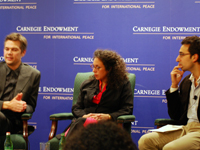
The Iran Job follows American basketball player Kevin Sheppard as he accepts a job to play in Iran. Carnegie hosted a work-in-progress screening of this documentary, followed by a discussion with the film's director and producer, Sara Nodjoumi and Till Schauder. Carnegie's Karim Sadjadpour moderated.
A Synopsis of the Film
The Iran Job begins with the decision of Kevin Sheppard to move to Iran for a year to play basketball. Sheppard, an American basketball player from the U.S. Virgin Islands, accepted a contract to the Iranian Super League. The film follows Sheppard to the Iranian city of Shiraz, where it documents his experiences both on and off the court.
Sheppard quickly discovered that it was impossible to escape from politics while in Iran. Tensions between the West and Iran continued to increase during his time there. While the film includes a number of scenes detailing his experiences playing basketball, it also focuses on the unexpected friendships that Sheppard made during his time in the country. In particular, he met three outspoken Iranian women, who quickly become central figures in the film. These women met frequently with Sheppard to debate and discuss a variety of issues, including religion, politics in Iran, and gender roles.
By the end of Sheppard’s contract, Iran was in the middle of upheaval; Iranians were taking to the street in protest of the 2009 presidential elections, and the Iranian regime was violently suppressing the reformist Green Movement. The film captures a glimpse of Iran immediately before the elections, through the eyes of an outsider.
Genesis of the Film
Schauder described the initial idea and development of the film:
- Initial Idea: The project began when Till received a letter from a friend describing American basketball players who played in the Iranian league. Although the idea was intriguing, it took a while to find a player who would be able to carry a feature-length film. From the first conversation with Kevin, however, it was clear he would fit the part, Schauder said.
- The Role of Women: It was not part of the original plan for the film to have Iranian women feature so prominently, Schauder said. After Schauder met Kevin’s three female friends in Shiraz, however, he realized that theirs was a compelling and important story to tell. They were eager to participate in the film and to take this opportunity to advocate for change at home in Iran.
- Timing: Nodjoumi and Schauder began filming in 2008, before the contested presidential elections and the subsequent protests. As it turned out, the rise of the Green Movement in Iran coincided with the making of the movie. This political dimension added significantly to the depth of the story they were telling as it exposed many of the issues in Iranian society that Sheppard and his Iranian friends were discussing.
Elements of the Film
- Kevin: Nodjoumi and Schauder described Kevin as very funny and perceptive. He arrived in Iran with many of the same ideas and misconceptions about the country that most other Americans hold, they said. His experience of learning more about the country, and the humor he brought to that experience, made the film insightful and enjoyable, as well as accessible to a wider audience.
- Soundtrack: The soundtrack of The Iran Job is a collection of songs from prominent Iranian rap and hip-hop artists. Schauder explained that this soundtrack is, in itself, an example of the contradictions plaguing Iranian society. Rap music is illegal in Iran, he said, however it is also widespread and extremely popular.
- Basketball: Nodjoumi said that she hoped the fact that the movie followed a basketball player would help the film reach an audience that may not usually think about the Middle East and its political landscape.
- Filming: Since Schauder traveled to Iran on his own to film the movie, it was a challenge to get numerous shots for each of the film’s scenes. For some scenes, he employed local Iranians to assist with filming, he said.
Carnegie does not take institutional positions on public policy issues; the views represented herein are those of the author(s) and do not necessarily reflect the views of Carnegie, its staff, or its trustees.
Event Speakers
Senior Fellow, Middle East Program

Karim Sadjadpour is a senior fellow at the Carnegie Endowment for International Peace, where he focuses on Iran and U.S. foreign policy toward the Middle East.
Till Schauder
Sara Nodjoumi