

{
  "authors": [
    "C. Raja Mohan",
    "Ashley J. Tellis",
    "RADM (Ret.) Michael McDevitt"
  ],
  "type": "event",
  "centerAffiliationAll": "dc",
  "centers": [
    "Carnegie Endowment for International Peace",
    "Carnegie China"
  ],
  "collections": [],
  "englishNewsletterAll": "ctw",
  "nonEnglishNewsletterAll": "",
  "primaryCenter": "Carnegie Endowment for International Peace",
  "programAffiliation": "SAP",
  "programs": [
    "South Asia"
  ],
  "projects": [],
  "regions": [
    "South Asia",
    "India",
    "East Asia",
    "China"
  ],
  "topics": [
    "Security",
    "Military",
    "Arms Control"
  ]
}
Sino-Indian Maritime Rivalry
Wed, October 24th, 2012
Washington, D.C.
IMGXYZ4067IMGZYX
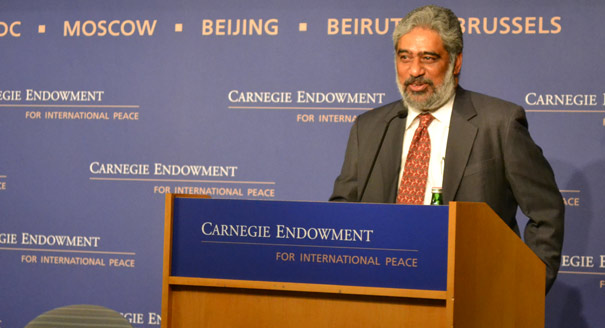
Rising China and emerging India are becoming major maritime powers. As they build large navies to secure their growing interests, both nations are roiling the waters of the Indo-Pacific—the vast littoral stretching from Africa to Australasia. In a new book invoking a tale from Hindu mythology—Samudra Manthan or “to churn the ocean”—C. Raja Mohan tells the story of a Sino-Indian rivalry spilling over from the Great Himalayas into the Indian and Pacific Oceans.
Mohan examined the prospects of mitigating these tensions and constructing a stable Indo-Pacific order. Rear Admiral (Ret.) Michael McDevitt of the Center For Naval Analyses provided comments, and Carnegie’s Ashley J. Tellis moderated.
Taking to the Seas
- A Long Rivalry: Mohan explained that that Sino-Indian relations have a long history of rivalry. Repeatedly throughout the last century, Indian and Chinese leaders have tried to find common ground—only to be hamstrung by new sources of tension. Historically, the two powers have found themselves at odds over their Himalayan border, but in McDevitt’s words, their competition has “gone feet-wet” in recent years.
- Building Navies: As India and China come of age in a globalized economy, Mohan explained, each state now finds itself with both the means and the motivation to build powerful navies.
- Sea Lines of Communications: Both Mohan and McDevitt emphasized the importance of the Asia-Pacific’s crucial sea lines of communication (SLOCs). Both Beijing and New Delhi rely heavily on maritime trade for their commercial and energy security. The U.S. Navy has traditionally guaranteed free access to the Pacific, but the region’s rising powers may want to make sure that they can project their own seapower should the United States prove unable or unwilling to do so, the participants added.
A Littoral Approach
Mohan outlined how China and India are taking increasing assertive roles in each other’s maritime backyard:
- India: From exploring oil deposits off the coast of Vietnam to advising Singaporean submariners, New Delhi is shoring up its partnerships with Southeast Asian nations. Mohan explained that the Indian Navy has found naval training partnerships to be particularly fruitful sources of defense partnership—while India has little to offer in the way of defense sales to its neighbors, the expertise of its sailors helps to forge military-to-military cooperation and expand India’s influence in the region.
- China: Beijing, meanwhile, has sent naval vessels on counter-piracy missions and port calls throughout the Indian Ocean region. While McDevitt pointed out that China is a long way from implementing what some believe to be its “string of pearls” strategy of encircling India with naval bases, Mohan argued that India has taken notice of the Chinese Navy’s newfound ability to operate ships far from home for long period of time.
An Inevitable Dilemma
- A Potential Threat: Even if both India and China have the most peaceful of intentions, Mohan explained that their naval adventures give rise to an inevitable security dilemma in which each state sees the other’s navy as a potential threat.
- U.S. Role: Confidence-building measures and public diplomacy will only go so far towards mitigating this dilemma, Mohan asserted. He argued that the ability of the United States to carry through on its rebalancing to the Asia-Pacific will prove a decisive factor in the Sino-Indian naval rivalry.
- An Uncertain Future: McDevitt added that, while Burma’s recent liberalization has created a new space for the United States to work with states in the Asia-Pacific littoral, Washington sees a significant role for its Indian allies in guaranteeing open SLOCs in their neighborhood. China, meanwhile, believes it occupies a position of relative regional strength, and McDevitt argued that it may prove reluctant to accede to American or Indian requests in the years to come.
Carnegie is grateful for the MacArthur Foundation’s support of this event.
Carnegie does not take institutional positions on public policy issues; the views represented herein are those of the author(s) and do not necessarily reflect the views of Carnegie, its staff, or its trustees.
Event Speakers
Former Nonresident Senior Fellow, Carnegie India
A leading analyst of India’s foreign policy, Mohan is also an expert on South Asian security, great-power relations in Asia, and arms control.
Former Senior Fellow
Ashley J. Tellis was a senior fellow at the Carnegie Endowment for International Peace.
RADM (Ret.) Michael McDevitt