

{
  "authors": [
    "Colin Kahl",
    "David Albright",
    "George Perkovich",
    "Daryl Kimball"
  ],
  "type": "event",
  "centerAffiliationAll": "dc",
  "centers": [
    "Carnegie Endowment for International Peace"
  ],
  "collections": [
    "Iranian Proliferation"
  ],
  "englishNewsletterAll": "ctw",
  "nonEnglishNewsletterAll": "",
  "primaryCenter": "Carnegie Endowment for International Peace",
  "programAffiliation": "NPP",
  "programs": [
    "Nuclear Policy"
  ],
  "projects": [],
  "regions": [
    "Middle East",
    "Iran"
  ],
  "topics": [
    "Nuclear Policy",
    "Foreign Policy"
  ]
}
Guarding Against a Nuclear-Armed Iran: Proliferation Risks and Diplomatic Options
Thu, September 5th, 2013
Washington, DC
The recent election of Hassan Rouhani as president of Iran provides a new and important opening for the United States and its P5+1 partners to secure an agreement that limits Iran’s nuclear capabilities in exchange for easing tough international sanctions. As Iran continues to improve its nuclear capabilities in the coming months and sanctions continue to undermine Iran’s economy, it is in the interest of all sides to revise earlier diplomatic proposals and to seize the opportunity to achieve progress in the next round of talks, which are expected to resume in September.
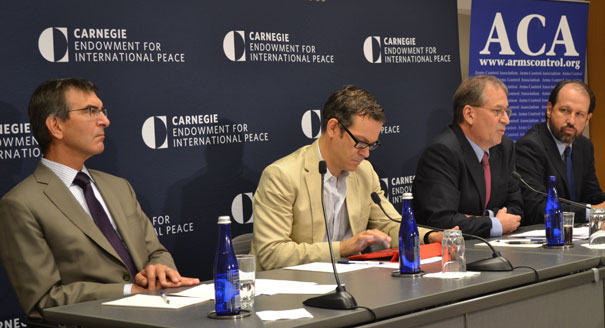
The Arms Control Association (ACA) and the Carnegie Endowment for International Peace hosted an assessment of Iran’s nuclear capabilities and the elements required for a deal that could provide both sides with a “win-win” outcome.
Copies of the newly updated edition of ACA’s 44-page briefing book on “Solving the Iranian Nuclear Puzzle” were available at the event.
Colin Kahl
Colin Kahl is an associate professor in the Security Studies Program in the Edmund A. Walsh School of Foreign Service at Georgetown University, where he teaches courses on international relations, international security, the geopolitics of the Middle East, American foreign policy, and civil and ethnic conflict. He is also a senior fellow at the Center for a New American Security.
David Albright
David Albright is founder and President of the non-profit Institute for Science and International Security (ISIS) in Washington, D.C. He regularly conducts scientific research, publishes in numerous technical and policy journals, and is often cited in the media. His book Peddling Peril: How the Secret Nuclear Trade Arms America’s Enemies was listed by The Atlantic as one of the best foreign affairs books of 2010.
George Perkovich
George Perkovich is vice president for studies and director of the Nuclear Policy Program at the Carnegie Endowment for International Peace. His research focuses on nuclear strategy and nonproliferation, with a concentration on South Asia, Iran, and the problem of justice in the international political economy.
Daryl Kimball
Daryl Kimball has been Executive Director of the Arms Control Association since September 2001. Mr. Kimball is a frequent media commentator and has written and spoken extensively about nuclear arms control and non-proliferation. In 2004, the National Journal recognized Kimball as one of the ten key individuals whose ideas shape the policy debate on weapons proliferation.
Carnegie does not take institutional positions on public policy issues; the views represented herein are those of the author(s) and do not necessarily reflect the views of Carnegie, its staff, or its trustees.
Event Speakers
Colin Kahl
David Albright
Japan Chair for a World Without Nuclear Weapons, Senior Fellow

George Perkovich is the Japan Chair for a World Without Nuclear Weapons and a senior fellow in the Carnegie Endowment for International Peace’s Nuclear Policy Program. He works primarily on nuclear deterrence, nonproliferation, and disarmament issues.
Daryl Kimball
Arms Control Association
Daryl Kimball is the executive director of the Arms Control Association. Previously the executive director of the Coalition to Reduce Nuclear Dangers, Kimball is a frequent source for reporters and has written and spoken extensively about nuclear arms control, non-proliferation, and weapons production.