

{
  "authors": [
    "James L. Schoff",
    "Dmitri Trenin",
    "Anton Tsvetov"
  ],
  "type": "event",
  "centerAffiliationAll": "dc",
  "centers": [
    "Carnegie Endowment for International Peace",
    "Carnegie Russia Eurasia Center"
  ],
  "collections": [],
  "englishNewsletterAll": "ctw",
  "nonEnglishNewsletterAll": "",
  "primaryCenter": "Carnegie Russia Eurasia Center",
  "programAffiliation": "russia",
  "programs": [
    "Russia and Eurasia"
  ],
  "projects": [],
  "regions": [
    "North America",
    "United States",
    "East Asia",
    "South Korea",
    "China",
    "Japan"
  ],
  "topics": [
    "Economy",
    "Trade",
    "Security",
    "Foreign Policy"
  ]
}
A U.S. Perspective on Japan’s Foreign Policy Under Prime Minister Abe
Wed, November 11th, 2015
Moscow
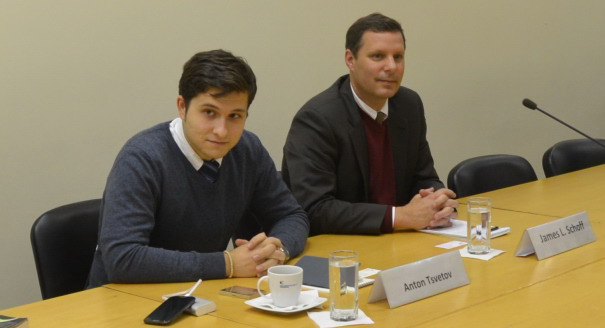
What are the prospects for the future of U.S.–Japan relations? Speaking at the Carnegie Moscow Center, James L. Schoff, a senior associate in the Asia Program at the Carnegie Endowment for International Peace, gave an overview of the current state of bilateral relations and discussed how the United States assesses Japan’s foreign policy under Prime Minister Abe.
Carnegie’s Dmitri Trenin gave the opening remarks and the Russian International Affairs Council’s Anton Tsvetov moderated.
Discussion Highlights
- U.S.–Japan Relations: Schoff characterized bilateral relations between the United States and Japan as a very firm friendship, which he argued will become stronger in the new regional context. According to Schoff, the main task of Washington in the Asia-Pacific region now is collaboration with Japan, which does not threaten the security of other players in this region and which is mutually beneficial.
- Other Relations in the Region: Another main task for the United States, Schoff said, is to develop trilateral (the United States—China—Australia) and multilateral relations in the region. He suggested that the best way to do this is through such substructures as ASEAN, the East Asia Summit, and the Trans-Pacific Partnership (provided, he added, that the partnership passes the U.S. Congress). Also, the United States should promote harmonization of relations among individual Asia-Pacific countries, such as Japan and South Korea, Schoff concluded.
James L. Schoff
James L. Schoff is a senior associate in the Carnegie Asia Program. His research focuses on U.S.-Japanese relations and regional engagement, Japanese politics and security, and the private sector’s role in Japanese policymaking.
Dmitri Trenin
Dmitri Trenin, director of the Carnegie Moscow Center, also chairs the research council and the Foreign and Security Policy Program.
Anton Tsvetov
Anton Tsvetov is the media and government relations manager at the Russian International Affairs Council. His research interest focuses on the Asia-Pacific and especially Vietnam.
Carnegie does not take institutional positions on public policy issues; the views represented herein are those of the author(s) and do not necessarily reflect the views of Carnegie, its staff, or its trustees.
Event Speakers
Former Senior Fellow, Asia Program

James L. Schoff was a senior fellow in the Carnegie Asia Program. His research focuses on U.S.-Japan relations and regional engagement, Japanese technology innovation, and regional trade and security dynamics.
Former Director, Carnegie Moscow Center
Trenin was director of the Carnegie Moscow Center from 2008 to early 2022.
Anton Tsvetov