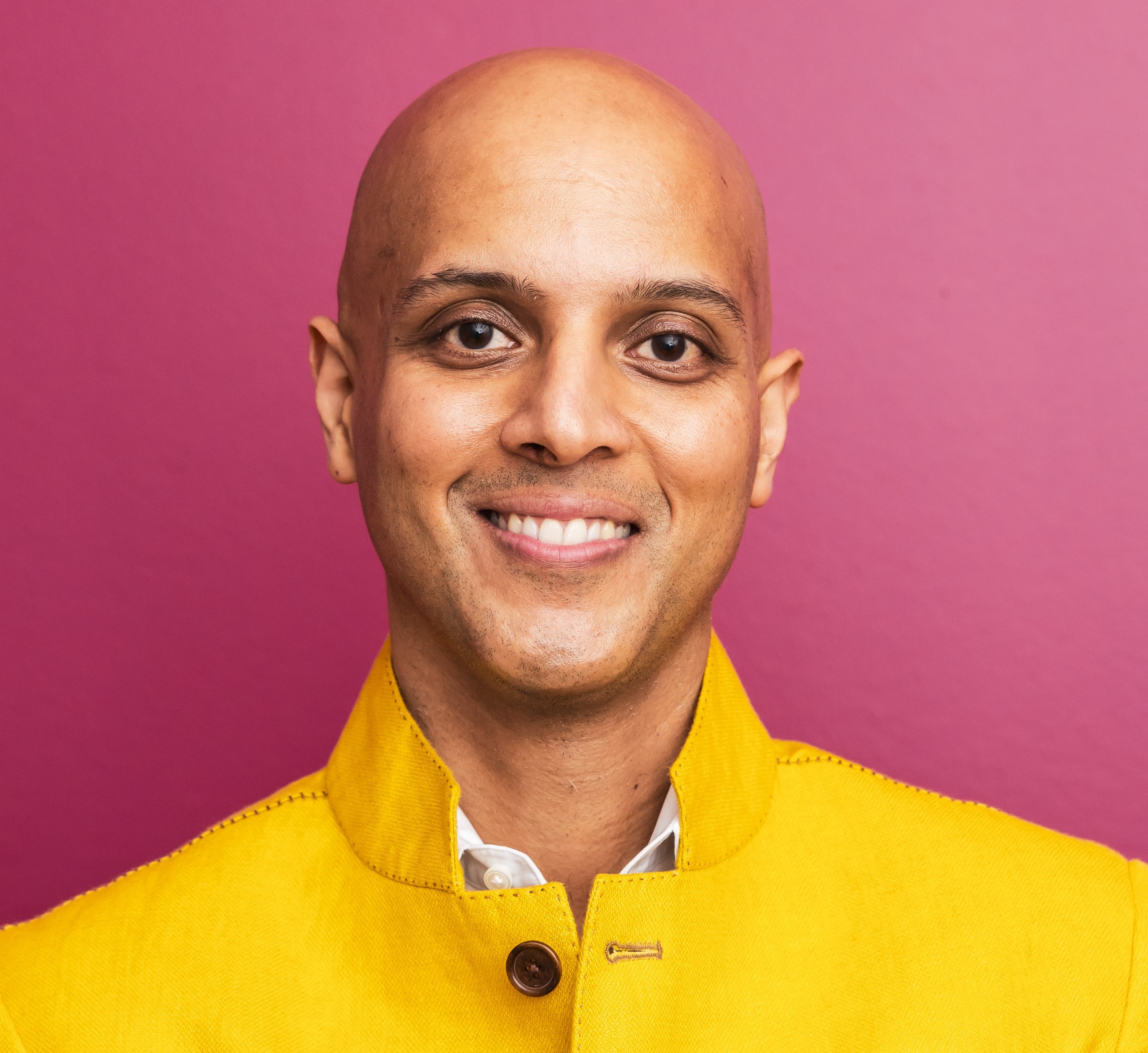
On this week’s show, Milan sits down with the novelist Karan Mahajan. Karan is an associate professor in Literary Arts at Brown University and the author of the books Family Planning and The Association of Small Bombs.
Karan is also the author of a much-anticipated new novel, The Complex. Karan and Milan discussed the book at our first ever live Grand Tamasha event at Carnegie headquarters in Washington, DC on March 16.
In The Complex, readers are introduced to the fictional Chopra family as they navigate the personal and political turmoil of late 1970s India. As each member of the family struggles to forge an identity in the shadow of patriarch SP Chopra’s legacy, buried tensions surface and rival visions of power, belonging, and ambition collide.
Set against a nation in upheaval, The Complex traces the roots of many forces that continue to shape contemporary India—from political radicalization and shifting class structures to the pull of the global diaspora and the evolving meaning of family itself.
The New York Times calls the book "magisterial” and writes that “[Mahajan's] work has always woven a subversive, contemporary sensibility into a traditional, almost 19th-century approach to form and style.”
During the recording, Milan fielded written questions from audience members, and you’ll hear these as well on this week’s show.
Episode notes:
- Sibani Ram, “How this professor’s long-awaited novel confronts India’s hidden histories,” Los Angeles Times, March 23, 2026.
- Sam Sacks, “Fiction: ‘The Complex’ by Karan Mahajan,” Wall Street Journal, March 14, 2026.
- “Karan Mahajan on Literary Tradition, Trump, and Writing Multiple Points of View,” Literary Hub, March 10, 2026.
- Jonathan Dee, “How Did the Worst Member of the Family Become a National Leader?” The New York Times, March 10, 2026.
- “From Delhi to Providence, Karan Mahajan’s ‘The Complex’ culminates 10 years of research, writing,” Brown University, March 4, 2026.
Transcript
Note: this is an AI-generated transcript and may contain errors
Milan Vaishnav Welcome, everybody, to a special live edition of Grand Tamasha, a co-production of the Carnegie Endowment for International Peace and the Hindustan Times. I'm your host, Milan Vaishnav. We are delighted today to be hosting our first ever live Grand Tamasha recording here at Carnegie HQ in Washington, D.C. We are especially happy to welcome the author Karan Mahajan to the show. Karan is an associate professor of the literary arts at Brown and the author of two highly acclaimed books, Family Planning and The Association of Small Bombs, and he's joining us today to talk about his much-anticipated new novel called The Complex, which you can see here. In this new book, readers are introduced to the fictional Chopra family as they navigate the political-social turmoil of India starting in about the 1970s, culminating in about the early 1990s. As each member of this large Chopra family struggles to find their footing, find their identity in the shadow of the patriarch, S. P. Chopra's, legacy, a set of buried tensions and rival visions of power, belonging and ambition collide. Set against a nation in upheaval, The Complex traces the roots of many forces that continue to shape contemporary India, from political radicalization, shifting class structures, to the pull of the global diaspora and the evolving meaning of family itself. The New York Times, which reviewed the book a few days ago, which you should all read the pretty glowing review, I think it's a review that every author would probably dream of getting, calls the book “magisterial,” and writes that “Mahajan's work has always woven a subversive contemporary sensibility into a traditional, almost 19th century approach to form and style.” Karan and I are going to have a conversation like we normally do for Grand Tamasha, but we will also leave time to take your questions. I think there are various pieces of paper around the room with a QR code. You can scan that, send us your questions, they'll be beamed to me somehow on this iPad, I'm told. We will go until about six and then Karan is going to stick around. There'll be a reception outside with drinks, some appetizers, there will books for sale, which you have, I think generously agreed to sign for people. So, I hope you'll all join me in welcoming Karan Mahajan to Grand Tamasha. Karan, let me start with the name of the book, the setting of the book. It centers on this building, two buildings actually, that you call ‘the complex.’ It's this multi-family compound situated somewhere in Delhi, where different branches of this large, rambunctious Chopra family live, live in pretty close quarters, complete with all the secrets, shady dealings, constant jockeying for space that you might expect. Tell us a little bit about what inspired the setting of The Complex.
Karan Mahajan Thank you for that question, Milan. And I just wanted to thank everyone for coming today. Also wanted to thank Milan for hosting this. He's a public intellectual that I've been following for a number of years. It's better than being a private intellectual. And someone who I actually consulted recently when I was writing a piece about the Sikh diaspora in North America. So, you know, he's someone I'm very excited to be in conversation with because this is also a very political book. And as you pointed out, in some ways, it is a novel that is about this one clan that lives in this pressure cooker of a compound and the ways in which the dynamics in that family change as people go abroad and then come back. And also, it's a book about the ways in which reactionary thinking kind of festers in a family before it explodes onto the national stage. And so this particular setting was actually very crucial to the architecture of the book, the forward momentum of the book, and it really comes from my own personal experience with these kinds of families in Delhi when I was growing up in the 80s, which is a period when, especially in South Delhi where I was growing up, there were a lot of joint or semi-joint families. You could see this happening where people were slowly dividing these large post-independence bungalows into apartments or not. And that there was this strange shift towards modernity going on, which of course accelerates in 1991 when the Indian economy liberalizes. And so, you know, these questions of space, privacy, how you make a life for yourself as an individual in a crowd, those things become very central when you're focusing on a setting like this.
Milan Vaishnav I think it's always interesting to hear authors talk a little bit about the process of putting this together. For those of us who are not in this world, it's a bit of a black box. I mean, you grew up in Delhi, you know it well. Is this the kind of thing that you have to do research for or is it that it's so intimate and familiar that you're essentially just living off this reservoir of memories, events, conversations, you know, how does it work?
Karan Mahajan Well, so I think fiction, the type that I write, operates on two different levels. The first level is very much memory, which is that every object and setting that appears in this book is something that I have an intense emotional connection to, even if it's a throwaway image that is glanced on the side of the road, it's not there accidentally. It's something that I've remembered. So, it's very dense network of feeling for me. But I did have to do a ton of research because A, I was, you know, born in 1984, so the 80s are kind of like, you know, childish tantrumy, blur for me. I don't actually know what was going on. But I'm interested in filling those areas of darkness that exist for me. So I remember, for example, I had a family friend who, in 1990, when these anti-affirmative action protests, the Mandal Commission protests occurred, laid down in front of a bus because he didn't want other backward castes, as they're called, lower castes, to have reservations. And that image stayed with me for a long time. Why was this guy doing it? Why were people from my class so invested in protesting the Mandal Commission report, which was giving reservation, right? So that required an enormous amount of research, talking to a ton of people from that period, understanding why many people who are on the left now in India, when they were in college, participated in anti-affirmative action protests. So, that was one aspect of it. And then a lot of the book is actually set in the U.S. as well in the 1980s. And so that involved a kind of collective memory surfing that I would do with immigrants from that period, especially Indian immigrants. I would ask them, you know, what was it like to live out in the middle of nowhere in 1979? You know, where did you go for Indian food? Did you, what were your first impressions when you arrived? And you know the things that people say are so amazing, right? Like it's so much more than you can get from reading a straightforward historical account. Like there was one woman who said, you know, I couldn't believe that kids would just leave their bicycles on a suburban street and just go away for the night. She had come from Calcutta, right? So that just stays with you, and it gives you an insight into entire world.
Milan Vaishnav I mean, you know, the sweep of the book is pretty considerable, right, in terms of the evolution of India's own political-social upheaval which the book tracks pretty closely, again, starting from the period of the late 70s, early 80s onward. But I feel like when you read fiction that tries to do this, people sort of approach it in one of two ways. One, it's just completely fictionalized. The second is it's like loosely fictionalized based on people you could maybe recognize. This is kind of a third category because it's fiction, but you weave in real characters, real politicians, real events, real developments. So, tell us about that choice.
Karan Mahajan I think what I really want to do is create a sense of instability in the reader, even as they're being lulled by the story, which is this question of, okay, I'm reading about these people who are clearly made up. I mean, they're acting horribly most of the time, hopefully entertainingly horrible. And then suddenly, this person is interacting with the head of a political party who seems familiar. And there's a kind of new charge that is introduced in the novel, which was almost a sense of: is this non-fiction? Is this a kind of documentary? I like that because you want the reader to feel like the world of the novel is almost infecting their world. At least that's how I feel. For that reason, I will often pick characters who are one degree removed from famous people. For example, as I pointed out, there's a really reprehensible character in this novel, Laxman, who, Laxman Chopra, who ends up becoming a right-winger and a member of the BJP. And at various points, he's interacting with individuals who are the leaders of that party.
Milan Vaishnav I mean, I want to ask you about the kind of, there's this looming figure in the book who is this sort of unseen patriarch of the family, S. P. Chopra. He's not, he dies before the book starts. He is portrayed as somebody who was an important voice during the time of the constitutional framing. He was a former Reserve Bank of India governor. He has this kind of again talked about as this larger-than-life figure who devoted his life to the Republic. But I want to just read something that you wrote towards the end of the book, where you say, S.P. Chopra was like a tycoon who dies surrounded by admirers with the children realizing only later when they opened the almirahs and checkbooks that he was bankrupt and left them nothing. So, this seems like a commentary that goes well beyond just money alone. Tell us a little bit about what you were trying to say by portraying him in that way.
Karan Mahajan Yeah, so I mean, this book is very much about a family that is in decline and a family that is obsessed with essentially making the Chopra name great again, right, at all costs. So, they're kind of looking up constantly over their shoulders at this dead patriarch, S.P. Chopra, who actually, in a kind of non-cynical way, I portray as being someone who had a significant role during India's independence, during partition, who may in fact have been someone that a lot of people loved and looked up to and went to for advice. But the flip side of that is that he was such a larger-than-life figure that these nine children he's had have grown up somewhat stunted, which of course you see happening in families all the time. You see it in a show like Succession and also, he perhaps left them a seed of a reactionary ideology. That he is someone who's just a little bit anti-science, he's a little anti-Nehru, he is a little bit anti-Muslim, and then that becomes enough for the younger siblings to run with when they start inventing their own politics of grievance. But I think that that particular passage you read out is a kind of thought that a character is having. And I think purposely the novel doesn't answer the question of whether it was hollow or not. I do think in relation to a book you've written about corruption in India, one thing that is interesting about that period of titanic figure[s] from India's history is that many of them participated in the independence movement but weren't necessarily involved in government in a big way afterwards. And when you're not actually ruling, you don't have the opportunity to become someone who's corrupted, right? So, you can remain unsullied in a way that someone who is in government for 30 years cannot. And the book is playing with that idea too.
Milan Vaishnav But I mean, I forget how you phrased it just now, but you talked about, you know, the seeds of maybe these invented grievances or blown out of proportion grievances, but I mean, to what extent are their grievances legitimate about, their own feelings about losing their status in this India that's sort of undergoing this tremendous social and economic churn?
Karan Mahajan I don't think they're legitimate because this is a classic case of a family that is a bourgeois, Punjabi family in Delhi. They are the majority, right? They aren't actually threatened by any minorities. In fact, like in a very purposeful way, the novel almost has no minorities in it because I want to create this atmosphere of people constantly talking about and demonizing minorities without having interacted with them. I think what they do feel is a sense of disappointment in post-colonial India and in socialist India, which is that they have not, some of these siblings and kids of S.P. Chopra have not joined the government but have kind of failed at these smaller businesses they're running, like Laxman runs a bobby pin business. Later on, I get into a balm manufacturing business, not bomb, but balm. And I like writing about these smaller enterprises that people used to try to run during the license Raj in India. And, you know, in the novel, the way the grievance is felt is with relation to the relatives who have been able to escape and go to the US, but the irony that the novel is playing with is that those people in the US are looking backward and thinking, why can't I move back to India? I'd like to go back to India.
Milan Vaishnav I want to get to the US bit in a second, but early in the book, I don't think this is giving away a lot for those of you who are worried about spoilers, because it takes place very early in a book, there's a young woman named Gita. She's married into the Chopra family. She is essentially raped, sexually assaulted by Laxman Chopra, who you mentioned earlier, who's one of these sort of good-for-nothing sons who ends up being politician after a series of failed businesses. When she goes to another family member to recount the fact that this relative has raped her, this family member, who's a woman, says, well, I mean, at least it might help you get pregnant, right? So, because she's having problems of bearing a child. So, this is like a, for me, a really pivotal moment because it reveals how family loyalty can kind of rationalize almost any sin or any wrongdoing. But just tell us a little bit about that scene.
Karan Mahajan Yeah, it's one of the most disturbing scenes in the novel. It disturbs me to even think about it in a way, because Vibha, the female relative who is a little older than Gita and covers up for her brother, essentially, is someone who has actually suffered quite a bit at the hands of men herself. She had this marriage in England that the novel gets into that implodes when she realizes that this Indian doctor she's married in England already has a white wife that he's not told his family about. Something that used to happen and still sometimes happens. And nevertheless, her response is to not protect another woman, but to essentially protect the patriarchal structure in the family, right? And so, I'm really fascinated by those kinds of contradictions that occur in characters where they'll sometimes act against their own interests. It's something I think I do get from a writer like Dostoevsky or a writer like Conrad. And it really leads to this feeling of hopelessness at this point in the novel, that then we see Gita trying to transcend in her own private way, which leads to all sorts of other problems.
Milan Vaishnav So, maybe this is a good time to sort of pause and ask you to do a little bit of a reading. Because I want to ask you about that diaspora part of this. So, there is a scene in the book where Sachin Chopra, Gita’s husband, they both moved to the United States to try to escape this morass of the complex. Would you like to read a little section?
Karan Mahajan Yeah, I'll read a couple of pages, and this is essentially Sachin's perspective. He gets there before Gita, who follows him thinking they're going to make this new life for themselves. “When Sachin had arrived in the US in 1974, he'd been a shy, grieving young man. His father, a civil engineer at a government-run housing finance company, had died suddenly of a stroke before Sachin had left for his masters. In this new nation anyway, Sachin had no family to speak of. He was a man without a past. The lack of a past in America was a kind of freedom. But it meant everything was up to you. After his masters, the job at Trident Packaging had not come easily. When he had applied the first time for a summer job, he received a cyclostyle letter informing him that there were no vacant positions. He planned to stay on at Brooklyn Poly for his PhD. He had enough credits and had been granted a teaching assistantship. But then, against the wishes of his advisor, he decided to drop out. After all, he'd never even wished to be an engineer. He'd only done it to please his grandfather, the great S. P. Chopra, who was also dead. Why was he trying to please the dead? He drove cabs for two months in Newark, where you didn't need a green card to become a cabbie, and bemused and scared, ferried the human cargo of the city behind his tensed back, his eyes and ears and nose absorbing every twitch, perfume and snore emanating from the backseat, wondering on the one hand what his family might think if they learned he had gone to America to become a mere chauffeur, and thinking on the other but this is freedom. I could be killed by any of these fast-talking passengers, shot in the back, and I would vanish from the record of the universe and yet this is freedom. His mother would mourn his loss, it was true, but the family was big enough to absorb casualties. Being born into the Chopra clan was no different from being an immigrant here. You were apprised nobody. He had been free from the moment he'd been born or more precisely from the moment his father had died. As he drove in the cab at night, his father's mournful face with the high forehead, gray skin, the large downward eyes, and the signature toothbrush mustache giving him a chaplainesque self-important dignity. This face would flare across the windshield or flash at him from underneath a golf hat as he drove by. And he would recall the last picture he had of his father, the dead man lying on his back, wrapped in white, mouth open, nose stuffed with cotton, the lines on his forehead like the score of some piece of music that gave a clue to the pattern of his father’s thoughts. Even then, under the soaring cremation canopy with his noisy family surrounding him, his engineering mind had been at work, using reality as a springboard to sail into the abstract. And the next thing he knew, his tall and smart Air Force Flying Officer brother, Brij, in his white kurta, was circling a gigantic but struggling fire, the substances within all evaporating at different rates, the cotton curling and giving off bluish fumes, the skin burning clearly like cellophane, That beautiful word cellophane, an intimation of his life in plastics ahead. And then Brij, handsome Brij, still capable of emotion, was taking a long stick and bashing the charred skull of his father. And then his father's soul was released and loosed into the air, one last substance that burned at its own mysterious rate.” I'll stop there.
Milan Vaishnav Wow, thank you. I want to ask you a little bit about this push and pull that's going on in this section where these two emigrate, they want to create their own lives. Delhi has this magnetic force that keeps pulling them back despite the sordidness of everything they've left behind. You write at one point, if India drew her back, referring to Gita, it also repelled her. India was her spouse. Who was he, referring her husband, Sachin? And at one point, Gita tells her husband that he's mad, as in crazy, for wanting to go back to India, but there's nothing saner than going home. So, tell us a little bit about the push and pull, and is this something that you yourself, having grown up in India, moved to the States, made a life here, have experienced yourself?
Karan Mahajan Yeah, this was really the germ of the novel, was this idea that immigration is not a linear process, never has been, but particularly is not in modern times when you can take a flight back or talk to people at home, right? So, I arrived in the U.S. in 2001 to go to college, always believed I would move back, continued holding onto that belief, even as more and more of life accreted over here, right? And at some point, the denial becomes something you have to contend with. But also, at the same time, there's this other thing going on, which is that you are going back once or twice a year. You were saying you go back three times a year with your job, and each time, you do gain a kind of intimacy with the place, but it's also a discontinuous intimacy. So, I wanted to make sense of those phenomena and also to try to understand when you do go back, how you rationalize that decision, especially at a time when there was a great deal of disparity between the two nations. I think it's less so now. And so, Gita and Sachin became a way of exploring that and from two different perspectives. Because he has come for a job, she is following him through marriage and is unable to find a foothold in her own career, and so is flailing and is longing for the system of meaning that she's left behind. So, even if it's a negative system of meaning, it is a system of meaning. And she's constantly saying, when will we move back? And he's constantly putting it off, but that also becomes an untenable situation at some point.
Milan Vaishnav I want to go back to Laxman Chopra, who's very much at the center of the story, this sort of deeply flawed uncle kind of character.
Karan Mahajan Yeah, those uncles.
Milan Vaishnav He, you know, had had this earlier sort of sexual assault of this family member, but then later begins an affair, seemingly consensual affair, with a much younger member of the family, his niece, I believe. It's a kind of open secret. Everybody seems to know about it. And eventually three of them, Laxman, his actual wife, and his mistress, the niece, open a business together. And the niece both seems to be incredibly drawn to him, but yet at the same time, totally repulsed by him in this strange way. What's going on there? What's motivates her participation in this kind of relationship with her family?
Karan Mahajan Yeah, you know, at some point in writing Laxman, I began to see him as a repository of some of the worst forces that are operating in politics, both here and in the U.S., and I certainly was thinking of Donald Trump and this idea of a man who has committed sexual assault several times being in power, and also this idea that at the same time, loved by many people apparently. There are women who've chosen to be with him. I thought to myself, what is the psychology and ideology of people in that equation? Karishma, who you're referring to as the individual who has an affair with Laxman, is someone who is in an abusive marriage herself. She recognizes that Laxman is an expression of pure power, essentially a will to power, both within the family and outside it. And she thinks it's a will to power that she can hook onto, form an alliance with. But of course, that also goes bad in the end. So, it was a really key part of the novel for me to write, because I think I'm a fairly contrarian writer in the sense where whenever I encounter a character who I morally disagree with, I actually want to take on that point of view. Because I think that's what fiction can do that other forms necessarily can't do. And it's much harder to, let's say, present a character like that on TV than it is to actually spend time with this character on pages, where it's icky, but it's not as icky as if the person was right there.
[…]
Milan Vaishnav I mean, at one point, Laxman is almost like cataloging his various sins, which include rape, various sexual misdeeds, and he's sort of thinking out loud, you know, and so what if I'm found out? He would “wear the scandal proudly like a badge, strutting around like a man sentenced for killing someone everyone agreed was evil. When you were condemned fiercely, it was because everybody wanted what you had.” I mean, is this kind of like essentially description of every politician in India?
Karan Mahajan Yeah, I mean, I was also thinking of it in that particular context as related to the hypocrisies surrounding marriage and reproduction in families, too. That, you know, he thinks about marriage as being these tight cells of repression, right? And so, in a way, even though he's doing something bad, he represents a kind of freedom. I mean I think this is also why it can be perversely... I don't want to use the word pleasurable, but I want to use the word, you know, it can sort of be an engine for a novel to have a negative character at its heart because those people act on their impulses and they don't really reflect on them and they move on and things keep happening, right? So he, unlike other people in this complex who are stuck in their lives, who can't find their way out of their terrible marriages, has found a way out. But at the same time, of course, you know he's going to find a kind of comeuppance at the end of it. And the good characters, conversely, like Gita, are conflicted about what they're doing. And again, I'm not drawing a very…it's not like a comparison that I was fully conscious of, but you could think of her as being a kind of hand-wringing cosmopolitan elite, while he is the right-wing son of the soil who's moving forward with his deeds.
Milan Vaishnav So, there's a question from the audience, which I'm going to incorporate, and I encourage anyone else who has questions to please scan that code and send them. It's actually a pretty profound question. I want to hear more about the sacred versus profane theme that runs through the book, specifically conducting an affair in a temple, which is something that we didn't quite get into, but is part of the Laxman-Karishma relationship. How much of that was drawn from real life stories? And what should readers take away from that juxtaposition?
Karan Mahajan Excellent question, because there is a major thread in the novel. So, one thing that this novel is doing, which I didn't feel other novels had done, is talking about the different sects of Hinduism that exist and how they fed into Hindu nationalism. So this is a sect in this novel called the Jeev Sangathan that's based on a number of other sects, but it's a reformist sect of Hinduism which doesn't believe in idol worship, and you worship fire. Laxman is running the temple associated with this, but because it is a sect not associated with idol worship, one of the ironies is no one goes to this temple, right? People don't want to go to a boring temple. And so, he has free run of this place, essentially, and he has an empty room upstairs, which he uses because—I’m also really obsessed with this idea of where do you find privacy to do anything in like a giant joint family? Like how do, how do people operate within that space? Many people here seem to be from India like or have relatives in India like you know, they…people were clearly sleeping with each other in these families, right? It's like where was it happening? That literally was my question. And so I just because I'm naughty, I feel like I went to the worst idea in a way, but also it has a plot reason. I never want to do something for the sake of shock and I also try to play everything with the poker face, which is that this leads to a series of events in which Laxman eventually leaves the Jeev Sangathan and joins up with Sanatana Dharma, which is the more orthodox form of Hinduism. And so, you realize that this whole episode, which seems to be about sex, is actually about the ways in which streams of Hinduism are moving in a particular direction.
Milan Vaishnav There’s another question from the audience, something that we talked about briefly before coming on. What do your family and friends think about this novel? Do they see people they recognize, and do they see you betraying Indian culture or history, a la Philip Roth?
Karan Mahajan Oh, I wish they would see me as Philip Roth, but they won't. I mean, you know, I'll try to answer it earnestly because it is something I think about, which is that it is very hard to write something that doesn't offend someone. And again, that's why I really think through my intentions with writing something. I want to make sure that I'm doing it for reasons that seem ethical and moral to me. Like in this book, I thought to myself, I really want to explore this question about immigration, how it's not linear, and also the ways in which a right-wing movement can arise from personal dramas. Because these are questions I have. And at times when I'm looking at these events and the news are looking at my own life, I feel lonely and don't know the answers to these. But when you're writing about a milieu that you know, which from this case is like Punjabi Delhi, I'm sure people will see themselves in it. I, again, have taken pains to kind of disguise things and set things elsewhere so that doesn't happen. But yeah, surely a lot of people are going to be pissed.
Milan Vaishnav And have you heard from them?
Karan Mahajan No, this is the advantage of writing a 450-page book. One just hopes that they just won't pick it up.
Milan Vaishnav And when, tell us about just the nuts and bolts of the book. The book is out now in the U.S. When does it come out in India?
Karan Mahajan It’s out in India in May. So, I can report back to all of you then.
Milan Vaishnav I want to just go back to a kind of process question a little bit. There was a line in the New York Times review of your book, which truly was glowing, but a line that stuck out to me that I thought might annoy you a little bit, and I want see if it does. The reviewer described you as, this is all the nice part, “confident, ambitious, increasingly important.” So, you were not important before, but you're now important. That's not the annoying part; “from whom one only wishes we heard from more often.” As if you're too slow in your writing, I guess. Does that annoy you? Should readers expect your next novel sooner rather than later?
Karan Mahajan No, I don't want an escalating, like the first novel took like two years, the next one took six years, this one took eight years, so I don't like this kind of escalating pattern it's taking. I was pleased that he wants to hear from me at all, that was a good sign. One reason a book like this takes a long time or took me a long time was not the actual writing. So, you know, you're not kind of sitting down and painstakingly producing the 450 pages. It's the structuring of a book like this, which… I wanted it to have a real inevitability when you get to the end. And for this real mass of characters to feel like they were interlocked in a way that generated meaning rather than erased it. And so truthfully, I had written much of this book in a spurt in 2020. I was the first person at Brown to get COVID and was sent home early. Luckily, it was a mild case. I recovered. And then I wrote 300 pages in a sprint over three or four months. And it felt great until I realized it was something that needed to be structured much more. And the two or three years I took were just sitting with the pages, realizing I had to cut certain things. That there were places where I was avoiding certain really important questions. So, I'm hoping that in the future, I will have a less bipolar approach to writing where you write a lot and then you just have to hold back.
Milan Vaishnav So, I mean, just like on that for a second, just to go a little bit in the weeds. Again, I think most of us are not novelists I think it's fair to say. You know, I sort of imagine like you're sitting in this lovely office in Providence and you have like a bulletin board like, I don't know, people have seen the show Homeland with Carrie, the Claire Daines character, where she has these crazy post-its and everything like, is that what it looks like? Have you mapped this whole thing out with, on index cards? I mean, because there are a lot of people in this book, there are lot of moving parts, many people are sleeping with multiple people, like it's hard to keep track, right?
Karan Mahajan Yeah, it’s tough. I wish it looked so sexy. I mean, you know, it really is just a jumble of papers. And I think because I'm a writer who operates so much from memory, what I tend to do is I will read all the research, like really absorb it. And then I never look at it again. And I kind of let it come out of my pores essentially. Like the parts that have really stayed with me and have formed some kind of link with my consciousness is all that emerges. And I think this is where it differs from nonfiction to a degree, though nonfiction writers also use memory quite a bit. But here I have the luxury of discarding certain things that must have seemed important when I started doing the research. And so, it's a much more austere kind of setting. It's like, I mean, not even austere, it's like worse than that. It's me banging away in a coffee shop on the top floor where everyone's like this guy is here every day. Why is he always here? He must be writing a novel. How pathetic.
Milan Vaishnav I want to ask you a little bit about your own personal relationship to Delhi. You know, there are a lot of looking around, some Delhiites here. Without speaking for anyone in the room, I do find that people have a very bipolar reaction to Delhi natives, where they are, you know, just like Karishma is equally attracted to and repulsed by Laxman. A lot of Delhiites are equally attracted to and repulsed by Delhi. You know, in some ways it's like one of the great cultural cities of the world; obviously you're living amidst the ruins of this ancient civilization, but it has terrible pollution, awful traffic, you’re surrounded by the sleaze and corruption of sort of politics, right? So how do you think of Delhi now having been away for so long?
Karan Mahajan Can we do an audience poll to see where people stand? Like more, if you're more attracted and are more repulsed for people who know Delhi. All right.
Milan Vaishnav Alright, so who is more attracted to Delhi than repulsed? And who is repulsed more than attracted? Okay, great, so this proves your point.
Karan Mahajan Okay, great. So, this proves your point, Milan. This proves your point. It's pretty, it's a pretty even split. I have always, you know, I've always loved Delhi. I uncomplicatedly love it in that sense, in the sense of being a place, which I really understand, and which is almost contiguous with my soul. Like it's, it is, even all these years later, the place that I go to when I'm looking for really charged memories. I think some of that is that there's many writers for whom the period of life that existed before they became writers is the most alive, because it hasn't been processed and there's infinite material there. You open one door, and then you realize there's another door. Question about, okay, what were your parents doing? Then it's like, what where their friends doing? What were my schoolmates doing? There's all these things that you can get into. I will say it has become, unfortunately, Delhi has become a place that is very difficult to live in if you have an option of living somewhere else and [I’m] privileged enough that I do. In some ways, my own immigrant journey, this question of going back and forth in my head mentally came to an end somewhat in the last few years where I realized that if when I have a kid, I can't actually in good conscience, move the kid to Delhi. And so that's made me in some ways more stable here. So that's the only good outcome Delhi pollution has ever had.
Milan Vaishnav Someone from the audience asks, what was the hardest part of the book to write? What took the longest? Were there parts that you had to just step away from?
Karan Mahajan Also a great question, because I think it’s always surprising what authors say when you ask them this question. For example, Sachin Chopra, whose perspective I just read out, actually was the character who was hardest to write. He's, in some ways, a character who is not in touch with himself. Even in the section I read, he is thinking about how he's going to be an engineer, doesn't really want to be an engineer. Then when his father has died, is kind of distracting himself with engineering problems. He's someone who's not in touch with himself essentially and cannot explain why he feels bad around his family, even though it's clear that he was sort of the victim of physical abuse or of verbal abuse. And making a character like that interesting, both on the page and in scenes is really hard. Whereas again, like someone like Laxman who's just doing despicable things, kind of becomes a centrifugal force in a novel where all sorts of people are interacting with him and having strong emotions with him. So that really took a long time to write. Sachin’s perspective.
Milan Vaishnav And were there parts of the book that you had to step away from because, you know, you just needed to get perspective?
Karan Mahajan The plot that concerns the infertility that Sachin and Gita are dealing with was very complicated and I did have to step away from that and I'll tell you why which is that I didn't want the novel to present a bad answer that oh they had a kid and now everything is solved right? Because obviously, that's not true in real life and also to me that seems like ethically questionable which is that, you know, someone who can't conceive also has a life that's charged with meaning, right? And so, getting to a point where I could understand how that played out was really difficult. And of course, like writing a great deal from the perspective of a woman like Gita was difficult and challenging in different ways. I did a ton of research. I read a lot of books by women specifically about intense bodily experiences just to understand more of how like women embody themselves. And that helped me sort of write about her various challenges.
Milan Vaishnav Okay, this is a very appropriate question, another really great question based on what you just said. It seems to me that women are really at the heart of this novel, and I notice that the reviews of the novel seem to only focus on the men. How do you feel about that, and can you talk more about the gender dynamics in the family?
Karan Mahajan Excellent question, and I'm pretty pissed about that actually in the reviews is that the reviews have strangely read it as a novel that is entirely about Laxman, and they are by men the reviews. But all the women who have read it so far who I've talked to or I've been I've read opinions by have seen it as not just a family novel, but a novel about these two complicated women. So, I am struck by that. I'm struck by in A, by the way, I should also say that I'm relieved, obviously, that the women connect with the women. There's always a chance of failing when you're writing outside your own perspective. But I do think it's a misreading of this novel because the novel's first 100 pages are almost entirely about Gita, and the ending of the novel is also about Gita, and she is the moral center of the novel. I don't think you would want to read this novel if you didn't have character you could hold on to as the moral center, you wouldn't be left with just Laxman.
Milan Vaishnav Yeah. Another question from somebody is, you know, one of the things that's changed in India apart from the sort of rise of religious nationalism and religious inspired politics is the role and relevance of the literary novelist. How do you see your work against the backdrop of contemporary Indian writing in English?
Karan Mahajan Also a really good question because it is true that people engage very differently with novelists, not just Indian writing, but with novelists in general in a place like India where I sometimes get the sense that people are reading truly to understand the big changes that are happening in their own lives in front of them every single day as society is morphing so rapidly. So, I will say that I certainly define myself as an Indian, quote unquote Indian writer when I came to the U.S. And I think that was a way of holding on to India, right? You do all these things because your own identity is under threat. And I was very inspired by the canon of Indian writing in English. Over time, I read many more Indian writers in translation from other languages. My Hindi is, reading Hindi is not good enough to actually read in Hindi, but the novelist Yash Pal, who wrote a thousand-page novel about partition. I think it's probably my favorite book and one of the most impressive political novels ever written. Those have all influenced me and in a strange way, which is that, you know, with Yash Pal, it was realizing that the rhythms of Hindi were embedded in me and I needed to constantly remind myself of that so I could access parts of my own memory. But contemporary Indian literature, I find to be actually quite opaque in the sense that one can't discern like a larger thread anymore, which is a good thing. But actually, I'm organizing a conference at Brown based on the Granta India issue that just came out in the fall, where we're going to invite a bunch of Indian writers from all over India and try to debate this question of what is Indian literature now? Because it's tough to define a canon, unlike with literature and English over here. And also, it's tough to say, is it mostly realism that's holding it together? Is it satire? Is it a kind of reaction to Hindu nationalism? So, I think my work is just like one of many people who are operating in this field right now, but I wouldn't say that I have a direct connection anymore.
Milan Vaishnav Could you just say a word, not everyone in this room might know about the special issue of Granta, which is this, you know, celebrated literary magazine is on India. We might just telling people what it was.
Karan Mahajan Yeah, this is an issue that comes out once every decade or so from Granta, which is, as Milan was saying, a famed British magazine, and they try to do a compendium of contemporary Indian writing. So, they have a few poets, a few fiction writers, non-fiction writers. They have a photo essay. This particular collection did something interesting I thought where it featured mostly Indian writing in translation. So, you had writers from Canada and from Tamil and so on and it had non-fiction but the non-fiction was mostly responding to Modi's India. And so, there is a kind of divide opening up where like there's a question of like at what point will non- fiction India move beyond the question of Hindu nationalism and Modi and whether it's actually been stultifying. In a way, the way the New India discourse was stultifying in the early 2000s, where people start like holding on to something as a major theme when in fact other things are happening. So I would really recommend that you read it because it does have some of the best writing that's coming from India right now.
Milan Vaishnav Yeah, and I should just say, Karan had a very interesting essay on the killing of Hardip Singh Nijher, the Khalistani activist in Canada, which was a interesting puzzle that you were trying to unfurl.
Karan Mahajan Yeah, it was fascinating.
Milan Vaishnav Maybe we should have time for one or two more questions, try to put them together. Another super question. You say that your book is anchored in Punjabi Delhi. To what extent is or was there a counter foil, like a secondary city like Lucknow, Allahabad, or non-Punjabi Delhi that you had in mind? Other authors have been more explicit, e.g. Debbie Cutledge in Quarterlife.
Karan Mahajan I wouldn't say I had a counter foil in this particular instance, but I did have this idea of Delhi and the hinterland, and one of the reasons for that is that this is a land-owning Punjabi family that has moved from outside Patiala essentially to Delhi and their imagination is constantly drawn to this village where the patriarch SP Chopra grew up and this is part of their inability to completely assimilate into higher society in Delhi is that they are still in some ways very villagey in their behaviors. Like at one point, one of the characters thinks my father was half villager, half statesman. And that almost completely defines who these characters are. They're not polished, and they don't quite know how to navigate that upper crust in Delhi. So no, I didn't think of a counter foil would be the answer there.
Milan Vaishnav So, maybe one last question. It's kind of an interesting question. What is something about this book that only you might know?
Karan Mahajan These are all some of the best questions I've gotten. Like, I think something...
Milan Vaishnav This is what happens when you come to a think tank.
Karan Mahajan Well, a think tank and also like, you know, very like anonymous, right? At least to me, they're anonymous. So, you can say whatever the hell you want. No, no, no. What is something about this book that only I would know?
Milan Vaishnav I mean, it could be about the process, or it could be, you know, anything. Take it in any direction.
Karan Mahajan This has really stumped me, I mean, because the whole book is, of course, things only I know that I'm then disguising to turn into fiction. One of the things that I probably know about this book that is true of every other book I've written is that it's deeply personal and I don't mean deeply autobiographical. I just mean that every emotion that is felt in the book, obviously is an emotion that I have experienced, and there's a lot of risk in putting those emotions into characters you don't like, and to making yourself vulnerable that way, which of course is part of the joy then of publishing too, and then seeing how those feelings land in the world. So I'd say that, you know, deeply personal versus deeply autobiographical is something that I know about this book.
Milan Vaishnav Okay, last, last question. For readers who are not as familiar with India or Indian families, what do you hope they take away from reading this book?
Karan Mahajan Everyone should live in a giant joint family and sleep around. No, I think there's no single lesson here except for the fact that any institution or family that isn't the thrall of a myth about the past is bound to invent a kind of politics of grievance, because obviously the present can't live up to the past. And that can happen in families. And of course, like the nation is just a family on a larger scale. So that idea that these smaller units have a direct connection with what's happening on a large scale, I guess that is an idea I want people to take away.
Milan Vaishnav Alright. Karan Mahajan, Grand Tamasha, thank you all.
Karan Mahajan Thank you.