

Report
Mr. Husain Haqqani, Ashley J. Tellis
{
  "authors": [
    "Husain Haqqani"
  ],
  "type": "legacyinthemedia",
  "centerAffiliationAll": "dc",
  "centers": [
    "Carnegie Endowment for International Peace"
  ],
  "collections": [],
  "englishNewsletterAll": "democracy",
  "nonEnglishNewsletterAll": "",
  "primaryCenter": "Carnegie Endowment for International Peace",
  "programAffiliation": "DCG",
  "programs": [
    "Democracy, Conflict, and Governance"
  ],
  "projects": [],
  "regions": [
    "Pakistan"
  ],
  "topics": []
}
REQUIRED IMAGE
Source: Carnegie
Originally published in the Gulf News, August 16, 2002
The likelihood of free and fair parliamentary elections in Pakistan on October 10 is diminishing, notwithstanding the government's protestations to the contrary. The names of several hundred thousand eligible voters have not been included in the voters' lists.
Ten million eligible voters have not been issued a national identity card, which is mandatory for registered voters to exercise their franchise. Leaders of the two major political parties in the country - Benazir Bhutto and Nawaz Sharif have been excluded from the electoral process through decrees designed exclusively to keep them out. And, if all that was not enough, covert machinations have already started to prop up a king's party in the form of the Grand National Alliance, comprising minor parties.
The referendum, and the dubious manner in which it was conducted, showed that the present government was not very different from past military regimes. The general's October election is unlikely to add to Pakistan's prestige and will certainly not confer the legitimacy being sought by General Musharraf's regime.
The argument offered to justify the manipulated political process is that there is no alternative. But the fact is, there are several alternatives. General Musharraf could go back to being the military leader with a difference that he set out to be. That would require him to hold an honest election and to accept its results.
Or he could take the risk of becoming a politician and run for office himself, creating a political party to oppose the politicians he despises. But he must face the fact that his recent actions in the political sphere have not found many takers.
He could also try talking to the political leaders with an open mind, not as an officer ordering his men into battle. Instead, he is allowing the country to drift once again into a fixed election. The polls are unlikely to change the way that Pakistan's politics are conducted. When the recipe is an old one, how will the outcome be different?
The government's decision to relentlessly persecute the leaders of the country's largest mainstream political parties has resulted in these parties drawing closer to each other than ever before. Public support for politicians diminishes but does not end as a result of corruption allegations. The inability of the government to secure convictions from courts on substantive charges despite years of 'accountability' has taken the sting out of the allegations, in any case.
Both Nawaz Sharif and Benazir Bhutto continue to enjoy the support of their core groups of political workers. The consequence of this political reality is a no-win situation for the military regime. If the current manipulation of the electoral process, described by the Pakistan Peoples Party (PPP) as pre-poll rigging, succeeds, the new parliament will have little respect or credibility.
If the PPP and the PML emerge as the major winners in the election despite all the manoeuvres against them, General Musharraf's new political order will be dead on arrival.
There is no doubt that the weaknesses of the traditional political class contributed to the military takeover of October 12, 1999. But the Pakistani establishment's entrenched biases are also militating against the country moving forward.
As if enough fault-lines did not exist in Pakistani society already, a civil-military division has been added to the divisions between religious and secular, Punjabi and non-Punjabi, rich and poor, urban and rural. Surely, a society so divided cannot meet the challenge of rebuilding an effective state.
While the flaws of the political class are listed again and again, there has been insufficient appraisal of the establishment's own role in institutional and political decline. For more than half its existence as an independent country, military leaders have governed Pakistan.
Their mistakes have contributed as much, if not more, to the mess the country is in most of the time. Field Marshal Ayub Khan went wrong in suppressing political dissent. He was responsible for introducing the political culture of labelling critics and opponents as traitors. General Yahya used force against fellow Pakistanis in erstwhile East Pakistan and failed to recognise the results of an election he had himself organised. In doing so, he was following Ayub's lead in considering popular politicians as traitors.
General Zia ul Haq stepped in to restore order after intense political polarisation. He ended up defining the party he had ousted from power - the PPP - as 'the enemy' and went on to wage war against it. In the process, he increased political polarisation, sponsored religious fanaticism, fanned sectarianism and encouraged ethnic politics.
All these actions were justified on grounds of keeping 'the enemy' -- the country's largest political party -- out of power. One of Zia's lieutenants, General Ghulam Gilani Khan, launched the political career of Nawaz Sharif whose rise to power was also aided at different stages by Generals Beg and Hameed Gul. The manner in which the Grand National Alliance is currently being supported is reminiscent of Sharif 's promotion.
Then, as now, the justification was the need to create a new political class. But politics is an organic process and politicians must evolve naturally from the masses, and for that reason alone manipulated politics and controlled democracy are doomed to fail over time.
In 1988, the establishment manipulated the political process to contain the PPP's popular influence and helped create and finance the IJI led by Nawaz Sharif. The result was the last 10 years of quasi-civilian rule, which ended with General Musharraf's military takeover.
The IJI was created with the help of the country's covert agencies before Benazir Bhutto's election as Prime Minister for the first time. If the official hostility to her is only a consequence of her alleged incompetence and corruption in office, one may well ask why the intelligence services opposed her election even before any of these "failings" came to light?
Bhutto was clearly condemned even before she had been given a chance.Ironically, at that time Nawaz Sharif had no political support. He benefited from the fact that the military was looking for an alternative to the populist legacy of Zulfikar Ali Bhutto, a one time military protégé who became a political giant in his own right after serving as a minister in Ayub Khan's cabinet for eight years.
Just as these politicians fell afoul of the military leadership that had helped them in their political careers, it is perfectly possible that the new politicians currently being courted may turn out to be liabilities a few years down the road. Pakistan's leadership crisis has deepened after every military intervention and fixed election.
Each military government has started out with popular support and declarations of goods intentions. The military governments have done little more than managing affairs of state on a daily basis without significant institutional reforms. The reason for this failure may not be difficult to identify. Military officers are used to dealing with regimented minds.
The troops under their command ask no questions while obeying orders. But when called upon to command civilians, military men find it difficult to deal with the constant debates and disagreements. The diversity of civilian issues is the most important characteristic of running a government.
Civilians need to be led differently. In the army, an entire parade can turn in unison on a single command while civilians must be persuaded, not commanded. Instead of leading Pakistan through another election of dubious validity, under constitutional amendments lacking political sanction, General Musharraf should acknowledge his limitations as an agent of change.
Field Marshal Ayub Khan set the pattern for military rulers by defining politicians such as Suhrawardy, Maulana Maududi and Daulatana as enemies to be eliminated. General Zia looked upon the Bhutto family in a similar manner. These prejudices led those military leaders into dividing the nation and intensifying political conflicts instead of acting as healers or harbingers of a renewed democracy.
It is time to let the people of Pakistan make their own choices. There must be a lesson in the fact that the people do not always choose the leaders pre-selected for them by establishment figures.
Former Visiting Scholar
Recent Work
Mr. Husain Haqqani, Ashley J. Tellis
Mr. Husain Haqqani
Carnegie does not take institutional positions on public policy issues; the views represented herein are those of the author(s) and do not necessarily reflect the views of Carnegie, its staff, or its trustees.
“Central Asia” as an analytical category is itself part of the problem. The term is a Soviet administrative inheritance, drawn along lines that served the convenience of Moscow. The Central Asian states the Soviets named no longer see themselves through this category alone and are not aligning across political blocs but are instead building external partnerships sector by sector, assigning different partners to different functions.

Jennifer B. Murtazashvili
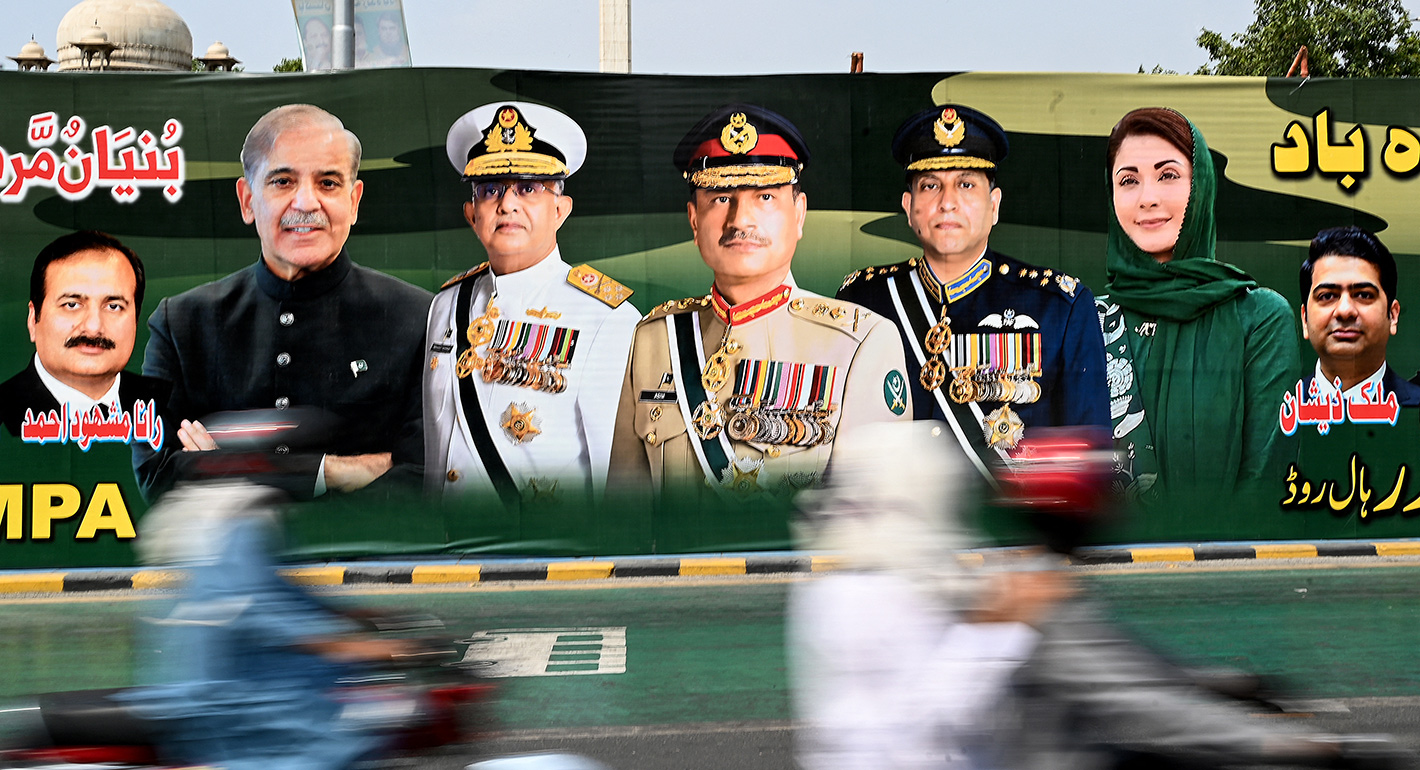
The regime bets that international legitimacy can be translated into domestic stability. But that depends upon whether it can leverage international goodwill to manage grievances and the economy at home.
Zoha Waseem, Yasser Kureshi
Military rule is now a defining political factor in South Asia. Here’s how analysts can understand and account for it.

Paul Staniland
Not only does the fighting jeopardize regional security, it undermines Russian attempts to promote alternatives to the Western-dominated world order.
Ruslan Suleymanov
An exploration into how India and Pakistan have perceived each other’s manipulations, or lack thereof, of their nuclear arsenals.
Rakesh Sood