

Paper
Mei Ying Gechlik (Veron Hung)
{
  "authors": [
    "Mei Ying Gechlik (Veron Hung)"
  ],
  "type": "legacyinthemedia",
  "centerAffiliationAll": "dc",
  "centers": [
    "Carnegie Endowment for International Peace"
  ],
  "collections": [],
  "englishNewsletterAll": "asia",
  "nonEnglishNewsletterAll": "",
  "primaryCenter": "Carnegie Endowment for International Peace",
  "programAffiliation": "AP",
  "programs": [
    "Asia"
  ],
  "projects": [],
  "regions": [
    "China"
  ],
  "topics": [
    "Political Reform",
    "Democracy",
    "Trade"
  ]
}
REQUIRED IMAGE
Source: Carnegie
China's Constitutional Amendment is Flawed
Reprinted with permission from the International
Herald Tribune, Thursday, March 5, 2004
WASHINGTON The Chinese Communist Party's proposal to amend the Chinese Constitution
to strengthen human rights and private property protection has drawn praise.
But major flaws exist in the amendment. Chinese leaders should fix them before
the rubber-stamp national legislature adopts the amendment next week.
The greatest limitation of the proposal is that it fails to provide for a mechanism to review whether a law or a government decision violates the Constitution. U.S. Supreme Court judges have power to do so but their counterparts in China do not. In fact, Chinese judges cannot even declare a local piece of legislation invalid if it is found to be inconsistent with a national law. A Chinese judge who boldly did so in a recent case that has sparked widespread discussion is likely to be punished for making a serious mistake.
Given Chinese judges' lack of power to review the constitutionality of legislation, legal scholars have long called for establishing a constitutional review body. This body - be it a court or a committee within the national legislature - should consist of leading constitutional experts. Although any mechanism established could still be controlled by the Communist Party, it is unlikely that the party would interfere in cases that pose no threat to its governance, such as those that merely involve legal technicalities. Limited justice is better than no justice. For this reason, a constitutional review body should still be established.
The Communist Party also proposes that "citizens' legally obtained private property shall not be violated." It sounds reasonable to deny protection to illegally obtained private property, especially at a time when China and its citizens are most concerned about gangsters' economic activities. But such a provision would allow China's problematic local governments to declare a citizen's property illegal at whim.
To address foreign investors' concern about this problem, immediately after China's accession to the World Trade Organization in 2001 Beijing began to require all local governments to file their legislation with the State Council, the country's highest executive organ. Any citizen can also request that the council review a piece of filed local legislation if it is believed to be in conflict with a national law.
By the end of 2003, all 2026 pieces of local legislation have been reportedly filed with the State Council. Yet citizens have not adequately taken advantage of the review process, even though official sources acknowledge that some filed local rules are inconsistent with national laws.
This problem is unlikely to be solved in the near future, so in the final version of the constitutional amendment Chinese leaders should either define clearly the phrase "legally obtained private property" or specify that only the national legislature shall have the power to interpret it.
The proposed amendment also provides that "the state may, for the necessity of public interest, requisition or expropriate citizens' private property and pay compensation in accordance with law." This means that the state "may" (not "shall") pay compensation and the compensation is not explicitly required to be of reasonable amount. The differences between "may" (keyi in Chinese) and "shall" (bixu) are recognized in the Chinese legal system, but misuse of these terms is common. A provision that makes "reasonable compensation" mandatory is needed.
The Chinese Communist Party should be commended for proposing to add to the constitution this sentence: "the State respects and safeguards human rights." Once adopted, it will be the first time that the term human rights has been used in the document, which, at present, only provides for "rights."
One must not assume, however, that "human rights" used in this context has the same meaning as that under international law. Although China signed - but has not ratified - the international covenant on civil and political rights, the lack of explicit or implicit references to this agreement or other human-rights treaties in the Chinese Constitution makes it arguable that the term human rights as proposed carries a different meaning.
China often wraps a well-understood political term in its own rhetoric to mean something different. "Socialism with Chinese characteristics" and "a Socialist rule of law state" are good examples. The final version of the amendment must clarify the meaning of "human rights."
If these problems in the proposed constitutional amendment are caused by legislative oversight - which is possible, as China's poor draftsmanship is notorious - Chinese leaders should fix them before the national legislature adopts the amendment. If these loopholes are left intentionally, Chinese leaders should understand that half-hearted commitment to reform is demoralizing and would undermine their efforts in consolidating their governance.
Veron Mei-Ying Hung is an associate of the Carnegie Endowment for International Peace, in Washington.
Copyright © 2002 The International Herald Tribune

Former Non-Resident Associate
Recent Work
Mei Ying Gechlik (Veron Hung)
Mei Ying Gechlik (Veron Hung)
Carnegie does not take institutional positions on public policy issues; the views represented herein are those of the author(s) and do not necessarily reflect the views of Carnegie, its staff, or its trustees.

With the growth in points of friction between the great powers, organizations like the SCO will continue to play a role in the strategic adaptation of the smaller powers caught between them.

Temur Umarov
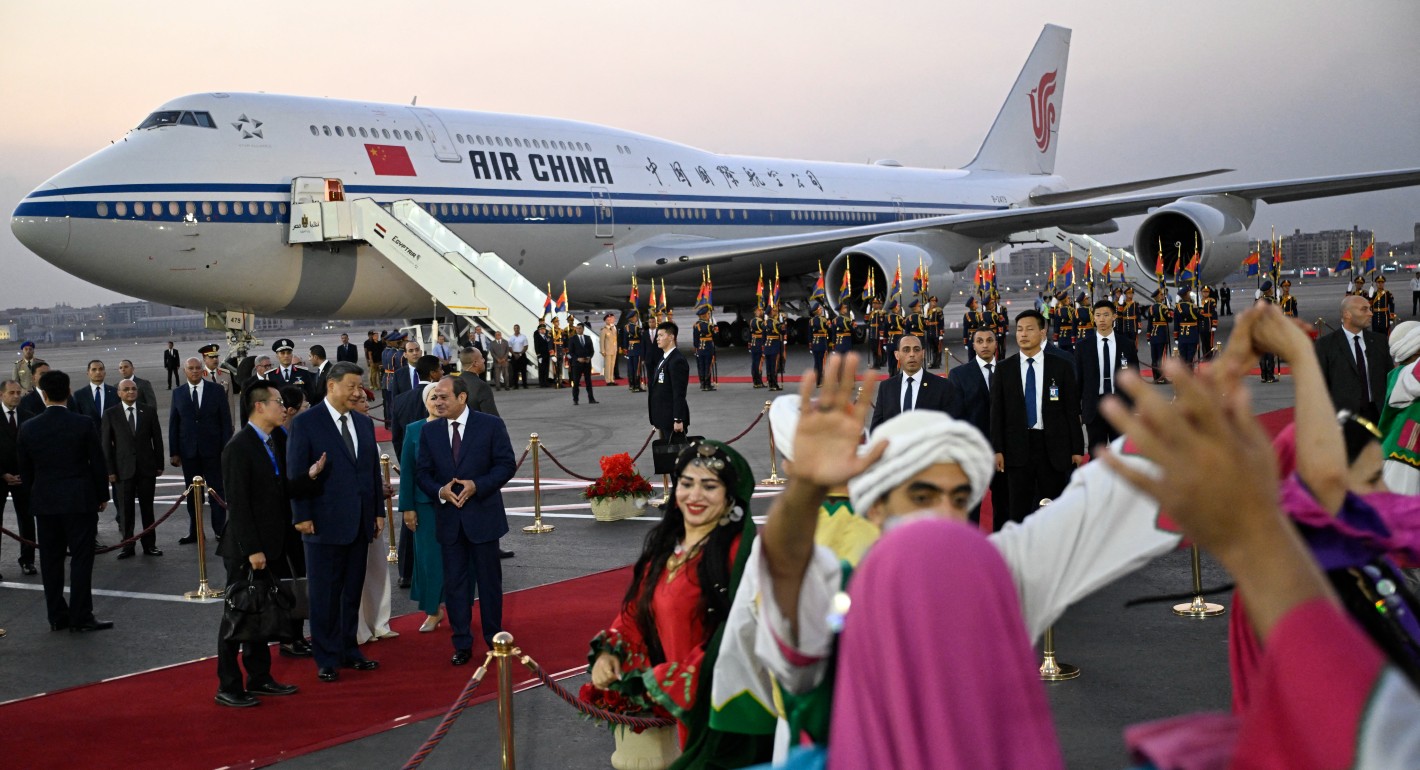
Amid celebrations of bilateral ties was a deeper focus on stability in the Middle East.

Amr Hamzawy

Canadian Prime Minister Mark Carney has twice inspired praise for standing up to U.S. President Donald Trump: at the 2026 World Economic Forum in Davos and on Canada-U.S. trade negotiations. Is Carney showing a third way better than the EU has in dealing with the Trump administration?

Rym Momtaz, ed.

Xi, Putin, and other regional leaders are back-slapping in Bishkek, but the SCO has yet to answer the most serious questions about continental Asia's economic future.

Evan A. Feigenbaum

Can economic ties help contain conflict between Egypt and Israel, or do they simply postpone confrontation? Drawing on the German-Russian experience, the article examines how the gas deal creates mutual dependence, keeps channels of cooperation open, and raises the cost of conflict, without necessarily delivering lasting peace.

Nourhan Hefzy