

Commentary
The acknowledgment has sparked fears of a new arms race with China and Russia.
Chris O’Meara
{
  "authors": [],
  "type": "other",
  "centerAffiliationAll": "dc",
  "centers": [
    "Carnegie Endowment for International Peace"
  ],
  "collections": [],
  "englishNewsletterAll": "ctw",
  "nonEnglishNewsletterAll": "",
  "primaryCenter": "Carnegie Endowment for International Peace",
  "programAffiliation": "SAP",
  "programs": [
    "South Asia"
  ],
  "projects": [],
  "regions": [
    "South Asia",
    "India"
  ],
  "topics": [
    "Foreign Policy",
    "Nuclear Policy"
  ]
}
Source: Getty
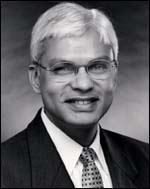
President Bush, on his first visit to India, sealed the U.S.-India Nuclear Deal. Carnegie Senior Associate Ashley J. Tellis has been widely recognized as one of the core individuals who made this deal possible. Tellis was drafted in advance of President Bush's visit to India to serve as a senior advisor to the Under Secretary of State for Political Affairs, R. Nicholas Burns. In this position, Tellis provided support of various State Department activities relating to U.S.-Indian relations and brought his unique understanding of the establishments in New Delhi and Washington to finalize the deal.
In an interview with rediff-India Abroad R. Nicholas Burns said,
"Ashley has worked for the United States government at several junctures -- at the White House staff as well as in New Delhi -- and he knows more about India's nuclear program than any other living American. [And so, I wanted to...] I have great respect for him, for his creativity and ingenuity and also for his knowledge and technical expertise, and I felt that he would be a great addition to our staff and our delegation, and he was. He was instrumental in getting a decision."
Click below to read more about Tellis' role in the historic U.S.-India Nuclear Deal:
People Behind the Deal (Times of India, March 3, 2006)
Those Who Made the Deal Happen (Indian Express, March 4, 2006)
Click on the right to access article
All the PM's Men (Hindustan Times, March 5, 2006)
Click on the right to access article
Carnegie does not take institutional positions on public policy issues; the views represented herein are those of the author(s) and do not necessarily reflect the views of Carnegie, its staff, or its trustees.

The acknowledgment has sparked fears of a new arms race with China and Russia.

Chris O’Meara
Smaller powers cannot go it alone, but Canadian history shows that integration with the United States will not always be benign.
Paul Samson

The European Commissioner for Trade is headed to China. But after President Xi’s bridge-building visit to Washington, can a more isolated EU overcome Beijing’s stranglehold on critical raw materials? Who will blink first?

Rym Momtaz, ed.

The summit may be remembered as a fatal blunder, when Washington, Beijing, and the AI industry collectively chose ceremony over action.

Jeffrey Prescott

European NATO countries are wrestling with the possibility of U.S. disengagement from the alliance. With the continent’s security increasingly uncertain, governments must restore the credibility of their collective defense.



Hans-Dieter Lucas, Adam Thomson, Pierre Vimont