• Research
  • Emissary
  • About
  • Experts
Carnegie Global logoCarnegie lettermark logo
DemocracyIran
  • Donate
{
  "authors": [
    "Amr Hamzawy"
  ],
  "type": "legacyinthemedia",
  "centerAffiliationAll": "dc",
  "centers": [
    "Carnegie Endowment for International Peace"
  ],
  "collections": [],
  "englishNewsletterAll": "menaTransitions",
  "nonEnglishNewsletterAll": "",
  "primaryCenter": "Carnegie Endowment for International Peace",
  "programAffiliation": "MEP",
  "programs": [
    "Middle East"
  ],
  "projects": [],
  "regions": [
    "Middle East",
    "Egypt"
  ],
  "topics": [
    "Foreign Policy"
  ]
}
Source: Getty

In The Media

President Bush Meets with Egyptian President


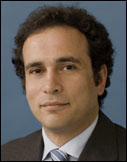
Carnegie's Amr Hamzawy discusses President Bush's meeting with Egyptian President Hosni Mubarak and Egypt's role in negotiating peace between Hamas and Israel over the Gaza Strip.


Link Copied
By Amr Hamzawy
Published on May 19, 2008
Program mobile hero image

Program

Middle East

The Middle East Program in Washington combines in-depth regional knowledge with incisive comparative analysis to provide deeply informed recommendations. With expertise in the Gulf, North Africa, Iran, and Israel/Palestine, we examine crosscutting themes of political, economic, and social change in both English and Arabic.

Learn More

Source: C-Span's Washington Journal

Carnegie's Amr Hamzawy discusses President Bush's meeting with Egyptian President Hosni Mubarak and Egypt's role in negotiating peace between Hamas and Israel over the Gaza Strip.

Click here to view the broadcast.

About the Author

Amr Hamzawy

Director, Middle East Program

Amr Hamzawy is a senior fellow and the director of the Carnegie Middle East Program. His research and writings focus on governance in the Middle East and North Africa, social vulnerability, and the different roles of governments and civil societies in the region.

    Recent Work

  • Commentary
    Iran Is Pushing Its Neighbors Toward the United States

      Amr Hamzawy

  • Paper
    U.S. Peace Mediation in the Middle East: Lessons for the Gaza Peace Plan
      • Sarah Yerkes

      Amr Hamzawy, Sarah Yerkes, Kathryn Selfe

Amr Hamzawy
Director, Middle East Program
Amr Hamzawy
Foreign PolicyMiddle EastEgypt

Carnegie does not take institutional positions on public policy issues; the views represented herein are those of the author(s) and do not necessarily reflect the views of Carnegie, its staff, or its trustees.

More Work from Carnegie Endowment for International Peace

  • City at night
    Commentary
    Emissary
    The Iran War Is Also Now a Semiconductor Problem

    The conflict is exposing the deep energy vulnerabilities of Korea’s chip industry.

      Darcie Draudt-Véjares, Tim Sahay

  • Commentary
    Strategic Europe
    Taking the Pulse: Is France’s New Nuclear Doctrine Ambitious Enough?

    French President Emmanuel Macron has unveiled his country’s new nuclear doctrine. Are the changes he has made enough to reassure France’s European partners in the current geopolitical context?

      • Rym Momtaz

      Rym Momtaz, ed.

  • Commentary
    The Iran War’s Dangerous Fallout for Europe

    The drone strike on the British air base in Akrotiri brings Europe’s proximity to the conflict in Iran into sharp relief. In the fog of war, old tensions in the Eastern Mediterranean risk being reignited, and regional stakeholders must avoid escalation.

      Marc Pierini

  • Indian Prime Minister Narendra Modi, wearing an orange cap, and the Chief Minister of Uttar Pradesh, Yogi Adityanath, dressed in saffron robes, are greeting supporters of the Bharatiya Janata Party (BJP) during a roadshow ahead of the Indian General Elections in Ghaziabad, Uttar Pradesh, India, on April 6, 2024.
    Paper
    India’s Foreign Policy in the Age of Populism

    Domestic mobilization, personalized leadership, and nationalism have reshaped India’s global behavior.

      Sandra Destradi

  • Trump United Nations multilateralism institutions 2236462680
    Article
    Resetting Cyber Relations with the United States

    For years, the United States anchored global cyber diplomacy. As Washington rethinks its leadership role, the launch of the UN’s Cyber Global Mechanism may test how allies adjust their engagement.

      • Christopher Painter

      Patryk Pawlak, Chris Painter

Get more news and analysis from
Carnegie Endowment for International Peace
Carnegie global logo, stacked
1779 Massachusetts Avenue NWWashington, DC, 20036-2103Phone: 202 483 7600Fax: 202 483 1840
  • Research
  • Emissary
  • About
  • Experts
  • Donate
  • Programs
  • Events
  • Blogs
  • Podcasts
  • Contact
  • Annual Reports
  • Careers
  • Privacy
  • For Media
  • Government Resources
Get more news and analysis from
Carnegie Endowment for International Peace
© 2026 Carnegie Endowment for International Peace. All rights reserved.