

In The Media
Michele Dunne, Robert Kagan
{
  "authors": [
    "Robert Kagan"
  ],
  "type": "legacyinthemedia",
  "centerAffiliationAll": "",
  "centers": [
    "Carnegie Endowment for International Peace"
  ],
  "collections": [],
  "englishNewsletterAll": "",
  "nonEnglishNewsletterAll": "",
  "primaryCenter": "Carnegie Endowment for International Peace",
  "programAffiliation": "",
  "programs": [],
  "projects": [],
  "regions": [
    "North America",
    "United States"
  ],
  "topics": [
    "Military",
    "Foreign Policy"
  ]
}
Source: Getty
Despite critics who claim that America’s power is fading fast, both presidential candidates know that the U.S. remains the key player on the international scene. Even in the throes of the financial crisis, America maintains unmatched economic and military power; and the challenges to U.S. power today are in fact no greater than challenges that the country has faced in past decades.
Source: Washington Post

One hopes that whoever wins next week will quickly dismiss all this faddish declinism. It seems to come along every 10 years or so. In the late 1970s, the foreign policy establishment was seized with what Cyrus Vance called "the limits of our power." In the late 1980s, the scholar Paul Kennedy predicted the imminent collapse of American power due to "imperial overstretch." In the late 1990s, Samuel P. Huntington warned of American isolation as the "lonely superpower." Now we have the "post-American world."
Yet the evidence of American decline is weak. Yes, as Zakaria notes, the world's largest Ferris wheel is in Singapore and the largest casino in Macau. But by more serious measures of power, the United States is not in decline, not even relative to other powers. Its share of the global economy last year was about 21 percent, compared with about 23 percent in 1990, 22 percent in 1980 and 24 percent in 1960. Although the United States is suffering through a financial crisis, so is every other major economy. If the past is any guide, the adaptable American economy will be the first to come out of recession and may actually find its position in the global economy enhanced.
Meanwhile, American military power is unmatched. While the Chinese and Russian militaries are both growing, America's is growing, too, and continues to outpace them technologically. Russian and Chinese power is growing relative to their neighbors and their regions, which will pose strategic problems, but that is because American allies, especially in Europe, have systematically neglected their defenses.
America's image is certainly damaged, as measured by global polls, but the practical effects of this are far from clear. Is America's image today worse than it was in the 1960s and early 1970s, with the Vietnam War; the Watts riots; the My Lai massacre; the assassinations of John F. Kennedy, Martin Luther King and Bobby Kennedy; and Watergate? Does anyone recall that millions of anti-American protesters took to the streets in Europe in those years?
Today, despite the polls, President Bush has managed to restore closer relations with allies in Europe and Asia, and the next president will be able to improve them even further. Realist theorists have consistently predicted for the past two decades that the world would "balance" against the United States. But nations such as India are drawing closer to America, and if any balancing is occurring, it is against China, Russia and Iran.
Sober analysts such as Richard Haass acknowledge that the United States remains "the single most powerful entity in the world." But he warns, "The United States cannot dominate, much less dictate, and expect that others will follow." That is true. But when was it not? Was there ever a time when the United States could dominate, dictate and always have its way?
Many declinists imagine a mythical past when the world danced to America's tune. Nostalgia swells for the wondrous American-dominated era after World War II, but between 1945 and 1965 the United States actually suffered one calamity after another. The "loss" of China to communism; the North Korean invasion of South Korea; the Soviet testing of a hydrogen bomb; the stirrings of postcolonial nationalism in Indochina -- each proved a strategic setback of the first order. And each was beyond America's power to control or even to manage successfully.
No event in the past decade, with the exception of Sept. 11, can match the scale of damage to America's position in the world. Many would say, "But what about Iraq?" Yet even in the Middle East, where America's image has suffered most as a result of that war, there has been no fundamental strategic realignment. Longtime American allies remain allies, and Iraq, which was once an adversary, is now an ally. Contrast this with the strategic setbacks the United States suffered during the Cold War. In the 1950s and 1960s, the pan-Arab nationalist movement swept out pro-American governments and opened the door to unprecedented Soviet involvement, including a quasi-alliance between Moscow and the Egypt of Gamal Abdel Nasser, as well as with Syria. In 1979, the central pillar of American strategy toppled when the pro-American Shah of Iran was overthrown by Ayatollah Khomeini's revolution. That produced a fundamental shift in the strategic balance from which the United States is still suffering. Nothing similar has occurred as a result of the Iraq war.
So perhaps a little perspective is in order. The danger of today's declinism is not that it is true but that the next president will act as if it is. The good news is that I doubt either nominee really will. And I'm confident the American people would take a dim view if he tried.
Click here to view this article as it originally appeared in the Washington Post.

Former Senior Associate
Kagan, author of the recent book, The Return of History and the End of Dreams (Knopf 2008), writes a monthly column on world affairs for the Washington Post and is a contributing editor at both the Weekly Standard and the New Republic.
Recent Work

Michele Dunne, Robert Kagan
Robert Kagan, Michele Dunne
Carnegie does not take institutional positions on public policy issues; the views represented herein are those of the author(s) and do not necessarily reflect the views of Carnegie, its staff, or its trustees.
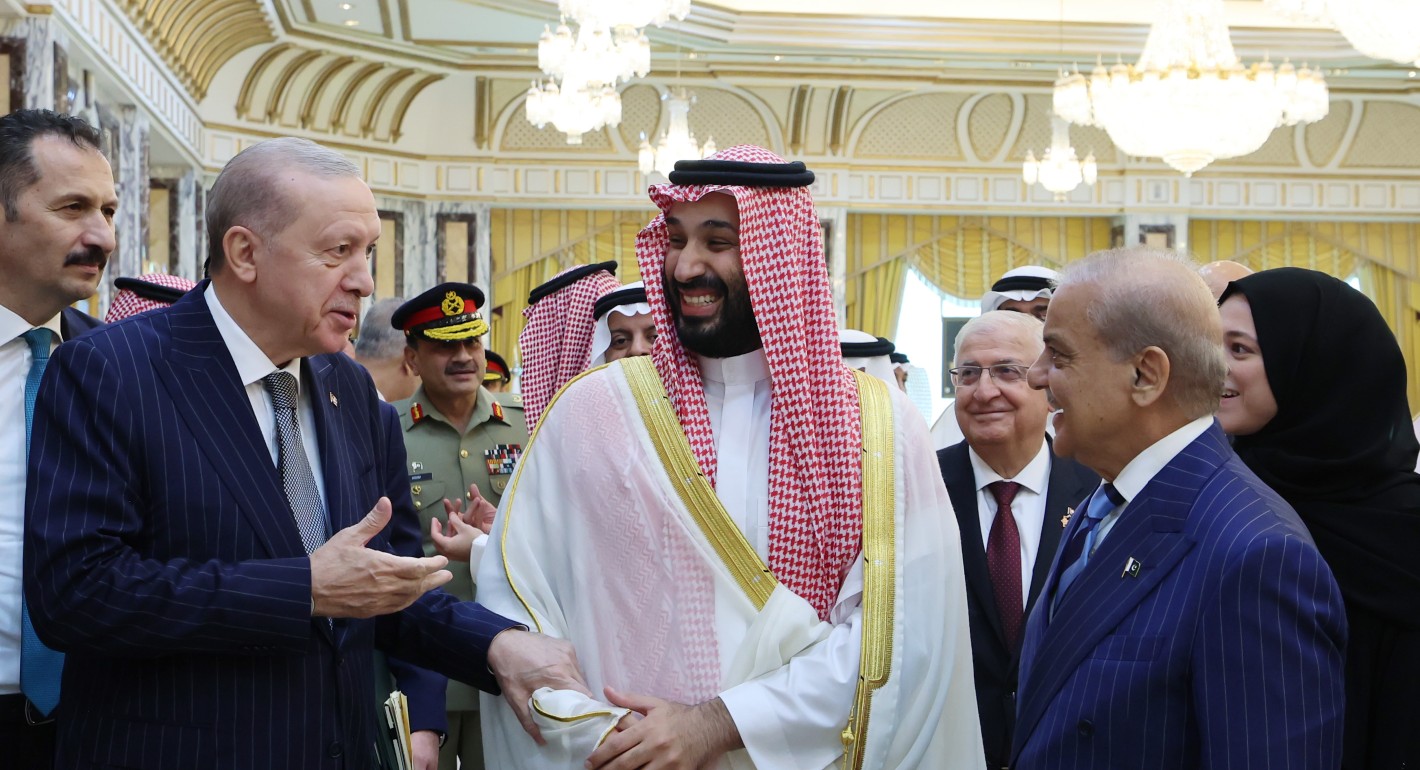
Why Pakistan, Saudi Arabia, and Turkey are joining forces on regional security.


Alper Coşkun, Amr Hamzawy

Despite public disputes over trade and immigration, the strategic partnership’s foundations remain sturdy.

Sameer Lalwani

It signals a new era of tech diffusion and warfare.

Steve Feldstein

With its public finances in shambles, the far right polling at 35 percent ahead of the 2027 presidential election, and a growing protest movement, is France’s crisis a threat to the EU’s geopolitical awakening?

Rym Momtaz, ed.

Ahead of a tough winter for Ukraine, Donald Trump’s swing back toward Russia bodes ill. But instead of panicking, Kyiv’s European allies are focusing on action.
Rym Momtaz