

Q&A
Suzanne Maloney, Aaron David Miller, Karim Sadjadpour
{
  "authors": [
    "Karim Sadjadpour"
  ],
  "type": "legacyinthemedia",
  "centerAffiliationAll": "dc",
  "centers": [
    "Carnegie Endowment for International Peace"
  ],
  "collections": [],
  "englishNewsletterAll": "menaTransitions",
  "nonEnglishNewsletterAll": "",
  "primaryCenter": "Carnegie Endowment for International Peace",
  "programAffiliation": "MEP",
  "programs": [
    "Middle East"
  ],
  "projects": [],
  "regions": [
    "North America",
    "United States",
    "Middle East",
    "Iran"
  ],
  "topics": [
    "Foreign Policy",
    "Nuclear Policy"
  ]
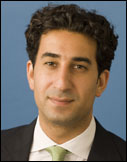
}
Source: Getty
One of the most urgent and troublesome foreign policy challenges for the incoming Obama administration is Iran. Iran policy is a Rubik's Cube of components, including Tehran's nuclear activities, its hostility to Israel, its role in Iraq and Afghanistan, its support for Hamas and Hezbollah and the nature of the Islamic republic itself.
Source: NPR's All Things Considered

Iran policy is a Rubik's Cube of components, including Tehran's nuclear activities, its hostility to Israel, its role in Iraq and Afghanistan, its support for Hamas and Hezbollah and the nature of the Islamic republic itself.
In a sense, President-elect Barack Obama has already changed policy, by repeatedly saying during the campaign that he would seek engagement with Iran without preconditions, but the choices for the incoming president are not easy to sort through.
Just as Obama suggested a change in course, so too did Iranian President Mahmoud Ahmadinejad, who sent a letter of congratulation — vaguely worded — to the president-elect. This was a first for Iran since the triumph of the Islamic Revolution 30 years ago. So, what's next for the strained relationship?
"The first step might be to respond favorably to that letter or at least in a cautious but positive way," says Peter Galbraith, a former diplomat and author of Unintended Consequences: How War in Iraq Strengthened America's Enemies.
Where To Begin?
Galbraith argues that the new administration should start with the most contentious issue.
"At the top of the list is Iran's nuclear program," he says. "And so the overriding goal ought to be to try to achieve a freeze on its nuclear activities or other kinds of arrangements that will guarantee that Iran does not, in fact, proceed further toward developing nuclear weapons."
That has been the goal of the Bush administration for the past five years, without any success. Under the pressure of numerous economic sanctions, Iran has only hardened its stand on its right to enrich uranium, so other analysts urge avoiding the most contentious problems for the moment in favor of issues where Iranian and American interests overlap — such as in Iraq and Afghanistan.
That's the view of Karim Sadjadpour of the Carnegie Endowment for International Peace.
"If we immediately approach Iran and give them ultimatums on the nuclear issue and on Israel, the likelihood is that we'll forsake building confidence with them and bringing about more cooperative Iranian behavior on the other issues," Sadjadpour says.
A Strategy Overhaul?
Still others argue that what U.S. policy on Iran needs is a thorough overhaul, something bold and daring. Flynt Leverett, who worked on Iran policy in the White House during President Bush's first term, says the new approach should be strategic and comprehensive.
"A strategy that would encompass all of the issues that we have vis-a-vis Iran," Leverett says. "And I think that inevitably that takes you in the direction of a grand bargain, or what you might describe as, at least, a grand agenda."
Leverett has developed these proposals with his wife, Hillary Mann Leverett, who also served on the National Security Council in the first Bush term. She argues that the incoming administration should resist the temptation to delay any policy initiatives until after Iran's election in June, when Ahmadinejad is up for re-election.
The relationship between the United States and Iran is strategic, she argues, not necessarily tied to individual leaders in Iran.
"As we constantly are looking for the next better Iranian president to deal with, we are giving up opportunities to put the relationship between the U.S. and Iran on a more strategic, constructive path," she says. "What matters is ... that we see Iran as a country we can work with in our strategic interest, whether Ahmadinejad is the next president or someone else."
Too Much Talk About Military Action?
Then there is the issue of how the United States should apply pressure in direct talks with Iran. Many in the Bush administration were quite clear that they favored threatening the use of the military option and regime change.
Some analysts believe there's been too much talk about attacking Iran and that has been counterproductive. Hillary Mann Leverett advocates effectively removing the military option from consideration.
"If the United States continues to talk about a military option and use economic pressure, it is going, from the Iranian perspective, I think, to undermine where they think talks can go, and therefore make them less invested in having the talks get there," she says.
On the other hand, Galbraith argues that sometimes the threat of military action is necessary.
"In fact, I would take steps to strengthen or to make it more credible, and that would include withdrawing forces from Iraq. But I wouldn't rattle the saber," Galbraith says.
There are no guarantees that any of these options will bear any fruit. That's because, in Sadjadpour's view, there is still no answer to the fundamental question about Iran: Why does it behave the way it does?
"Meaning, does Iran behave the way it does because of this immutable ideology which was born out of the 1979 revolution? Or is Iranian behavior really a byproduct of U.S.-Iran relations?" Sadjadpour asks. "Meaning, could a more conciliatory or more pragmatic U.S. approach beget a more conciliatory Iranian response?"
One way to find an answer, Sadjadpour says, is to begin the process of engagement with Iran, as the president-elect seems committed to, and see how the Iranians themselves answer the question.

Senior Fellow, Middle East Program
Karim Sadjadpour is a senior fellow at the Carnegie Endowment for International Peace, where he focuses on Iran and U.S. foreign policy toward the Middle East.
Recent Work


Suzanne Maloney, Aaron David Miller, Karim Sadjadpour

Aaron David Miller, Karim Sadjadpour, Robin Wright
Carnegie does not take institutional positions on public policy issues; the views represented herein are those of the author(s) and do not necessarily reflect the views of Carnegie, its staff, or its trustees.

Despite a new textbook, an influx of Russian teachers and managers, and an end to the teaching of Ukrainian, the Kremlin is unlikely to have “reprogrammed” locals.

Konstantin Skorkin

The acknowledgment has sparked fears of a new arms race with China and Russia.

Chris O’Meara

Smaller powers cannot go it alone, but Canadian history shows that integration with the United States will not always be benign.
Paul Samson

The European Commissioner for Trade is headed to China. But after President Xi’s bridge-building visit to Washington, can a more isolated EU overcome Beijing’s stranglehold on critical raw materials? Who will blink first?

Rym Momtaz, ed.
The summit may be remembered as a fatal blunder, when Washington, Beijing, and the AI industry collectively chose ceremony over action.
Jeffrey Prescott