

Q&A
Suzanne Maloney, Aaron David Miller, Karim Sadjadpour
{
  "authors": [
    "Karim Sadjadpour"
  ],
  "type": "legacyinthemedia",
  "centerAffiliationAll": "dc",
  "centers": [
    "Carnegie Endowment for International Peace"
  ],
  "collections": [],
  "englishNewsletterAll": "menaTransitions",
  "nonEnglishNewsletterAll": "",
  "primaryCenter": "Carnegie Endowment for International Peace",
  "programAffiliation": "MEP",
  "programs": [
    "Middle East"
  ],
  "projects": [],
  "regions": [
    "Middle East",
    "Iran",
    "Israel"
  ],
  "topics": [
    "Political Reform",
    "Foreign Policy"
  ]
}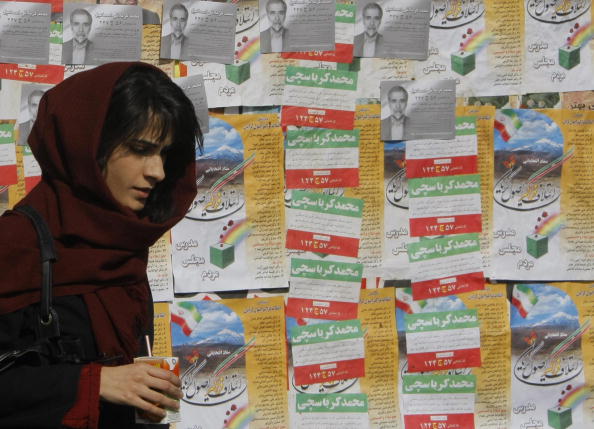
Source: Getty
Under it's current leadership, Iran is incapable of altering its approach towards Israel in the context of a broader U.S.-Iran accommodation.
Source: The National

After all, Iran is not an Arab country, has no direct land disputes with Israel, has no Palestinian refugee problem, has a long history of contentious relations with the Arab world and is home to the largest Jewish community in the Middle East outside Israel itself.
The devastating images of innocent Palestinian women and children killed in Gaza are heart-wrenching. But why should Iran be a more strident enemy of Israel than, say, Lebanon, Egypt or even Syria — Arab nations that have lost hundreds of their sons in wars fought against the Jewish state?
Broadly speaking, there are two schools of thought. One says that Iran and Israel are natural rivals for primacy in the Middle East, and so the hostility between them is really a strategic joust cloaked in ideological garb. “One country cannot have two kings,” is how Amir Mohebian, one of Iran’s top political thinkers, once put it to me.
As the Iranian political analyst Saeed Leylaz observes: “Hamas is a very practical and useful tool for Iran, not an ideological one at all. It is a very good tool for Iran, especially in its dealings with the US. What is happening right now in Gaza has made it easier for Iran to promote anti-US feelings among Muslims.”
The other school of thought contends that opposition to Israel is a deeply held ideological tenet of Iran’s 1979 revolution. Tehran is not simply “playing the Palestinian card” as a means of garnering popular support in the region; the Palestinian cause is a glorious end in itself. The rhetoric of the Iranian regime is taken at face value: nothing less than the dissolution — ie, the political dissolution, not physical annihilation — of the Jewish state would satisfy Tehran’s hardline leadership.
When I was based in Tehran with the International Crisis Group, and frequently interviewing Iranian officials, I used to believe that Iran would be capable of altering its approach towards Israel in the context of a broader US-Iran accommodation.
I no longer believe this to be the case.
Tune out the rantings of President Mahmoud Ahmadinejad and focus on the most powerful man in Tehran, Supreme Leader Ayatollah Sayyid Ali Khamenei, whose writings and speeches are the most accurate reflection of Iranian domestic and foreign policy aims and practices.
A study I did on Mr Khamenei, based on three decades’ worth of his speeches, confirmed for me the Supreme Leader’s cynical, conspiratorial disposition. What surprised me, however, was how consistent and disciplined his message was. In thousands of pages of material there were few, if any, contradictions.
And, remarkably, the issue that has featured most prominently in his political discourse during his tenure as leader has been his opposition to Israel’s existence. Whether his audience is Iranian students or foreign dignitaries, or the topic of his speech is foreign policy, education or agriculture, he rarely misses an opportunity to invoke the professed virtues of the 1979 revolution — justice, independence, self-sufficiency and Islam — and to express his deep disdain for “the Zionist entity”.
For many close observers of US–Iranian relations, the Islamic Republic’s uncompromising stance on Israel presents the greatest impediment to US–Iranian entente. Not only is Khamenei well aware of this argument, he also agrees with it. Yet it is a bargain he appears unwilling to make.
Mr Khameini says: “The ridiculous accusations such as human rights violations or seeking weapons of mass destruction are only empty claims aimed at exerting pressure on the Islamic Republic, and if Iran stops its support of the Lebanese and Palestinian people, the United States will also change its hostile attitude toward the Islamic Republic. But we consider supporting the Palestinian and Lebanese people one of our major Islamic duties. This is why Washington is applying every pressure lever against the Islamic Republic in order to stop this support.”
Two important caveats should be entered. First, Iran has grudgingly said that it will accept any Palestinian-Israeli peace resolution that the Palestinians themselves sign off on. Second, if ever the regime’s existence is at stake, survival trumps ideology. In the near term, however, both of these appear unlikely prospects.
Nonetheless, to paraphrase Donald Rumsfeld, we have to deal with the Iranian leaders we’ve got, not the ones we wish we had. A continued US-Israel-Iran proxy war for power and influence in the Middle East will continue to produce the same horrendous results witnessed in Lebanon in 2006 and Gaza today: no clear winners, unnecessary and excessive civilian casualties, and more fertile ground for radicals more interested in continuing the fight than in ending it.

Senior Fellow, Middle East Program
Karim Sadjadpour is a senior fellow at the Carnegie Endowment for International Peace, where he focuses on Iran and U.S. foreign policy toward the Middle East.
Recent Work


Suzanne Maloney, Aaron David Miller, Karim Sadjadpour

Aaron David Miller, Karim Sadjadpour, Robin Wright
Carnegie does not take institutional positions on public policy issues; the views represented herein are those of the author(s) and do not necessarily reflect the views of Carnegie, its staff, or its trustees.

Before the next wave of EU enlargement takes place, the union needs to grapple with thorny questions of how power is distributed among its members.


Emil Sondaj Hansen, Ditte Brasso Sørensen
The real test may come after the leaders leave the room.



Sheena Chestnut Greitens, Oriana Skylar Mastro, Yukon Huang, …

The Horn of Africa countries are among those facing a new security calculus.


Andrew Leber, Lesley Anne Warner

The European far right might fail to steer EU policy in the direction Russia wants, but they will create enough chaos inside Europe to benefit the Kremlin.

Dimitar Bechev

The new U.S.–Denmark–Greenland agreement will help Washington exert political, economic, and financial dominance under the guise of security. Yet, it acknowledged Copenhagen’s and Nuuk’s sovereignty on the island.

Marc Pierini