• Research
  • Emissary
  • About
  • Experts
Carnegie Global logoCarnegie lettermark logo
DemocracyIran
  • Donate
{
  "authors": [
    "James M. Acton"
  ],
  "type": "legacyinthemedia",
  "centerAffiliationAll": "dc",
  "centers": [
    "Carnegie Endowment for International Peace"
  ],
  "collections": [
    "Korean Peninsula"
  ],
  "englishNewsletterAll": "",
  "nonEnglishNewsletterAll": "",
  "primaryCenter": "Carnegie Endowment for International Peace",
  "programAffiliation": "NPP",
  "programs": [
    "Nuclear Policy"
  ],
  "projects": [],
  "regions": [
    "East Asia",
    "South Korea",
    "North Korea"
  ],
  "topics": [
    "Nuclear Policy"
  ]
}
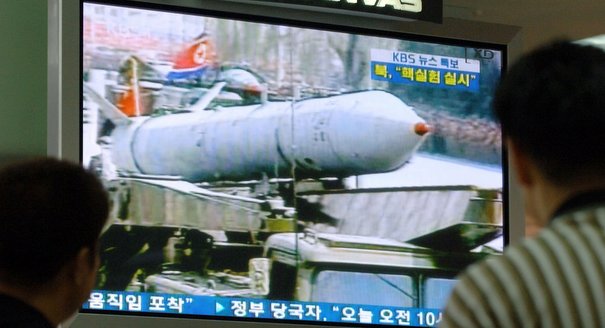
Source: Getty

In The Media

Verifying North Korea's Nuclear Programme: Technical Options and Policy Choices

This paper, presented at the Institute of Nuclear Materials Management (INMM) 50th Annual Meeting, considers the challenges and policy choices associated with verifying a North Korean declaration about its past nuclear activities.

Link Copied
By James M. Acton
Published on Jul 12, 2009
Program mobile hero image

Program

Nuclear Policy

The Nuclear Policy Program aims to reduce the risk of nuclear war. Our experts diagnose acute risks stemming from technical and geopolitical developments, generate pragmatic solutions, and use our global network to advance risk-reduction policies. Our work covers deterrence, disarmament, arms control, nonproliferation, and nuclear energy.

Learn More

Source: INMM Conference Paper

Verifying North Korea's Nuclear Programme: TechnicThis paper considers the challenges and policy choices associated with verifying a North Korean declaration about its past nuclear activities. In terms of the plutonium programme, there are two key choices facing policy makers. First, in light of North Korea’s reported statement that its October 2006 test involved only 2 kg of plutonium, is the IAEA’s standard definition of a significant quantity appropriate? Second, using open source information, this paper argues that the uncertainty in the material unaccounted for, σ(MUF), will be between 5 and 10 kg, depending on the degree of cooperation afforded by North Korea. In order to ensure that verification produces a conclusive answer, the magnitude of σ(MUF) will necessitate some combination of decreasing the detection probability and increasing the false alarm rate from their standard IAEA values, or adopting entirely different criteria against which to assess North Korean compliance. The paper also includes a discussion of the process for verifying the absence or existence of a clandestine uranium enrichment programme by formulating it as a Bayesian inference problem. This framework, together with an analysis of the politics of inspections at undeclared locations suggests that, unless detailed intelligence pinpointing the location of a clandestine centrifuge facility is available, inspection rights at undeclared facilities may be of limited utility.

About the Author

James M. Acton

Jessica T. Mathews Chair, Co-director, Nuclear Policy Program

Acton holds the Jessica T. Mathews Chair and is co-director of the Nuclear Policy Program at the Carnegie Endowment for International Peace.

    Recent Work
  • Other
    Unpacking Trump’s National Security Strategy
      • Cecily Brewer
      • +18

      James M. Acton, Saskia Brechenmacher, Cecily Brewer, …

  • Commentary
    Trump Has an Out on Nuclear Testing. He Should Take It.

      James M. Acton

James M. Acton
Jessica T. Mathews Chair, Co-director, Nuclear Policy Program
James M. Acton
Nuclear PolicyEast AsiaSouth KoreaNorth Korea

Carnegie does not take institutional positions on public policy issues; the views represented herein are those of the author(s) and do not necessarily reflect the views of Carnegie, its staff, or its trustees.

More Work from Carnegie Endowment for International Peace

  • Commentary
    Strategic Europe
    Europe on Iran: Gone with the Wind

    Europe’s reaction to the war in Iran has been disunited and meek, a far cry from its previously leading role in diplomacy with Tehran. To avoid being condemned to the sidelines while escalation continues, Brussels needs to stand up for international law.

      Pierre Vimont

  • An elderly woman walks past a poster at a health centre in Gunwi, some 200 kilometres south of Seoul
    Paper
    Governing Aging Economies: South Korea and the Politics of Care, Safety, and Work

    South Korea’s rapid demographic transition previews governance challenges many advanced and middle-income economies will face. This paper argues that aging is not only a care issue but a structural governance challenge—reshaping welfare, productivity, and fiscal sustainability, and reorganizing responsibilities across the state, private sector, and society.

      Darcie Draudt-Véjares

  • Commentary
    Strategic Europe
    Macron Makes France a Great Middle Power

    France has stopped clinging to notions of being a great power and is embracing the middle power moment. But Emmanuel Macron has his work cut out if he is to secure his country’s global standing before his term in office ends.

      • Rym Momtaz

      Rym Momtaz

  • Source: North Atlantic Treaty Organization
    Paper
    Are Long-Term NATO–South Korea Defense Ties Possible? Transitioning From an Arms Exporter to a Trusted Defense Partner

    South Korea has emerged as a major weapon exporter. But its relationship with Europe will depend on more than that.

      Chung Min Lee

  • People yelling and holding Yoon Again banners
    Commentary
    Emissary
    What Happens When a Conservative Movement Continues on Without a Leader?

    Lessons from Korea’s political right.

      Darcie Draudt-Véjares

Get more news and analysis from
Carnegie Endowment for International Peace
Carnegie global logo, stacked
1779 Massachusetts Avenue NWWashington, DC, 20036-2103Phone: 202 483 7600Fax: 202 483 1840
  • Research
  • Emissary
  • About
  • Experts
  • Donate
  • Programs
  • Events
  • Blogs
  • Podcasts
  • Contact
  • Annual Reports
  • Careers
  • Privacy
  • For Media
  • Government Resources
Get more news and analysis from
Carnegie Endowment for International Peace
© 2026 Carnegie Endowment for International Peace. All rights reserved.