

Q&A
Christopher Boucek
{
  "authors": [
    "Christopher Boucek"
  ],
  "type": "legacyinthemedia",
  "centerAffiliationAll": "dc",
  "centers": [
    "Carnegie Endowment for International Peace",
    "Malcolm H. Kerr Carnegie Middle East Center"
  ],
  "collections": [],
  "englishNewsletterAll": "menaTransitions",
  "nonEnglishNewsletterAll": "",
  "primaryCenter": "Carnegie Endowment for International Peace",
  "programAffiliation": "MEP",
  "programs": [
    "Middle East"
  ],
  "projects": [],
  "regions": [
    "Yemen",
    "Gulf"
  ],
  "topics": [
    "Security"
  ]
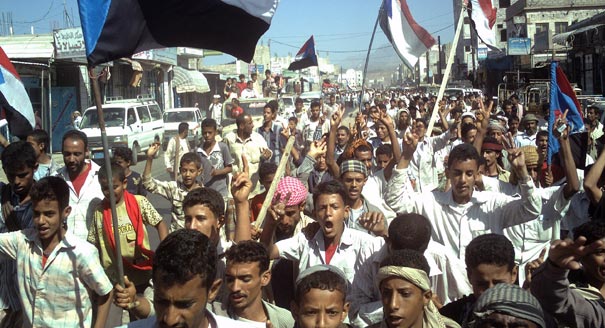
}
Source: Getty
Yemen’s stability and security situation is rapidly deteriorating, threatening the entire region, and without the help of Yemen’s neighbors and international partners, the situation will only continue to worsen, with potentially catastrophic results.
Source: Al Majalla

Yemen’s stability and security situation is rapidly deteriorating, and its potential implosion will have a dramatic impact on neighboring states. The country faces an astonishing confluence of unprecedented challenges – violent extremism, economic collapse, a looming water shortage, and a growing secessionist movement. If any one of these challenges comes to a head, it could overwhelm the Yemeni government. Unless appropriate steps are taken, Yemen risks becoming a failed state and a training ground for Islamist extremism, in which case its problems will quickly envelop the entire region.
Owing to the central government’s historically weak control, Yemen has often stood on the brink of chaos. The country has survived several individual crises in the past, but today, multiple interconnected challenges are poised to converge at the same time. At the heart of the country’s problems is a looming economic crisis. Yemen’s petroleum reserves are fast running out, and it has few viable options for creating a sustainable post-oil economy. Moreover, the country is consuming its limited water resources much faster than it can now replenish them. A rapidly expanding and increasingly poor population places unbearable pressure on the government’s ability to provide basic services. Islamist terrorism, magnified by a resurgent al-Qaeda organization, an armed insurrection in the North, and an increasingly active secessionist movement in the South, all endanger domestic security.
Historically, the central government has faced stuff resistance in expanding its authority, as the Yemeni people associate it with corruption, cronyism, nepotism, and thwarted economic and social opportunities. Yemeni officials are considering a policy of decentralization, granting more autonomy to local authorities, thereby institutionalizing the informal patronage systems that operate in lieu of an effective national government.
Corruption remains a major challenge for the government, amid allegations that almost 30 percent of government revenue is never deposited in government accounts. To address the serious and continuing problem of government graft, the country will need to institute sweeping judicial reforms, establishing fair and transparent prosecutions.
The situation is further complicated by a pending political transition. President Ali Abdullah Saleh has ruled the Republic of Yemen since its unification in 1990, and the next presidential election is scheduled for 2013. It is unclear whether Saleh will be constitutionally eligible to stand for reelection for what would be a third term, and he has no obvious successor in place.
Meanwhile, since 2004, the Yemeni government has been fighting a sporadic civil war against Zaidi Shi’a revivalists in the northern province of Sa'ada known as the Houthis. This conflict again erupted into open fighting in August when the government launched Operation “Scorched Earth”. Over the course of the conflict, fighting has been both fierce and indiscriminate, punctuated by periods of relative calm. The toll has been severe in Saada itself, resulting in extensive damage to infrastructure and an estimated 175,000 internally displaced people.
The conflict stems from a complex combination of competing sectarian identities, regional underdevelopment, perceived socioeconomic injustices, and historical grievances. Over time, the antagonism has increased, and the rebels want little to do with the regime.
The conflict has strained the Yemeni army, leading to questions about its ability to simultaneously engage in other missions, including counterterrorism operations. Moreover, the government’s failure to put down the rebellion has prompted concerns that other domestic challengers may perceive the regime as vulnerable, and possibly move against the central government. Islamist militants or other disaffected groups could mount attacks on other fronts while the government is distracted by the war in Saada. Ultimately – and perhaps most ominously – the war is worsening the economic crisis in Yemen. A large budget deficit is forecast for next year and the government is spending its foreign currency reserves at an alarming rate.
In November 2009, the conflict has expanded, drawing in Saudi Arabia. After an incursion by Zaidi rebels into Saudi territory, Riyadh reportedly allowed Yemeni forces to transit through its territory in order to attack Houthi positions. Saudi aircraft later were reported to have hit Houthi positions inside Yemen. This marks a major deterioration in the situation, and provides yet another example of how instability in Yemen threatens the entire region.
Though the region has much to lose in Yemen’s ongoing meltdown, it has much to gain by coordinating an international approach to improve stability there. The international community should encourage the Gulf states to offer Yemen membership in (or at least a ‘special relationship’ with) the Gulf Cooperation Council in exchange for tough steps, including progress on security concerns, curbing government subsidies, and addressing corruption.
Ultimately, there is no Yemeni or American solution for Yemen’s problems. They cannot be solved without the help of Yemen’s neighbors and international partners. The consequences of inaction could be too severe to contemplate, especially as the country’s demographic and economic woes exacerbate its worsening security situation.

Former Associate, Middle East Program
Boucek was an associate in the Carnegie Middle East Program where his research focused on security challenges in the Arabian Peninsula and Northern Africa.
Recent Work
Christopher Boucek

Christopher Boucek, Karim Sadjadpour

The Horn of Africa countries are among those facing a new security calculus.


Andrew Leber, Lesley Anne Warner

The European far right might fail to steer EU policy in the direction Russia wants, but they will create enough chaos inside Europe to benefit the Kremlin.

Dimitar Bechev

The new U.S.–Denmark–Greenland agreement will help Washington exert political, economic, and financial dominance under the guise of security. Yet, it acknowledged Copenhagen’s and Nuuk’s sovereignty on the island.

Marc Pierini

A summer of escalation in the Black Sea has hurt Ukraine economically and is exacerbating world food security. A truce is needed—as is a broader reframing of Europe’s Ukraine strategy.

Thomas de Waal

Are Germany’s economic, industrial, and political struggles becoming a liability for the EU’s ability to rise to the geopolitical moment?

Rym Momtaz, ed.