• Research
  • Emissary
  • About
  • Experts
Carnegie Global logoCarnegie lettermark logo
Democracy
  • Donate
{
  "authors": [
    "Michele Dunne",
    "Nathan J. Brown"
  ],
  "type": "legacyinthemedia",
  "centerAffiliationAll": "dc",
  "centers": [
    "Carnegie Endowment for International Peace",
    "Carnegie Europe",
    "Malcolm H. Kerr Carnegie Middle East Center"
  ],
  "collections": [],
  "englishNewsletterAll": "menaTransitions",
  "nonEnglishNewsletterAll": "",
  "primaryCenter": "Carnegie Endowment for International Peace",
  "programAffiliation": "MEP",
  "programs": [
    "Middle East"
  ],
  "projects": [],
  "regions": [
    "North America",
    "United States",
    "Middle East",
    "Israel",
    "Palestine",
    "Egypt",
    "Levant",
    "Gulf",
    "Maghreb"
  ],
  "topics": [
    "Security",
    "Foreign Policy"
  ]
}
Source: Getty

In The Media

Israel’s Challenge to the U.S.

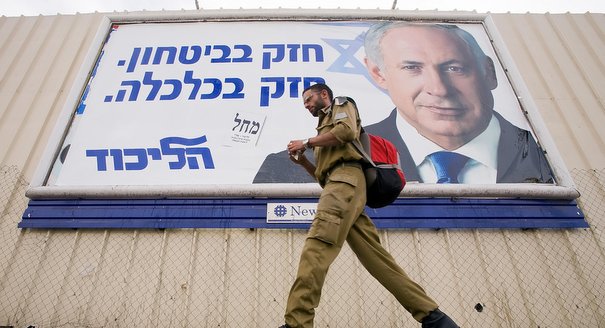
The announcement of new construction in East Jerusalem that interrupted U.S. Vice President Biden’s trip to Israel to reinvigorate peace negotiations reflects the strained relations between Israel and the United States and how much remains to be done before Israeli-Palestinian negotiations can lead to real progress.

Link Copied
By Michele Dunne and Nathan J. Brown
Published on Mar 11, 2010
Program mobile hero image

Program

Middle East

The Middle East Program in Washington combines in-depth regional knowledge with incisive comparative analysis to provide deeply informed recommendations. With expertise in the Gulf, North Africa, Iran, and Israel/Palestine, we examine crosscutting themes of political, economic, and social change in both English and Arabic.

Learn More

Source: The New York Times

Israel’s Challenge to the U.S.Vice President Joseph R. Biden Jr. was unpleasantly surprised in Israel on Tuesday when the country’s Interior Ministry declared that it would expand housing units for Jews in East Jerusalem. Mr. Biden, who earlier that day had expressed American support on Israel’s security needs, condemned the announcement, which had been made without the knowledge of Prime Minister Benjamin Netanyahu.

What did the incident reflect about the state of the Obama administration’s relations with Israel and the future of talks with the Palestinians?

A Dust-Up Obscures Far Deeper Problems

Nathan Brown

The Obama administration is soldiering on in the quest for Israeli-Palestinian peace by tweaking the approaches of its predecessors. It now seeks to further Palestinian institution building and economic development in the West Bank, isolate Hamas and Gaza, and get some kind of Israeli-Palestinian negotiations started that will move things in the direction of a two state solution.

Each of these ingredients may have made sense at a different time. The best time to have focused on Palestinian institution building, for instance, would have been in the late 1990s when there was a serious effort — with the support of the parliament — to build strong, professional and democratic institutions.
 
But since Hamas seized control of Gaza and Mahmoud Abbas seized control of the West Bank, the institutions being built have little connection with the societies they govern.
 
Some economic recovery will be possible — and has been taking place in the West Bank — but sustained economic development will not occur without a resolution of the underlying political problems. The policy of isolating Hamas and Gaza has not only had devastating humanitarian consequences; it has actually led to the Islamist movement’s entrenching itself even more deeply in control of the economy and political system of Gaza.
 
And the idea of negotiations at the present time — when the Palestinian leadership lacks the ability and the Israeli leadership lacks the willingness to build the basic elements of a two state solution — will lead to talks only for the sake of talks.
 
If a two state solution were to occur then a reversal of Israeli settlements would be a necessary condition. But it is nothing close to a sufficient condition. The current dust-up over building in Jerusalem obscures how much the other conditions are lacking.
 

Ill Will All Around

Michele Dunne

While there is absolutely nothing surprising about an Israeli decision to build 1,600 units in the East Jerusalem neighborhood of Ramat Shlomo, the ill-timed announcement during Biden’s visit exposes painfully the poor state of relations between the Obama administration and Israel. Although Prime Minister Netanyahu most likely was blindsided by the announcement, others in his coalition apparently thought it unproblematic to insult Biden and by association Obama.
 
And why should they? President Obama has shown Israelis neither consideration nor resolve. He failed to visit and use his much-vaunted powers of persuasion directly on Israelis last spring when he visited Egypt and Turkey; Obama also failed to show strength by imposing some consequence on Netanyahu when the Israeli leader refused to order a real freeze on settlements.
 
So now there is ill will and a lack of respect all around. The Palestinians probably hope this will redound to their benefit in the form of U.S. pressure on Israel, but it is more likely that Obama will see this episode as reason to disassociate himself from peace efforts even more than he has done in the past few months.
 
The Obama administration’s calls for a settlement freeze during 2009 differed from those of previous administrations because they were clear and unambiguous. The idea was to restore faith in the possibility of a negotiated solution to the Arab Israeli conflict by persuading Israel to make a gesture on this very important issue and Arab states to take steps toward normalizing relations.
 
The problem was that the Obama team was so overconfident that they failed to develop either a serious strategy to persuade the Israelis and Arabs or a Plan B in case of failure.
 
What this episode shows is not that it was wrong to focus on settlements, but that it was wrong to embark on a risky diplomatic venture without having the strategic thinking or fortitude to stick with it when the going got rough.
 
In this case, failed diplomacy did not leave the situation back where it was before Obama entered office, but did actual damage and set the diplomatic clock back nearly two decades, to an era when Israelis and Palestinians could not even sit at a table and talk directly.

Authors

Michele Dunne
Former Nonresident Scholar, Middle East Program
Michele Dunne
Nathan J. Brown
Nonresident Senior Fellow, Middle East Program
Nathan J. Brown
SecurityForeign PolicyNorth AmericaUnited StatesMiddle EastIsraelPalestineEgyptLevantGulfMaghreb

Carnegie does not take institutional positions on public policy issues; the views represented herein are those of the author(s) and do not necessarily reflect the views of Carnegie, its staff, or its trustees.
More Work from Carnegie Endowment for International Peace

  • Kushner and Putin shaking hands, with Witkoff standing next to them
    Commentary
    Emissary
    What If Trump Gets His Russia-Ukraine Deal?

    It’s dangerous to dismiss Washington’s shambolic diplomacy out of hand.

      Eric Ciaramella

  • Commentary
    Strategic Europe
    Taking the Pulse: Can the EU Attract Foreign Investment and Reduce Dependencies?

    EU member states clash over how to boost the union’s competitiveness: Some want to favor European industries in public procurement, while others worry this could deter foreign investment. So, can the EU simultaneously attract global capital and reduce dependencies?

      • Rym Momtaz

      Rym Momtaz, ed.

  • Article
    What Can the EU Do About Trump 2.0?

    Europe’s policy of subservience to the Trump administration has failed. For Washington to take the EU seriously, its leaders now need to combine engagement with robust pushback.

      Stefan Lehne

  • Commentary
    Strategic Europe
    To Survive, the EU Must Split

    Leaning into a multispeed Europe that includes the UK is the way Europeans don’t get relegated to suffering what they must, while the mighty United States and China do what they want.

      • Rym Momtaz

      Rym Momtaz

  • Trump stands in front of a blue screen reading "Board of Peace"
    Paper
    U.S. Peace Mediation in the Middle East: Lessons for the Gaza Peace Plan

    As Gaza peace negotiations take center stage, Washington should use the tools that have proven the most effective over the past decades of Middle East mediation.

      • Sarah Yerkes

      Amr Hamzawy, Sarah Yerkes, Kathryn Selfe

Get more news and analysis from
Carnegie Endowment for International Peace
Carnegie global logo, stacked
1779 Massachusetts Avenue NWWashington, DC, 20036-2103Phone: 202 483 7600Fax: 202 483 1840
  • Research
  • Emissary
  • About
  • Experts
  • Donate
  • Programs
  • Events
  • Blogs
  • Podcasts
  • Contact
  • Annual Reports
  • Careers
  • Privacy
  • For Media
  • Government Resources
Get more news and analysis from
Carnegie Endowment for International Peace
© 2026 Carnegie Endowment for International Peace. All rights reserved.