

Commentary
Michael Pettis
{
  "authors": [
    "Michael Pettis"
  ],
  "type": "legacyinthemedia",
  "centerAffiliationAll": "dc",
  "centers": [
    "Carnegie Endowment for International Peace",
    "Carnegie Europe"
  ],
  "collections": [],
  "englishNewsletterAll": "asia",
  "nonEnglishNewsletterAll": "",
  "primaryCenter": "Carnegie Endowment for International Peace",
  "programAffiliation": "AP",
  "programs": [
    "Asia"
  ],
  "projects": [],
  "regions": [
    "North America",
    "United States",
    "East Asia",
    "China",
    "Asia"
  ],
  "topics": [
    "Economy",
    "Trade"
  ]
}
Source: Getty
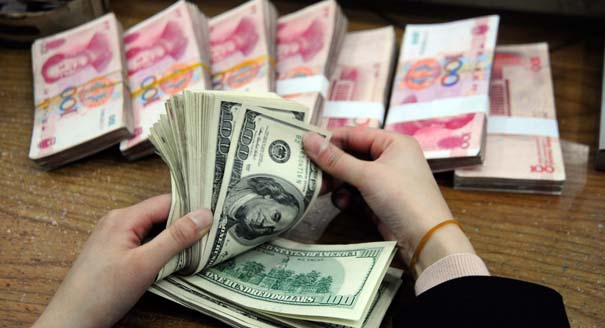
Investors concerned that China will dump its holdings of U.S. Treasury bonds should be worrying instead about an increase of foreign capital in U.S. markets, which will cause the U.S. trade deficit to surge.
Source: The Wall Street Journal

The People's Bank of China cannot simply sell Treasury bonds, pocket the cash and go home. If it wants to reduce its holdings, it must swap them for something else. There are broadly four options.
First, Beijing could sell U.S. Treasury bonds and buy other dollar-denominated assets. This would have little net impact on the U.S. market, except perhaps to cause a slight increase in Treasury yields and an equivalent, and welcome, contraction in U.S. risk premia. Those who sold assets to China's central bank receive money that becomes part of the larger pool that funds U.S. Treasury obligations.
Second, the People's Bank could sell U.S. Treasury bonds and buy assets denominated in euros or yen. Any major exchange would immediately cause the dollar to drop sharply, giving the U.S. economy an export-related boost as European or Japanese exports collapse and imports surge. But both countries would almost certainly retaliate strongly against Chinese trade. Recent reports that China has sharply increased its purchase of yen are already causing worry in Japan.
Third, China could sell its U.S. Treasury bonds and use the dollars to buy hard commodities. This simply reassigns the problem of recycling China's trade surplus to commodity exporters, with almost the same net results.
Finally China could sell U.S. Treasury bonds for cash and purchase assets in China. This option would be most damaging for China. The People's Bank currently sells huge amounts of yuan to Chinese exporters to suppress the value of its currency versus the dollar. Switching strategies and buying yuan would cause that exchange rate to soar, wiping out China's export industry and causing unemployment to surge.
Any sharp reduction in China's Treasury bond holdings is thus likely either to be irrelevant to the U.S. or to cause far more damage to China than to the U.S. If anything, China is likely to buy more dollar-denominated assets. And there are other global trends that will reinforce this buying spree.
The world's major capital-exporting countries are desperate to maintain or even increase their capital exports, which are simply the flip side of trade surpluses. China, for example, is unwilling to allow the yuan to rise against the dollar because it wants to protect and even increase its trade surplus. In Japan, any trade-surplus contraction will lead almost directly to reduced production and higher unemployment. So Japan, too, is eager to maintain capital exports. The same goes for Germany.
On the flip side, the world's capital importers face a dire situation. The second-largest importers of capital, behind the U.S., until now have been the highly-indebted trade-deficit countries of Europe. The Greek crisis caused a sharp drop in private capital inflows, as investors worried about insolvency. Only official lending has prevented defaults. These countries are unlikely soon to see a resurgence of net capital inflows. The world's second-largest net capital importer, in other words, is about to stop importing capital.
This leaves the U.S., which has the largest trade deficit in the world and is also the world's largest net importer of capital. As capital exporters try desperately to maintain or increase their capital exports, and deficit Europe sees capital imports collapse, the only way the world can achieve balance without a sharp contraction in the capital-exporting countries is if capital surges into the U.S.
The U.S., in other words, is not likely to face the "nuclear option" of a Chinese disruption of the U.S. Treasury bond market. It is far more likely to be swamped by a tsunami of foreign capital. This tsunami will bring with it a corresponding surge in the U.S. trade deficit and, with it, a rise in U.S. unemployment.
Therein lies the problem: A reduction in net foreign capital inflows means a welcome decline in the U.S. trade deficit, but the U.S. is likely to see just the opposite, as foreign capital pushes into U.S. markets and the U.S. trade deficit surges. The problem isn't too little capital inflow. On the contrary, the U.S. faces too much.

Nonresident Senior Fellow, Carnegie China
Michael Pettis is a nonresident senior fellow at the Carnegie Endowment for International Peace. An expert on China’s economy, Pettis is professor of finance at Peking University’s Guanghua School of Management, where he specializes in Chinese financial markets.
Recent Work
Michael Pettis
Michael Pettis
Carnegie does not take institutional positions on public policy issues; the views represented herein are those of the author(s) and do not necessarily reflect the views of Carnegie, its staff, or its trustees.
The debate over AI and work too often centers on displacement. Facing aging populations and shrinking workforces, East Asian policymakers view AI not as a threat, but as a cross-sectoral workforce strategy.

Darcie Draudt-Véjares, Sophie Zhuang

In its version of an AI middle power strategy, Seoul is pursuing alignment with the United States not as an endpoint but as a strategy to build industrial and geopolitical leverage. Whether this balance holds remains an open question.

Darcie Draudt-Véjares, Seungjoo Lee

China’s rapid technological progress and its first-rate infrastructure are often cited as refuting the claim that China has been systematically overinvesting in non-productive projects for many years. In fact, as the logic of overinvestment and the many historical precedents show, the former is all-too-often consistent with the latter.
Michael Pettis
For the Middle Corridor to fulfill its promises, one of these routes must become scalable. At present, neither is.

Friedrich Conradi
If Washington cannot adapt to the ongoing transformations of a multipolar world, its superiority will become a liability.

Amr Hamzawy