

Commentary
Alexey Malashenko
{
  "authors": [
    "Alexey Malashenko"
  ],
  "type": "legacyinthemedia",
  "centerAffiliationAll": "",
  "centers": [
    "Carnegie Endowment for International Peace",
    "Carnegie Russia Eurasia Center"
  ],
  "collections": [],
  "englishNewsletterAll": "",
  "nonEnglishNewsletterAll": "",
  "primaryCenter": "Carnegie Russia Eurasia Center",
  "programAffiliation": "",
  "programs": [],
  "projects": [
    "Eurasia in Transition"
  ],
  "regions": [
    "South Asia",
    "Afghanistan",
    "Pakistan"
  ],
  "topics": [
    "Political Reform",
    "Security",
    "Military"
  ]
}
Source: Getty
Radical Islamist groups have become significant political powers in many parts of the world and the West has yet to establish a strategy for building relations with them.
Source: Nezavisimaya Gazeta

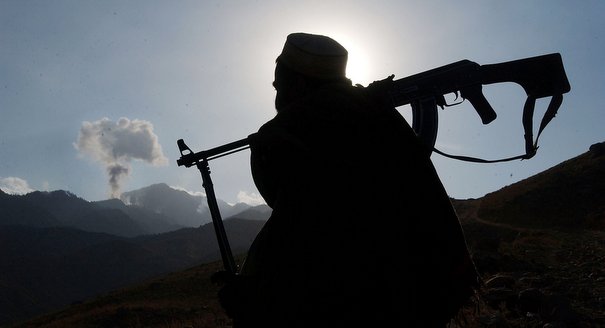
The Afghan people responded to the Soviet invasion by launching a holy war against the Russians, which gave the mujahedeen invaluable experience in combat and, especially important, in ideology. The divided nation needed to be consolidated and, in 1996, the Taliban did just that, “delivering” Afghanistan into the hands of terrorist groups in the process. After their ouster by U.S. forces in 2001, the Taliban transformed into a resistance movement dedicated to freeing the country from the presence of foreign troops and turning it into an Islamic state.
Afghanistan fit neatly into the global Islamist model based on a religious alternative that began to emerge globally but unevenly at the end of the nineteenth century. It appeared to be amorphous, yet was omnipresent; although it was utopian, yet its appeal continued to grow. Efforts to implement this model came to a head just as the twenty-first century dawned. Although the model can assume a variety of forms based on particular national or social characteristics, its supporters share a common purpose in building a society regulated by Islamic standards and the ultimate goal of establishing an Islamic state.
The Taliban model took adherence to Islam to extremes: Sharia law was absolute, Buddhist statues seen as heathen symbols were destroyed, and ownership of television sets was prohibited, for example. In spite of this extreme nature, the Taliban regime continued to enjoy considerable popular support, which doubled following the U.S. invasion. One superpower met with defeat in Afghanistan; the other has proven incapable of achieving victory there.
The Taliban are not a homogenous group; they follow at least two variants of Islamism and pursue two main Islamist goals: first, to make Afghanistan into an Islamic state and second, to implement Islamic ideals around the world (the same vision espoused by al-Qaeda, which had used Afghanistan as its base). In traditional Soviet terms, the Taliban might be said to be comprised of both “Statist” advocates and fighters for “the lofty goals of Islamic Communism.”
While the ideological gap between the “Statist” and the “Globalist” mujahedeen can be bridged, they do not agree on everything. The “Statists” see the pursuit of global ideals as a distraction or even an impediment to their attempts to achieve tangible results. But at the same time, these pragmatic Taliban realize they will never achieve their goals without the general support of the rest of the Islamic world. Therefore, the notion of causing a rift between the Taliban and al-Qaeda remains an idea mostly in theory, since the pragmatic nationalists would still need the broader Islamist cause and al-Qaeda still needs to achieve tangible results at the national level. In the meantime, the idea of making Islam the cornerstone of statehood for Afghanistan is supported by Saudi Arabia as well.
If the current regime and the NATO coalition succeed in reaching an understanding with their adversaries, what kind of Afghanistan is likely to emerge? Since the Taliban would not have total control over Afghan society, co-existence and even friendship with the Taliban—whether they are moderates or ideologues—would be inevitable. Neither of these groups, however, would abandon the firmly Islamist core of their ideology, a very ambiguous element indeed. The concept of jihad, for example, could imply either jihad “for” (in other words, a “constructive” jihad) or jihad “against.” In fact, no fundamental contradictions between the two forms of jihad exist; both are carried out in the name of Islam.
Thus, the Taliban will retain its Islamist (and most likely radical) nature, which means that the regime in Afghanistan would be (semi-)Islamist while being accepted internationally. This elicits the question, just whose victory is it?
The ongoing efforts to find a way out of the Afghan conflict shows the new situation that is emerging or has already emerged. To defeat the kind of radicalism that has long been considered a distortion or even a “perversion” of Islam will not be possible for decades and, in this sense Palestine, Iran, Pakistan, Sudan, Yemen, the North Caucasus, Somalia, and other countries will not change.
Although all Islamist radicals in these countries do not necessarily share organizational ties, their ideology is similar. Radical Islam has long since synthesized religion and ideology. The Islamists have established a firm niche for themselves in Muslim society; although this niche might shrink at times, it will not disappear completely.
Today, the Islamists are expanding their presence politically. No one can predict for certain how events will develop in Turkey, which not very long ago was thought to be fully secularized, or in Pakistan, where some observers feel that terrorism “is very close to victory.” Then there is Africa, with its huge potential for Islamists. The list goes on.
The war against the Islamists has been lost, or at least has not been won, and it is very clear it will not be possible to prevail over them. Although neither the United States, Russia, nor Europe has publicly admitted defeat, it now appears as though many politicians in Europe and the United States have prepared themselves psychologically for the reality of a “nuclear Iran,” anticipating that Mahmoud Ahmadinejad and his followers will become less dangerous once their vanity has been satisfied (after all, the main thing they want is simply to have the bomb). Al-Qaeda can also take pride in the fact that, despite its considerable losses, it has managed to rise again and again, like a phoenix.
Islamism—or the goal to rebuild society and the state based on an Islamic model—has many different faces. Depending on the means it chooses to pursue its strategic goals, it can be classified as moderate, radical, or extremist in nature. The focus of the present discussion has been on the radical and extremist Islamists, who in some cases have won tangible political victories and in others have proven their ability to continue the fight, which is also an accomplishment.
In 1982, Daniel Pipes wrote, “Muslims can either struggle to implement the fundamentalist vision, or they can adapt to Westernization.”1 Many observers believe that Muslims will eventually adapt, but how long this process takes is unknown. It could take forever, which would mean the state of confrontation inherent in this process would go on endlessly. Perhaps the radicals will lose in the end, but the question is, when? In a hundred years or more? And what will happen in the meantime?
The opponents of Islamism in Europe, America, and Russia have not yet arrived at a reasonable definition of the term that would help them to structure clear relations with the Islamists; in some cases they have simply not tried to find such a definition. This explains the shift from promising to “crush” the Taliban—who were said to represent a small fraction of the Afghan population—to calling for the establishment of a coalition government that would include their participation. It also explains the senseless talks with Hamas, and Russia’s various positions, with one group of politicians calling Islamist radicals in the Caucasus “bandits,” while another group with a clearer picture of the situation tries to engage them and reduce tension.
No common strategy has been established for working with radical Islam, and none is in the offing. Actions extend no further than occasional joint efforts between the intelligence services of the various countries. No political decisions on the matter have been made. This explains why the lists of terrorist organizations in Russia and the United States differ (the U.S. State Department only placed Doku Umarov, head of the Caucasus Emirate, on its terrorist list in June, 2010), as well as why people in Europe do not always understand just what Islamic radicalism in the North Caucasus represents.
The situation evokes thoughts of Samuel Huntington’s “Clash of Civilizations.” Although no such confrontation has occurred, numerous conflicts in which Islamic radicals play a part persist. These interconnected conflicts are reminiscent of a bouquet of different flowers all picked from the same field (civilization).
Hamas, the Taliban, the Iranian regime, and the numerous international Islamist organizations all represent elements of the new world order that everyone but the laziest have sought; this new world order is what will give the Islamists legitimacy. They cannot be expected to relinquish the political stage.
The inevitable future dealings with the Islamists will be difficult, and will require ongoing contact and a specific approach to the negotiating process, which in turn will require us to abandon the familiar stereotype of them as enemies.
At the same time, however, a willingness to talk with the other side does not preclude the possibility that force might still be used, since Islamic radicals are inclined to carry out provocative acts, and contact with them often takes place under conditions of political or psychological stress. The problem is that when the hour to use force arrives, no one can say with certainty how the situation will end. This is why the experience in Afghanistan (both negative and positive) will have been doubly valuable.
In building (and even normalizing) relations with the Islamists, it will be important to use every possible avenue to avoid “radicalizing the radicals.” In this respect, too, we have much to learn from future events in Afghanistan. Will the elements within the Taliban that today are considered pragmatists become more moderate, or will victory only make them more intransigent?
Another difficulty is that Islamists perceive themselves as victors no matter whether their relations with opponents change. Since they are doing the will of the Almighty, neither Ahmadinejad, Hamas, the Caucasus Emirate, nor the Taliban will admit to defeat. Thus, the West and Russia will have victors to deal with no matter how the situation ends.
1. Daniel Pipes, In the Path of God. Islam and Political Power (New York: 1983), 334.
Former Scholar in Residence, Religion, Society, and Security Program
Malashenko is a former chair of the Carnegie Moscow Center’s Religion, Society, and Security Program.
Recent Work
Alexey Malashenko
Alexey Malashenko
Carnegie does not take institutional positions on public policy issues; the views represented herein are those of the author(s) and do not necessarily reflect the views of Carnegie, its staff, or its trustees.
They face an uphill climb, but they could draw on a strategy that other diplomats have used in the past.


Shana Tabak, Alejandro Martin Rodriguez
Understanding the climatic pain points is necessary for policymakers hoping to minimize the war’s negative environmental consequences.

Alejandro Martin Rodriguez, Joy Arkeh, Sarah Yerkes

The books, podcasts, and films that explain the world it made.

Andrew Leber

In the tenth year of his presidency, President Mirziyoyev’s system is becoming even more personalized than that of his predecessor Karimov.

Galiya Ibragimova

With the growth in points of friction between the great powers, organizations like the SCO will continue to play a role in the strategic adaptation of the smaller powers caught between them.

Temur Umarov