Egyptian Opposition Wrestles Over Participation in Elections
While Egypt’s opposition groups remain divided on whether or not to boycott the upcoming parliamentary elections, there are indications that they, as well as many Egyptian citizens, are beginning to favor international monitoring to safeguard against electoral fraud.
Egyptian Opposition Wrestles Over Participation inTo participate or to boycott? In contrast to Egyptian opposition groups' unified position on the need to participate in parliamentary elections in 2005, they now stand divided on the merits of taking part in elections to be held on November 29.
To allow international monitoring or not? The government and the ruling National Democratic Party (NDP) are so far rebuffing such calls, which are gaining currency among the population and opposition groups.
Both questions highlight the tensions and limited opportunities inherent in the model of constrained political reform that has governed Egypt in recent years.
The NDP is guaranteed to win its usual two-thirds majority in the People's Assembly through its control over the state apparatus and its implementation of recent electoral reforms. But opposition movements such as the Ghad Party, the National Democratic Front Party, and the National Association for Change have decided to boycott the elections in protest against the NDP's refusal to meet opposition demands for measures guaranteeing the fairness and transparency of the elections.
These demands spring from the opposition's expectation, informed by their experiences in the 2008 local and June 2010 Shura council elections, that the regime is intent on limiting the competitiveness of the 2010 parliamentary elections to an even greater degree than it did in 2005.
Boycott calls are also coming from Egypt's independent press and youth activists, who argue that participation in elections whose results are predetermined would lend a false sense of democratic legitimacy to the ruling regime.
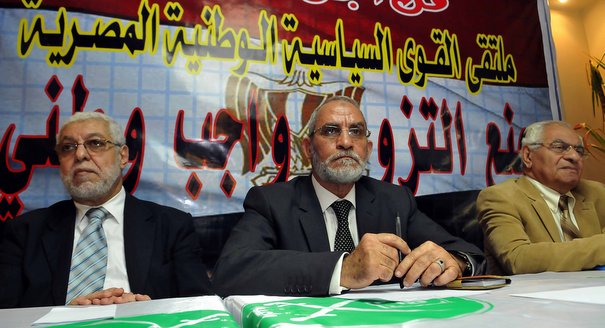
On the other side, the Wafd Party and the Muslim Brotherhood, the most organised and capable opposition groups in Egypt, have decided to participate, as have the Tagammu' Party and other smaller parties. Despite their prior agreement with those calling for a boycott, the Wafd and Brotherhood leaderships have justified their decision to participate on four grounds.
First, boycotting would exclude opposition parties and movements from the core of political life, namely electoral competition and parliamentary participation. Second, it would weaken the opposition's popular presence and organisational capacity by depriving it of the opportunity for direct interaction with voters and the rejuvenation of party cadres involved in electoral campaigns. Third, boycotting runs the risk of allowing the NDP full rein over the elections. And finally, by participating, the opposition can document electoral transgressions and demonstrate to the domestic and international audience the regime's failure to ensure the transparency of the elections, thereby dispelling myths of democratic legitimacy.
The parliamentary elections of 2010 are swirling also with the debate on international elections monitoring. Despite requests by the Obama administration and several non-governmental organisations to allow international monitors to ensure legitimate elections, NDP leaders have refused so far. They claim the presence of international observers would violate national sovereignty and enable foreigners to interfere in Egypt's internal affairs.
While the Egyptian opposition used to voice similar concerns, it is now shifting its stance regarding the question of international monitoring for the 2010 parliamentary elections in a way that shows that the idea is gaining steam. The Muslim Brotherhood has reversed the position it took on the eve of the 2005 parliamentary elections, with several of its leaders openly calling for international observers since last year.
Joining the Brotherhood in welcoming international monitoring are the Ghad Party, the Democratic Front Party, some non-partisan opposition movements such as the National Association for Change, and all of the non-governmental organisations engaged in the domestic monitoring process, such as the Egyptian Alliance for Monitoring the People's Assembly Elections (an umbrella organisation of some 120 NGOs).
In October 2009, the leaders of Ghad and the Democratic Front, as well as the head of the Brotherhood parliamentary bloc, Saad al Katatni, and members of the Egyptians Against Fraud movement, all signed a document calling for international election observers. In it, they requested that organisations such as international rights groups, the EU, the African Union, and the Arab League pressure the Egyptian government to this end. The National Association for Change, meanwhile, demands in the third article of its "Together, We Will Change" petition that local and international civil society organisations monitor the elections.
Even opposition groups that have announced their opposition to international monitoring are finding that position difficult to maintain in the face of the aforementioned reasons combined with public sentiment. There have been splits in the leadership of some parties, while others like the Wafd Party remained united in opposition to monitoring but are having to work hard to convince the Egyptian public of the wisdom of its stance.
These public statements and shifting stances indicate that opposition groups, as well as segments of the Egyptian public, are beginning to favour international monitoring as a necessary safeguard against electoral fraud that, in reality, does not represent interference in Egyptian affairs.
Ultimately, growing domestic support for the idea of international monitoring greatly reduces the credibility of claims by regime supporters that observers would be unwelcome in Egypt.
Michele Dunne was a nonresident scholar in Carnegie’s Middle East Program, where her research focuses on political and economic change in Arab countries, particularly Egypt, as well as U.S. policy in the Middle East.
Amr Hamzawy is a senior fellow and the director of the Carnegie Middle East Program. His research and writings focus on Egypt’s and other middle powers’ involvement in regional security in the Middle East, particularly through collective diplomacy and multilateral conflict resolution
Carnegie does not take institutional positions on public policy issues; the views represented herein are those of the author(s) and do not necessarily reflect the views of Carnegie, its staff, or its trustees.
More Work from Carnegie Endowment for International Peace
Ex-president Gurbanguly Berdimuhamedov remains interested in politics, but his son Serdar, Turkmenistan’s current president, is becoming increasingly independent and willing to break with his father’s legacy. If their covert rivalry goes too far, both risk losing power.
A notable degree of participative democracy has firmly arrived in Europe. But to have more far-reaching impact, democratic deliberation needs to move into a radically new phase.
Today’s global democratic recession is partly rooted in a common perception that democracies have a delivery problem, with many citizens in both autocracies and democracies alike now believing that strongmen can achieve better governance outcomes. But a study of four countries in Africa reveals that democratic-leaning governments have demonstrated better governance performance than autocratic governments.
The domestic impacts of how long it is taking to end the war in Ukraine have pushed the French electorate to the political extremes and compromised the country’s diplomatic capacity.