

Commentary
Nikolay Petrov
{
  "authors": [
    "Nikolay Petrov"
  ],
  "type": "legacyinthemedia",
  "centerAffiliationAll": "",
  "centers": [
    "Carnegie Endowment for International Peace",
    "Carnegie Russia Eurasia Center"
  ],
  "collections": [],
  "englishNewsletterAll": "",
  "nonEnglishNewsletterAll": "",
  "primaryCenter": "Carnegie Russia Eurasia Center",
  "programAffiliation": "",
  "programs": [],
  "projects": [],
  "regions": [],
  "topics": []
}
Source: Getty
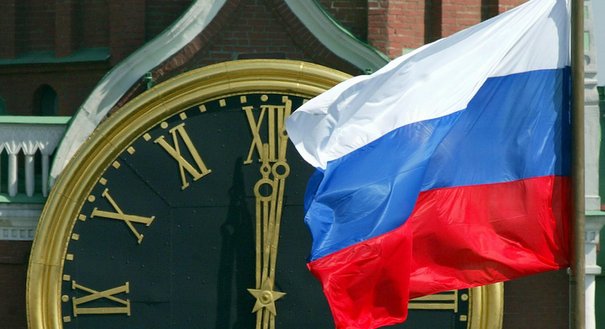
By seeking to reduce the number of time zones in Russia, the Kremlin is implementing a superficial and problematic change instead of tackling the serious reforms that the country needs.
Source: The Moscow Times

According to its territory, China should have five time zones, but Beijing introduced one single time zone for the entire country. For Moscow to copy China’s economic success would be all but impossible, but to superficially mimic China’s success by unifying Russia’s time zones is far simpler. This is one of the Kremlin’s guiding principles — to implement the simplest and most superficial changes instead of the changes that are most needed but most difficult to achieve.
Of course, the idea is not to merge neighboring times zones into a single zone, but to decrease the 10-hour spread between Kaliningrad, currently one hour behind Moscow, and Kamchatka, nine hours ahead of the capital. In that scenario, Moscow time would be just one of those zones. But if the authorities are so concerned that a large percentage of the population is out of sync with the Kremlin, then not only should the Far East recalibrate its time toward Moscow, but Moscow should move closer to eastern time as well. But that would never happen because of the Moscow-centric thinking that dominates all Kremlin policies. It would never occur to Kremlin leaders that they should make adjustments for others.
A good example of this was Prime Minister Vladimir Putin’s visit to Kamchatka in August. It was announced that he would hold a meeting with fishing industry officials, and everyone assembled at 4 p.m. When Putin arrived in the city, he immediately went fishing while the local officials patiently waited. The meeting finally convened after 2 a.m., which was not late at all for Putin, considering that it was really only 6 p.m. Moscow time.
Living according to a rhythm decreed by Moscow, and not by the biological clock, is not the harmless experiment that the Kremlin apparently believes it is. It is a serious change to people’s lives. After all, Russia is a northern country, and the winter days are already short. People will be counting how many hours of daylight the authorities have stolen from them. Electricity consumption will increase, nursery schools will not take their children out for afternoon walks, more traffic accidents will occur, and the elderly will find it difficult to ignore their biological clocks.
A protest rally of 3,000 people was held under pouring rain in Kamchatka last weekend. Demonstrators also gathered in Samara and other regions. It can only be hoped that in this way it will be possible to stop the Kremlin’s administrative cretinism.
Former Scholar-in-Residence, Society and Regions Program, Moscow Center
Nikolay Petrov was the chair of the Carnegie Moscow Center’s Society and Regions Program. Until 2006, he also worked at the Institute of Geography at the Russian Academy of Sciences, where he started to work in 1982.
Recent Work
Nikolay Petrov
Nikolay Petrov
Carnegie does not take institutional positions on public policy issues; the views represented herein are those of the author(s) and do not necessarily reflect the views of Carnegie, its staff, or its trustees.