As Egypt begins the complicated task of building sustainable political, economic, and social institutions, its new leaders can learn from Turkey’s experience by establishing a national security council and implementing a proportional electoral system.
The Relevance of Turkey’s Experience to EgyptMuch has been made of the “Turkish model” as an example for Egypt, but no national experience can serve as a model for another country, nor is the Turkish experience without serious problems. Also, Ankara has been disappointingly slow to embrace democratic revolutions in the Arab world, or to condemn regime repression in Tehran. Nevertheless, there are three important elements in the Turkish experience that are very relevant to Egypt today.
First, Egypt needs a way to manage civil-military relations during and after the transition. This can best be achieved through establishing a National Security Council with some parallels to the Turkish model. The Turkish security council was established in the early 1960s and includes the military chiefs of staff as well as the civilian president, prime minister and key ministers, such as defense, interior and foreign affairs. The council sets policy on defence and strategic affairs, and builds consensus between military and civilian authorities, ensuring the military a stake in the democratic state and helps ensure that the democratic transition does not lead to chaos or insecurity.
Such a council, adjusted to suit Egypt, would reassure the army that it will have a role and say in the new democratic order. This, in turn, will gain the military’s support in ensuring a stable and safe transition to democracy, without the situation deteriorating into chaos and without any one group hijacking the democratic transition.
Second, Egypt needs to move quickly to build the institutions that will enable democracy to function properly. Removing a dictator is easy compared to the challenge of building the complex institutions and habits of democracy. The effects of sixty years of authoritarian rule cannot be overcome overnight; Turkey’s democratic transition has taken decades, interrupted by coups and setbacks. But Egypt can learn from Turkey, Indonesia, and many countries in Asia, southern Europe, and Latin America, to effect a quicker and steadier transition to democracy.
Egypt needs new parliamentary, local and presidential election laws. Proportional representation would be most appropriate at the parliamentary and local levels to ensure a wide representation of Egypt’s new political spectrum. At the presidential level, new laws need to ensure a truly open process while at the same time building in steps that enable new parties and candidates to build a political base through party or regional primaries. Egypt would do well to set up a National Committee for Electoral Reform, made up of Egyptian political and legal experts, in order to review these various options and recommend the most appropriate.
Elections are meaningless without effective political parties that can channel public demands, present political alternatives and field candidates for office. After so many decades of dictatorship, building up these political parties will require a policy of support from the transitional government and ample assistance from the international community.
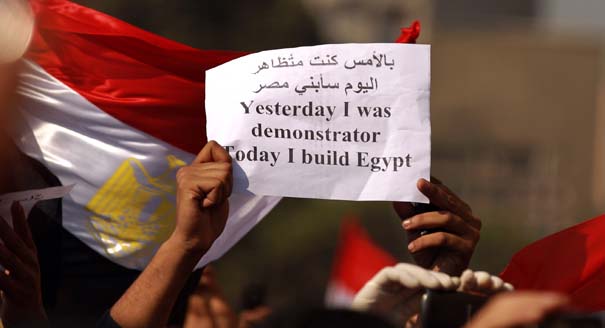
The youth of Tahrir Square have indicated the rise of a new trend in the Arab world: one that stands for the citizen, democracy, freedom, pluralism and social justice. They need a chance to organize into a credible political party. The traditional opposition parties also need a chance to assess and understand the new realities, renew their agendas, and prepare for elections.
As for the most organized movement in Egypt, the Muslim Brotherhood, they have much to learn from the rich electoral experience of the Islamist movement in Turkey. Turkish Islamists realized years ago that only a minority of voters are driven by purely religious concerns, and that a narrow religious agenda will gain as many opponents as supporters; accordingly, the AKP has gone well beyond religion as a political platform. Religious voters continue to form the core of its base, but otherwise it describes its social-cultural agenda as conservative rather than religious and has developed a set of policy positions on key political and economic issues that are of concern to all Turks. Like other parties in the west today, the AKP attracts votes from ideological purists, but the votes that allow it to win elections are drawn from a wide spectrum of voters interested in its governance policies not its cultural agenda.
Finally, Egypt, like Turkey before it, needs to revise its economic policies and embark on a more serious policy of export-led industrialization. Aside from political concerns, the protests in Egypt were driven by the desperation of a youth that could not find jobs and the realities of grinding and enduring poverty. The policies of economic liberalization that Egypt has pursued since the 1970s have brought only limited levels of growth – 4-5 per cent – and they have not been matched by rising levels of employment. This is because the growth has been in particular sectors – real estate, banking, tourism, services – that provide limited or low-paying jobs. As late developers from Turkey to China have learned, the only way for populous countries to move decisively out of underdevelopment is to focus on export-led industrialization that includes manufacturing and agro-industries. Egypt has the labour force and strategic location to do so and learn from the stunning success of Turkey in the past two decades.
The Egyptian people have indicated their will for change. Now begins the complex task of translating that will into sustainable political, economic and social institutions. In that process Egypt can learn a lot from Turkey’s recent experience – imperfect as it is – as well as that of other countries around the world that have been moved by the revolution of the Egyptian people and are ready to provide experience and assistance.
Carnegie does not take institutional positions on public policy issues; the views represented herein are those of the author(s) and do not necessarily reflect the views of Carnegie, its staff, or its trustees.
More Work from Carnegie Endowment for International Peace
China’s political future will be shaped between now and next October. As the Communist Party enters its intense “campaign season” to prepare for a major political transition in 2027, reading Beijing's actions and responses may become more difficult as domestic politics weigh on its behavior more than usual.
Putin’s conservative staffing policies and search for ever greater control have cemented parliament’s transformation into a bureaucratic appendage of the executive branch.
Ex-president Gurbanguly Berdimuhamedov remains interested in politics, but his son Serdar, Turkmenistan’s current president, is becoming increasingly independent and willing to break with his father’s legacy. If their covert rivalry goes too far, both risk losing power.
A notable degree of participative democracy has firmly arrived in Europe. But to have more far-reaching impact, democratic deliberation needs to move into a radically new phase.
Sergei Kiriyenko used Russia’s parliamentary vote to further hone his strategy of corporate mobilization that is designed to maximize votes for United Russia.