

Commentary
Dmitri Trenin
{
  "authors": [
    "Dmitri Trenin"
  ],
  "type": "legacyinthemedia",
  "centerAffiliationAll": "",
  "centers": [
    "Carnegie Endowment for International Peace",
    "Carnegie China",
    "Carnegie Russia Eurasia Center"
  ],
  "collections": [
    "China’s Foreign Relations"
  ],
  "englishNewsletterAll": "",
  "nonEnglishNewsletterAll": "",
  "primaryCenter": "Carnegie Russia Eurasia Center",
  "programAffiliation": "",
  "programs": [],
  "projects": [
    "Eurasia in Transition"
  ],
  "regions": [],
  "topics": [
    "Security"
  ]
}
Source: Getty
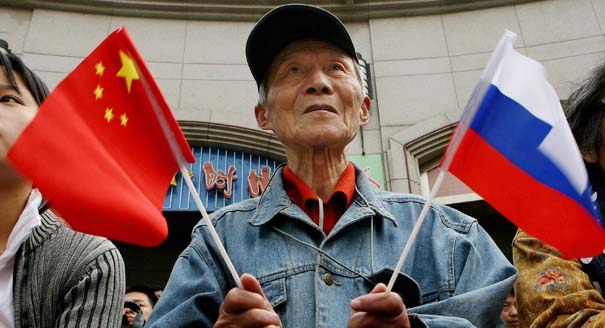
With the bureaucratic infrastructure for solid bilateral relations between China and Russia already in place, the next step is increased dialogue between the countries’ intellectuals, who can examine the relationship from a broader perspective.
Source: China Daily

When President Hu Jintao visits Russia on Wednesday, he and Russian President Dmitry Medvedev will duly celebrate the 10th anniversary of the Treaty of Good-Neighborliness and Friendly Cooperation between the two countries. But the main expectation this time will be the finalization of the 30-year agreement, under which Russia will supply China with 68 billion cubic meters of gas annually over the next 30 years from 2015.
When finalized, the agreement will strengthen China's energy security and diversify Russia's gas exports. Until now, the principal issue between the two countries has been the price of Russian gas for China. Gazprom wanted it to be as close to the lucrative European formula, whereas its Chinese partners based their calculation on the price of coal in China which Russian natural gas will replace.
No compromise is ever popular with all the sides involved. Critics in China will worry about inflation, and those in Russia will argue that the pipeline would put China as the only buyer in a more advantageous position.
Yet at the end of the day China will secure an important resource for a very long term. As for Russia, it will gain a foothold in a growing market and strengthen its bargaining position vis--vis Europe. The real issue for Gazprom is to produce enough gas for all its customers, East, West and at home.
Russia's energy projects are a means to spur regional development in Siberia and along the Russian Pacific coast. For Moscow, this is the principal geopolitical challenge of the 21st century. Partnering with China is vital in this, even if it is not exclusive. In an effort to develop their sparsely populated, but resource rich territories Russians are now reaching out to Japan and South Korea as well as across the North Pacific - to the United States and Canada.
China recently became Russia's biggest trading partner and is likely to hold that distinction this year. Yet economic relations are only part of the story. Moscow and Beijing cooperate at the global level, from the UN Security Council to the BRICS grouping, where they share similar notions about state sovereignty and territorial integrity and have a joint interest in winning more influence for major non-Western countries, such as themselves.
At the regional level, Sino-Russian cooperation is particularly salient in Central Asia. They are de facto co-leaders of the Shanghai Cooperation Organization, (SCO) which, like the Sino-Russian treaty, also marks its 10th anniversary this year. In a decade, the SCO has proven itself useful in a number of ways: allowing China to pursue its interests in the former Soviet republics without inviting a backlash from Russia, giving Russia a window and some leverage on China's behavior there, providing Central Asian countries with room to maneuver between Beijing and Moscow, and serving as a platform for top-level multilateral diplomacy in continental Asia.
Sino-Russian summits have become almost routine. Medvedev last visited China in September. There are annual meetings at the prime ministerial level. All the important ministers in the two governments and other senior officials have their own regularly scheduled meetings. The bureaucratic infrastructure is thus in place.
At the other end of the spectrum, there are millions of ordinary Chinese and Russian people on both sides of the border who visit each other's country every year. Chinese studies are becoming a hit in Russia. The civilizational divide between the two countries has stopped being a barrier.
This is not to say that there are no suspicions or tensions. But they have been few and far between. It has to be mentioned that the Chinese leadership handled Russia's post-Soviet transformation wisely, refraining from celebrating Russia's decline. The Russian leadership, on its part, managed China's steep rise without losing its head. This is a sound foundation for developing bilateral relationship even further.
To move forward, there needs to be more dialogue among both countries' intellectuals. As opinion leaders, these people have a task of projecting the relationship on a broader perspective, beyond the pragmatic gas deals and the officials' festive rhetoric.
Russians want to hear about China's long- and medium-term national strategies, the Chinese leaders' and public's view of the world and of Russia's place within that world. They want to satisfy themselves that China is committed, now and in the future, to good-neighborly relations with Russia.
In return, Russians need to tell their Chinese interlocutors that their biggest, all-consuming task is domestic modernization. They need to intimate that Russia will continue as an independent strategic actor, confident enough to be fully responsible for the sovereign decisions it takes. They need to communicate that in the 21st century Russia will be paying more attention to Asia and will see itself as a Euro-Pacific country.
What these mean is that Russia and China will interact much more - and hopefully more happily - in the future than they did in the past.
Former Director, Carnegie Moscow Center
Trenin was director of the Carnegie Moscow Center from 2008 to early 2022.
Recent Work
Dmitri Trenin
Dmitri Trenin
Carnegie does not take institutional positions on public policy issues; the views represented herein are those of the author(s) and do not necessarily reflect the views of Carnegie, its staff, or its trustees.

Are Germany’s economic, industrial, and political struggles becoming a liability for the EU’s ability to rise to the geopolitical moment?

Rym Momtaz, ed.

China’s police training infrastructure construction projects provide benefits to recipient countries, promote China’s image as a major global security provider, and are likely to reinforce alignment between Beijing’s security priorities and those of countries in the Global South.


Cameron Waltz, Sheena Chestnut Greitens, Kim Nguyen, …
They face an uphill climb, but they could draw on a strategy that other diplomats have used in the past.


Shana Tabak, Alejandro Martin Rodriguez
Understanding the climatic pain points is necessary for policymakers hoping to minimize the war’s negative environmental consequences.


Alejandro Martin Rodriguez, Joy Arkeh, Sarah Yerkes

The books, podcasts, and films that explain the world it made.

Andrew Leber