

Commentary
The real test may come after the leaders leave the room.
- +1
Sheena Chestnut Greitens, Oriana Skylar Mastro, Yukon Huang, …
{
  "authors": [
    "Yan Xuetong"
  ],
  "type": "legacyinthemedia",
  "centerAffiliationAll": "",
  "centers": [
    "Carnegie Endowment for International Peace",
    "Carnegie Europe",
    "Carnegie China"
  ],
  "collections": [
    "China and the Developing World",
    "U.S.-China Relations",
    "China’s Foreign Relations"
  ],
  "englishNewsletterAll": "",
  "nonEnglishNewsletterAll": "",
  "primaryCenter": "Carnegie China",
  "programAffiliation": "",
  "programs": [],
  "projects": [],
  "regions": [
    "Middle East",
    "Asia"
  ],
  "topics": [
    "Security"
  ]
}
Source: Getty
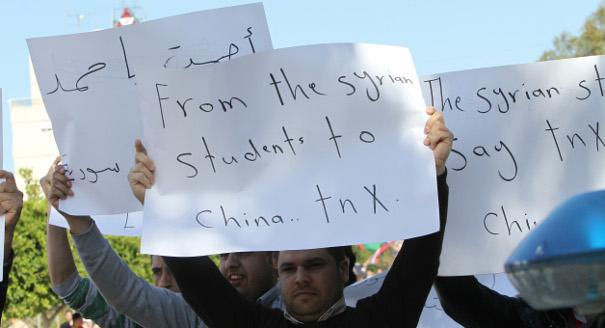
China's vetoes over UN draft resolutions on Syria represent of Beijing's interpretation of the international system, of humanitarian intervention, and of its own interests in the region.
Source: Sohu

Many people think that Beijing’s decision is bad for China. China’s international image will be tarnished, they say, and Beijing will offend both Arab and Western countries. China’s diplomacy has been gradually maturing and developing, but why did Chinese foreign policy makers, who were well aware of the disadvantages, still decide to veto the resolutions?
China has nothing to gain from supporting the resolution drafted by the UN Security Council. If China and Russia supported the resolution, rebel groups would come to power quickly in Syria. However, though those rebel groups would appreciate Western countries for their substantive military assistance, they would not think China and Russia provided valuable political support. The Arab League would also believe that the Chinese and Russian stance was only driven by trends in the international community. The league would not thank China for its support either.In Libya, China supported the idea of economic sanctions proposed by the Arab League and did not veto the resolution that set up a no-fly zone. But the Arab League and Arab countries did not express any appreciation of China’s position; instead they thanked Western countries.
Furthermore, although Beijing did not oppose Western-led action in Libya, China was not praised in the Western media. It was rather labeled an irresponsible country, since it abstained during the vote on the resolution and did not participate in the “real” action of fighting the Qaddafi regime.
The veto is also not going to have any substantive effect on China’s international image. The Chinese Communist Party is the sole party in power in China, so regardless of Beijing’s stance on Syria, the international community, dominated by Western countries, would continue to think China is an undemocratic country that does not respect human rights. Beijing’s veto simply means that the Western world is disappointed in China once again.
And even if Beijing had voted for the resolution, the Arab world would not support China , despite China’s support for some Arab issues. For example, when it comes to the Israeli-Palestinian conflict, China has provided long-term support for Arab countries. America, meanwhile, has stood behind Israel. However, when there is a conflict between China and the United States, Arab countries do not initially take China’s side. They still support the United States in its war against Iraq, for example, despite U.S. support of Israel.
China will actually benefit from its veto in a number of ways: First, China’s veto strengthened its strategic cooperative partnership with Russia. For China, the importance of Russia’s strategic support was greater than that of the collective support from 33 Arab countries. And strategic cooperation with Moscow helps China’s position in East Asia. Aligning with Arab world would not produce such a result.
Second, if the crisis in Syria continues, the risk of a war triggered by Iran’s nuclear program will be postponed. That would mean that China could continue to receive oil from Iran and thus not face oil shortages in the future. And as long as the Syrian crisis is not resolved, it will be difficult for America to determinedly support an Israeli military strike against Iran.
Third, Western and Arab countries alike will realize that China’s support is important and essential in Middle Eastern affairs. Beijing’s veto shows the world that China is an important world power whose voice should not be neglected.
Finally, Western countries often think that China’s foreign policy only serves China’s own interests. Beijing’s veto could change the international opinion that China is an irresponsible country because China has no substantial interests in Syria. On the contrary it helps China to create an international image of nation with principle.
If Western countries experience further complications in addressing the Syrian crisis, this will limit their ability to contain China.
In short, China would not have benefited from voting for the UN resolution on Syria and the harm caused by Beijing’s veto is not serious China has actually benefited in a number of ways.
Yan Xuetong
Former President, Carnegie China Management Board, Carnegie-Tsinghua Center for Global Policy
Yan Xuetong was president of the Carnegie-Tsinghua Center Management Board until June 2020.
Carnegie does not take institutional positions on public policy issues; the views represented herein are those of the author(s) and do not necessarily reflect the views of Carnegie, its staff, or its trustees.

The real test may come after the leaders leave the room.



Sheena Chestnut Greitens, Oriana Skylar Mastro, Yukon Huang, …

The Horn of Africa countries are among those facing a new security calculus.


Andrew Leber, Lesley Anne Warner

The European far right might fail to steer EU policy in the direction Russia wants, but they will create enough chaos inside Europe to benefit the Kremlin.

Dimitar Bechev

The new U.S.–Denmark–Greenland agreement will help Washington exert political, economic, and financial dominance under the guise of security. Yet, it acknowledged Copenhagen’s and Nuuk’s sovereignty on the island.

Marc Pierini

The nuclear relationship between China and the United States is increasingly shaped by widening perception gaps rather than deliberate strategic design.

Tong Zhao