

Commentary
Dmitri Trenin
{
  "authors": [
    "Dmitri Trenin"
  ],
  "type": "legacyinthemedia",
  "centerAffiliationAll": "",
  "centers": [
    "Carnegie Endowment for International Peace",
    "Carnegie Europe",
    "Carnegie Russia Eurasia Center"
  ],
  "collections": [],
  "englishNewsletterAll": "",
  "nonEnglishNewsletterAll": "",
  "primaryCenter": "Carnegie Russia Eurasia Center",
  "programAffiliation": "",
  "programs": [],
  "projects": [],
  "regions": [],
  "topics": [
    "Foreign Policy"
  ]
}
Source: Getty
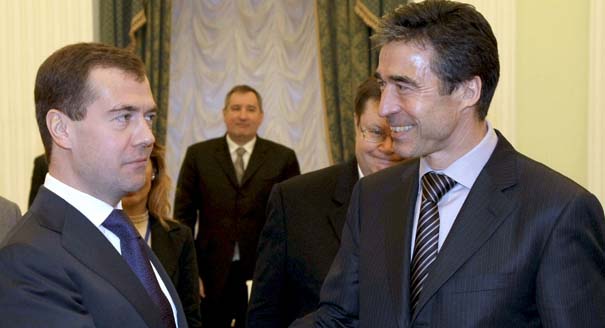
The core issue in the NATO-Russia relationship is the mutual deficit of trust. The Euro-Atlantic area needs a “security community,” where no member expects any other state to use force or threaten to use force against it.
Source: Security Times

The core issue in the relationship is the deficit of trust. Russians do not trust US long-term intentions; Russia’s neighbors from Central and Eastern Europe do not trust Russia’s. In 2010, this was well understood. NATO offered Russia cooperation on missile defense (MD), and Russia moved to address Stalin’s crimes at Katyn.
Fifteen months hence, nothing fundamental has changed, but efforts have slackened. In the area of missile defense, there is a growing sense of Western fatigue and Russian frustration. As a result, NATO countries are about to finalize, at the Chicago Summit in May 2012, an MD architecture, which – at least for now – will not include Russia. In the area of reconciliation and the related field of conflict resolution, the Russo-Polish process has not been emulated in other bilateral relationships, and no headway in dealing with frozen conflicts has been achieved.Meanwhile, relations between Russia and the leading NATO countries have become strained over Libya, Syria and Iran. Additionally, domestic political awakening in Russia triggered by the flawed Duma vote, and the presidential election campaign in the United States promise to inject a heavy dose of politics and ideology into Russia’s relations with the West.
For some on both sides, this is an argument for reassessing the NATO-Russia “reset” and even hitting the pause button. This may be politically expedient, but it is strategically wrong. Instead, a new effort is needed to press ahead toward eventually implementing the promise of Lisbon: fully demilitarized relations and a strategic partnership between the Cold War enemies.
Indeed, missile defense could yet become a game changer. What US-Russian relations need is not a new arms control agreement – which might be useful to build confidence, but a strategic transformation capable of building trust. Missile defense is strategic by definition, and cooperation at that level would surely be transformative. It would require each side to finally, unequivocally, and permanently drop the notion of the other as a potential adversary – in its own strategic thinking and contingency planning. When this is achieved, it would mean, for example, that under no circumstances would the United States need to consider the possibility of Russia straying to the “wrong side.”
To reach this goal one would have to work very hard. A breakthrough would be achieved when Russia withdraws its insistence on the “legally binding” nature of the agreement, and the United States and its allies design a missile defense architecture for NATO which would certifiably not impact on the integrity of the Russian nuclear deterrent. These roadblocks removed, NATO and Russia can proceed to work out the modalities of close cooperation and even partial integration between their respective missile defenses.
On the reconciliation track, Russia needs to expand its recent overture to include the Baltic States. Nothing could be more beneficial for Russia’s public image in Europe and North America now than such an opening. Securely integrated within NATO and the EU, Estonia, Latvia, and Lithuania are ready to be engaged.
The impulse, however, as in the Polish-Russian case, has to come from Moscow, the bigger party. The pattern is already there: based on shared values, recognize historical wrongs, open the archives and engage in a dialogue between societies. A few symbolic gestures, as in Katyn, would also be in order.
The talk between Russia and NATO today is about a future “security architecture” for Europe. This is too mechanistic. What the Euro-Atlantic area actually needs to feel more secure is not new institutions, or the enlargement of the existing ones, or new treaties, but a different quality of relations among the nations in the area. In political science, it is called a “security community”, where no member expects any other state to use force or threaten to use force against it.
Such a community first emerged over a hundred years ago, and has constantly expanded since. It started with America and Britain, then proceeded to reach out to France; linked with the Low Countries and North and South Europeans; crucially, it embraced Germany. In the last two decades, it has added Central and South-Eastern Europe. The next step – toward a full and inclusive Euro-Atlantic security community, with Russia, Ukraine, Georgia and others, and no gray areas will be in every way as crucial as Germany’s integration – and equally beneficial to all.
Former Director, Carnegie Moscow Center
Trenin was director of the Carnegie Moscow Center from 2008 to early 2022.
Recent Work
Dmitri Trenin
Dmitri Trenin
Carnegie does not take institutional positions on public policy issues; the views represented herein are those of the author(s) and do not necessarily reflect the views of Carnegie, its staff, or its trustees.

The European far right might fail to steer EU policy in the direction Russia wants, but they will create enough chaos inside Europe to benefit the Kremlin.

Dimitar Bechev
Washington needs to recognize that influence in the Western Hemisphere comes from presence, delivery, and reliability. It also must recognize that while the United States remains the key external actor, it no longer operates in a permissive environment and cannot presume deference from regional players who have other options, namely China.
Juan S. Gonzalez

Minsk clearly expected the dialogue with Washington to yield more results, in particular the lifting of EU sanctions and permission to export potash.

Artyom Shraibman

A summer of escalation in the Black Sea has hurt Ukraine economically and is exacerbating world food security. A truce is needed—as is a broader reframing of Europe’s Ukraine strategy.

Thomas de Waal
Why governance of rapidly evolving technology will be distributed and complex.


Stewart Patrick, Scott Singer