

Commentary
AI capabilities are moving fast. Most institutions—including governments—can’t keep up.
Anton Leicht, Scott Singer
{
  "authors": [
    "Bill Bradley",
    "David Walker"
  ],
  "type": "legacyinthemedia",
  "centerAffiliationAll": "dc",
  "centers": [
    "Carnegie Endowment for International Peace"
  ],
  "collections": [],
  "englishNewsletterAll": "ctw",
  "nonEnglishNewsletterAll": "",
  "primaryCenter": "Carnegie Endowment for International Peace",
  "programAffiliation": "SCP",
  "programs": [
    "Sustainability, Climate, and Geopolitics"
  ],
  "projects": [],
  "regions": [
    "United States",
    "North America"
  ],
  "topics": [
    "Climate Change"
  ]
}
Source: Getty
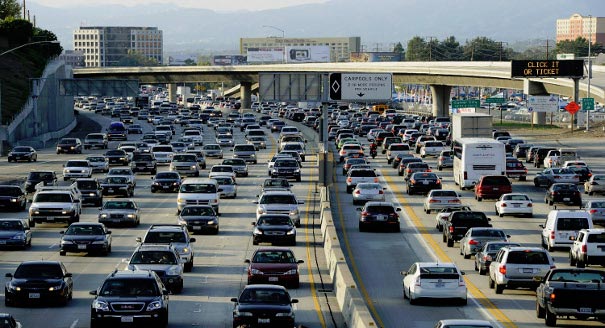
The United States should consider exchanging the current federal gas tax for a 6 percent oil-security fee to fully fund the country's national infrastructure program.
Source: Hill

The highway trust fund, which supports our federal transportation programs, is broke. It is kept alive through billions of dollars in periodic transfers from general funds. This is straight debt. If we add deferred maintenance on the federal-aid system, interest on borrowed money and a conservative calculation of the costs that transportation imposes on other federal programs such as health and welfare, the total annual transportation contribution to our national deficit exceeds $100 billion.
There is a better way to fully fund our national infrastructure program that is also kind to our pocketbook: Exchange the current federal gas tax for a 6 percent oil-security fee imposed on all oil produced in, or imported into, the United States. This oil security fee could be collected through the existing administrative structure of the Oil Spill Liability Fund — thus requiring no new bureaucracy. In return, the entire gas tax could be rebated. At $103 per barrel, the amount raised completely offsets the loss of this most unpopular tax. As the world oil price rise to more than $103 per barrel, the oil security fee yields net revenues.
So why switch from a gas tax to a percentage (ad valorem) fee on oil? Isn’t this just taking money out of one pocket and putting it into another? Not so. There are clear benefits to this new approach: First, this oil security fee distributes some downstream costs of oil consumption to upstream producers and processors who currently pay no tax for oil consumed in the production, refining and distribution of oil and refined products. Currently, oil-consumption taxes are imposed entirely on the retail consumer through a tax at the pump. Besides simple fairness, a per-barrel oil fee encourages “well-to-wheel” energy efficiency. Good idea.
Second, transportation represents more than 70 percent of all U.S. oil consumption. It is common sense that companies dependent on our transportation system for a majority of their sales should contribute to keeping that system in good shape. Currently, they do not.
Third, an ad valorem fee on oil is an insurance policy for transportation solvency. As oil prices climb higher than $103 per barrel, net revenue increases. This is a sharp difference from the current flat, un-indexed 18.3 cent gas tax, whether the oil price is $50 per barrel or $150 per barrel. Higher oil prices will lower demand, but infrastructure needs do not abate.
Fourth, by imposing the oil fee upstream, we capture revenue at home. Fully 16 percent of petroleum products refined in the United States are exported — untaxed. To the extent upstream oil processors pass the fee on to retail consumers, those consumers will include purchasers of such products on the world market, and not limited to U.S. consumers.
Fifth, by imposing this fee upstream on oil products alone, we are favoring — but not subsidizing — ethanol and other non-petroleum-based biofuels. This is good for our agricultural sector while advancing energy independence.
Finally, if the oil security fee promotes efficiency and, thus, demand destruction, oil prices will eventually fall. If they fall to less than $103 per barrel, we propose a gradual reintroduction of the gas tax to recapture lost oil fee revenue. Because the pump price of gasoline goes down about 2.5 cents for every dollar drop in the world price of oil, recapturing 1 cent of that drop as a gas tax per dollar reduction in the world oil price still allows the price at the pump to go down while more than making up for the lost oil security revenue. This also supports price stability, cutting the peaks and troughs off gasoline prices that cause panic at the pump.
According to the World Economic Forum’s 2011 Global Competitiveness Report, the United States has fallen from fifth to 23rd place in the quality of its infrastructure in the last 10 years. With world oil prices already higher than $103 per barrel, substitution of a 6 percent oil security fee for the gas tax provides enough revenue to keep the highway trust fund alive at current levels of authorized spending.
While a growing economy means our rate of federal infrastructure investment must increase, every dollar spent must yield maximum economic return. We must hold our legislators accountable against that goal. But failure to invest is not an option, nor is pretending to pay for this investment when we do not.
Bradley, a former Democratic New Jersey senator, and Walker, a former U.S. comptroller general and founder and CEO of the Comeback America Initiative, are authors of “Road to Recovery: Transforming America’s Transportation,” published by the Carnegie Endowment for International Peace.
Bill Bradley
David Walker
Carnegie does not take institutional positions on public policy issues; the views represented herein are those of the author(s) and do not necessarily reflect the views of Carnegie, its staff, or its trustees.
AI capabilities are moving fast. Most institutions—including governments—can’t keep up.


Anton Leicht, Scott Singer

The Bureau of Industry and Security needs to adjust its focus and practices to maintain its position as the U.S. government’s primary champion of international technological competition.

Geoffrey Irving
They face an uphill climb, but they could draw on a strategy that other diplomats have used in the past.


Shana Tabak, Alejandro Martin Rodriguez

European Commission President Ursula von der Leyen is about to give her annual address on the state of the EU. Here’s what she won’t—but should—say.

Rym Momtaz
Understanding the climatic pain points is necessary for policymakers hoping to minimize the war’s negative environmental consequences.


Alejandro Martin Rodriguez, Joy Arkeh, Sarah Yerkes