

Commentary
Thomas de Waal
{
  "authors": [
    "Thomas de Waal"
  ],
  "type": "legacyinthemedia",
  "centerAffiliationAll": "dc",
  "centers": [
    "Carnegie Endowment for International Peace",
    "Carnegie Europe"
  ],
  "collections": [],
  "englishNewsletterAll": "ctw",
  "nonEnglishNewsletterAll": "",
  "primaryCenter": "Carnegie Europe",
  "programAffiliation": "russia",
  "programs": [
    "Russia and Eurasia"
  ],
  "projects": [],
  "regions": [
    "Caucasus",
    "Azerbaijan"
  ],
  "topics": [
    "Political Reform",
    "Security"
  ]
}
Source: Getty
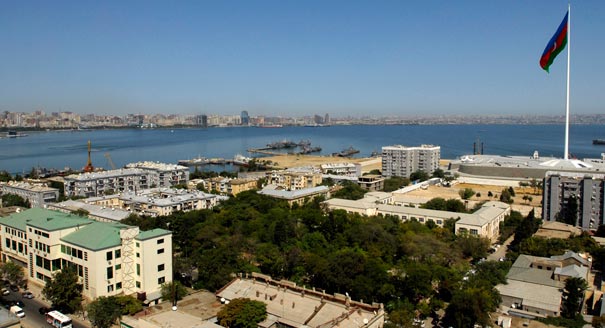
Azerbaijan has tricky relationships with all of its neighbors, from its suspended conflict with Armenia to simmering tensions with Iran and Turkmenistan to constant misunderstandings with Turkey.
Source: National Interest

Relations with Western countries could be described as transactional, dependent on energy supplies and the country’s status as a transit route to Afghanistan. The Azerbaijanis blame a fairly difficult relationship with Washington on the success of the Armenian lobby in Congress in blocking the reconfirmation of Matt Bryza as U.S. ambassador, leaving the State Department again without an envoy in Baku. American officials say that the relationship is not bad but will not be better as long as Azerbaijan is so far from being a democracy.
Azerbaijan has tricky relationships with all of its neighbors. The surrounding landscape offers suspended conflict with Armenia, simmering tensions with Iran and Turkmenistan, friendship masking perpetual suspicion with Russia and constant misunderstandings with its supposedly close Turkic cousin Turkey.Even the relationship with the closest neighbor, Georgia, is not trouble free. Georgian president Mikheil Saakashvili talked up Azerbaijani-Georgian friendship on a visit to Baku in early March and even proposed that the two countries should make a joint bid to host the 2016 European soccer championship. But Saakashvili caused his hosts headaches in a speech to the Azerbaijani parliament, telling his audience (in the Russian language) that Moscow’s foreign policy “has many names, but only one meaning for all of us, the neighbors of the Russian Federation: the end of our freedom and our independence, the end of the dream of Rasulzade and many others of our ancestors.”
The speech raised the ire of some Azerbaijani parliamentarians. They felt the Georgian president had offended protocol by using their parliament to attack a neighboring state with whom they try to maintain good relations. Saakashvili’s many references to Mammad Amin Rasulzade, whose famous phrase “The flag once raised will never fall” he used to conclude his speech, also went down badly. Rasulzade was the founder of the first Azerbaijani independent republic of 1918 and leader of the Musavat Party, now the leading opposition group to the government. He is a historical figure the current Azerbaijani governing elite prefers not to glorify in public.
Israel is another high-maintenance ally. The two countries have a strong commercial and political partnership with both stressing their pro-Western foreign-policy orientation and resistance to radical Islam. But being Israel’s best friend in this neighborhood comes at a cost. Unhelpfully for the Azerbaijani government, the Israeli media recently leaked the story of an arms deal worth $1.6 billion between Israel and Azerbaijan. The relationship causes friction with Turkey—the Turkish ambassador to Baku complained last year that the Azerbaijanis should support Ankara in its row with Israel, just as Turkey supported Azerbaijan in its conflict with Armenia. And, of course, it draws hostile attention from Iran.
Azerbaijan joined the UN Security Council in January. That is both a mark of respect and a big responsibility. As one Western diplomat in Baku put it to me, “You can hide in the UN General Assembly, you can’t hide in the Security Council.” The Azerbaijanis now have to take a line on issues such as Syria where they might have preferred to keep silent before.
As Turkey is finding on an even larger scale, it is easier to declare big foreign-policy ambitions than to realize them. Capacity is stretched. There are plenty of people in the new Azerbaijan who are good at making money and doing deals but a limited few who bear the burden of making a coordinated foreign policy.
At the same time, the government in oil-rich Baku is increasingly opaque. Foreign visitors and diplomats complain that they find it harder to gain access to the government officials making decisions and struggle to understand what government strategy is. This is the context in which Azerbaijan faces what could be its biggest foreign-policy test since the war with the Armenians ended in 1994: how to handle a looming crisis with Iran, a near neighbor, fellow Shiite state and strong ideological adversary.
The working presumption has always been that because both countries have the ability to hurt each other badly, they refrain from doing anything that drags them into full-scale confrontation. Iran has influence over dozens of mosques and tens of thousands of Islamists in Azerbaijan who could rattle the Azerbaijani state. It also provides an economic and energy lifeline for the Azerbaijani exclave of Nakhichevan. Azerbaijan has the capacity to stir up parts of Iran’s huge Azeri minority if it wanted to.
That presumption is now being tested. In January, the Azerbaijani government said its websites had been attacked and defaced with anti-Israeli messages, then announced it had foiled an Iranian plot to assassinate a Jewish teacher and a rabbi in Baku. An Azerbaijani parliamentarian took the opportunity to needle Tehran with the suggestion that his country should be renamed “North Azerbaijan”—implying that Iran’s Azerbaijani provinces would thereby become “South Azerbaijan.”
Thankfully, the situation has quieted down again. The Azerbaijani officials I talked to are focused on managing it. But if more trouble strikes, Azerbaijan will need to keep its nerve and—an unaccustomed predicament in recent times—find a way to ask for help.

Senior Fellow, Carnegie Europe
Thomas de Waal is a senior fellow at Carnegie Europe, specializing in Eastern Europe and the Caucasus.
Recent Work
Thomas de Waal
Thomas de Waal
Carnegie does not take institutional positions on public policy issues; the views represented herein are those of the author(s) and do not necessarily reflect the views of Carnegie, its staff, or its trustees.

Japan’s long-term security policy is driven by concerns about China, and there is little appetite for (or interest in) pursuing a confrontation with Moscow.

James D.J. Brown

Russia is testing the waters of NATO’s mutual defense clause. What do strikes in Romanian territorial waters mean for the alliance’s posture toward Moscow?

Dimitar Bechev
Why Pakistan, Saudi Arabia, and Turkey are joining forces on regional security.


Alper Coşkun, Amr Hamzawy

The truth of the strategic situation is that Europe and Russia are extremely unlikely to be able to “turn the page” on their confrontation within the next two decades.

Arkady Moshes

Despite public disputes over trade and immigration, the strategic partnership’s foundations remain sturdy.

Sameer Lalwani