
• Research
  • Emissary
  • About
  • Experts
Carnegie Global logoCarnegie lettermark logo
DemocracyIran
  • Donate
{
  "authors": [
    "Uri Dadush"
  ],
  "type": "legacyinthemedia",
  "centerAffiliationAll": "",
  "centers": [
    "Carnegie Endowment for International Peace"
  ],
  "collections": [],
  "englishNewsletterAll": "",
  "nonEnglishNewsletterAll": "",
  "primaryCenter": "Carnegie Endowment for International Peace",
  "programAffiliation": "",
  "programs": [],
  "projects": [],
  "regions": [
    "North America",
    "United States",
    "Southern, Eastern, and Western Africa"
  ],
  "topics": [
    "Economy"
  ]
}
Source: Getty

In The Media

The Next World Bank President

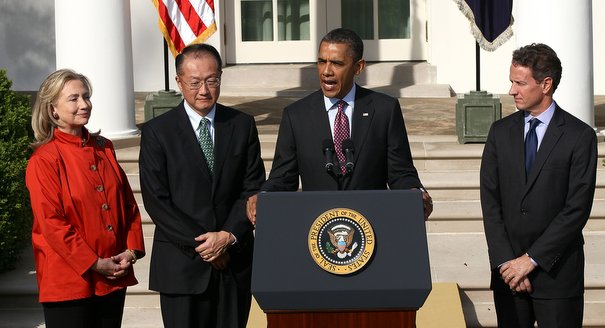
The new World Bank president, an American once again, was selected through a process that was far from competitive. However, the presence of two developing world candidates in this year's field may be a sign that the tide is turning.

Link Copied
By Uri Dadush
Published on Apr 16, 2012

Source: BBC World News

Speaking on BBC World News Today, Carnegie's Uri Dadush explained that, in keeping with tradition, the American nominee for World Bank president, Jim Yong Kim, was selected to head the organization when current president Robert Zoellick steps down in June. This year's selection process for the World Bank's top job was subject to unprecedented competition, with the participation of two developing country candidates—including Nigeria's finance minister, Ngozi Okonjo-Iweala. Dadush noted that, while Okonjo-Iweala's loss was disappointing—given that he and many development professionals believe she was the most qualified candidate—her presence in the competition will hopefully open the doors to a more transparent, merit-based process in the future, at both the World Bank and the International Monetary Fund. The viability of both institutions, he said, rests in part on their capacity to better represent a world in which the economic weight of emerging markets is growing.

About the Author

Uri Dadush

Former Senior Associate, International Economics Program

Dadush was a senior associate at the Carnegie Endowment for International Peace. He focuses on trends in the global economy and is currently tracking developments in the eurozone crisis.

    Recent Work

  • Commentary
    The Labors of Tsipras

      Uri Dadush

  • In The Media
    Greece, Complacency, and the Euro

      Uri Dadush

Uri Dadush
Former Senior Associate, International Economics Program
Uri Dadush
EconomyNorth AmericaUnited StatesSouthern, Eastern, and Western Africa

Carnegie does not take institutional positions on public policy issues; the views represented herein are those of the author(s) and do not necessarily reflect the views of Carnegie, its staff, or its trustees.

More Work from Carnegie Endowment for International Peace

  • A Black man pulls a trolley. He is small in the bottom center of the frame; in the background are stacks of large, colorful shipping containers and the parts of a large crane or similar piece of equipment.
    Article
    Africa’s Global Economic Edge: Advancing Strategic Sectors

    In key sectors such as critical minerals, specialty agriculture, and fintech, Africa can become a global powerhouse by investing more in manufacturing, value-add, and scaling.

      • Kholofelo Kugler

      Kholofelo Kugler, Georgia Schaefer-Brown

  • Commentary
    Diwan
    Iran Rewrites Its War Strategy

    In an interview, Hamidreza Azizi discusses how Tehran has adapted in real time to the conflict with the United States and Israel.

      Michael Young

  • Xi walking into a room with people standing and applauding around him
    Commentary
    Emissary
    The Xi Doctrine Zeros in on “High-Quality Development” for China’s Economic Future

    In the latest Five-Year Plan, the Chinese president cements the shift to an innovation-driven economy over a consumption-driven one.

      • Damien Ma

      Damien Ma

  • Article
    Kenya’s Health Deal Is a Stress Test for the America First Global Health Strategy

    U.S. agreements must contend with national data protection laws to make durable foreign policy instruments.

      • A Black woman with long hair wears a black blazer

      Jane Munga, Rose Mosero

  • Commentary
    Diwan
    Trump’s Plan for Gaza Is Not Irrelevant. It’s Worse.

    The simple conclusion is that the scheme will bring neither peace nor prosperity, but will institutionalize devastation.

      Nathan J. Brown

Get more news and analysis from
Carnegie Endowment for International Peace
Carnegie global logo, stacked
1779 Massachusetts Avenue NWWashington, DC, 20036-2103Phone: 202 483 7600Fax: 202 483 1840
  • Research
  • Emissary
  • About
  • Experts
  • Donate
  • Programs
  • Events
  • Blogs
  • Podcasts
  • Contact
  • Annual Reports
  • Careers
  • Privacy
  • For Media
  • Government Resources
Get more news and analysis from
Carnegie Endowment for International Peace
© 2026 Carnegie Endowment for International Peace. All rights reserved.












