

Paper
Paul Salem
{
  "authors": [
    "Paul Salem"
  ],
  "type": "legacyinthemedia",
  "centerAffiliationAll": "",
  "centers": [
    "Carnegie Endowment for International Peace",
    "Malcolm H. Kerr Carnegie Middle East Center"
  ],
  "collections": [],
  "englishNewsletterAll": "",
  "nonEnglishNewsletterAll": "",
  "primaryCenter": "Malcolm H. Kerr Carnegie Middle East Center",
  "programAffiliation": "",
  "programs": [],
  "projects": [],
  "regions": [
    "Levant",
    "Syria"
  ],
  "topics": [
    "Political Reform"
  ]
}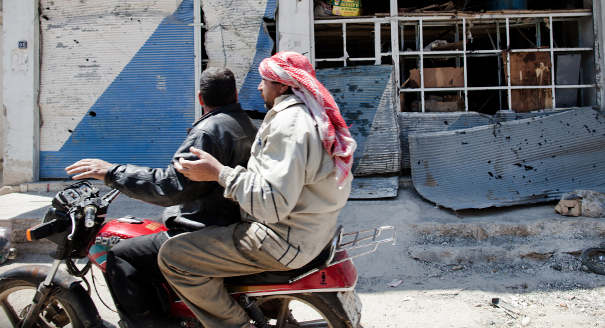
Source: Getty
The chances for a compromise soft landing in Syria remain slim; but the alternative is a crash landing that leaves a failed state and civil war in its wake.
Source: Il Espresso

The Arab countries, Turkey, and the West have put political and economic pressure on the Assad regime but have shied away from military intervention. The Arab League and the UN, for their parts, have both backed Kofi Annan’s mediation plan aimed at stopping the fighting and bringing all parties to the negotiating table.
The Annan plan is already failing; but it contains the right combination of pressure and politics—a combination that needs to be sustained and intensified over the long run to force the regime to compromise and to protect Syria from a full-scale decline into devastation and civil war.Without consistent and escalating pressure, the regime will not compromise; and without a political parachute for the regime’s leaders, they will fight to the death, taking the country down with them. The key to increased pressure on the Assad regime lies in convincing Russia and China that removing President Assad and his cronies from power is the only way to prevent Syria’s collapse—and rescue the state from ruin. Just as Washington understood that retiring Hosni Mubarak was crucial to salvaging the allied Egyptian state, Moscow should be made to see that preserving its alliance with Syria requires it to press for changes to the regime.
The launch and probable failure of the Annan initiative are necessary to convince Moscow and Beijing that Damascus is acting in bad faith. They are equally important in prompting the UN Security Council to ratchet up pressure on the Assad regime. This pressure should include tighter economic and political sanctions; a limited safe corridor or no-fly zone in northern Syria may need to be considered as well. Only if Syria gets a clear and much stronger message from a united international community will it begin to take the need for negotiation and compromise seriously. If the Assad regime continues to dig itself deeper into isolation and trouble, Iran may also become convinced that, in order to save its ally from complete ruin, it must encourage the Syrian leadership to change course and strike a new political deal with its domestic opponents.
Any negotiated settlement in Syria will have to include the following components: the departure of president Assad, his close family, and his cronies; the appointment of a new interim president; assurances to the Alawi community and military leadership that they have a place in the new Syria; a transitional government that includes the opposition as well as the Baath Party; the drafting of a new, democratic constitution; and the holding of free, transparent parliamentary and presidential elections.
The chances for a compromise soft landing in Syria remain slim; but the alternative is a crash landing that leaves a failed state and civil war in its wake. The international community should continue to back the Annan plan, and when it fails—as it almost inevitably will—move to tighten sanctions. Simultaneously, it must hold out to the regime leaders the lure of a safe exit, while offering the state and opposition the opportunity to negotiate a new deal for a new Syria.
This article originally appeared in Italian in Il Espresso.
Senior Fellow at the Middle East Institute
Paul Salem is a senior fellow at the Middle East Institute.
Recent Work
Paul Salem
Paul Salem
Carnegie does not take institutional positions on public policy issues; the views represented herein are those of the author(s) and do not necessarily reflect the views of Carnegie, its staff, or its trustees.

In the tenth year of his presidency, President Mirziyoyev’s system is becoming even more personalized than that of his predecessor Karimov.

Galiya Ibragimova

The greater threat to Zelensky comes not from Fedorov alone, but from the convergence between the former defense minister’s political campaign and the anti-corruption investigations moving ever closer to the presidential administration.

Balázs Jarábik

With his public call for new elections in Ukraine, ex-defense minister Mykhailo Fedorov has opened Pandora’s box.

Konstantin Skorkin

In the discussions made possible by the State Duma election campaign, one question is being asked more and more loudly. “What next?”

Andrey Pertsev
In an interview, Sohaib Jawhar analyzes the profound changes in the ties between the neighboring countries.

Michael Young