

Commentary
Dmitri Trenin
{
  "authors": [
    "Dmitri Trenin"
  ],
  "type": "legacyinthemedia",
  "centerAffiliationAll": "",
  "centers": [
    "Carnegie Endowment for International Peace",
    "Carnegie Russia Eurasia Center"
  ],
  "collections": [],
  "englishNewsletterAll": "",
  "nonEnglishNewsletterAll": "",
  "primaryCenter": "Carnegie Russia Eurasia Center",
  "programAffiliation": "",
  "programs": [],
  "projects": [
    "Eurasia in Transition"
  ],
  "regions": [
    "North America",
    "United States",
    "Caucasus",
    "Russia"
  ],
  "topics": [
    "Security",
    "Foreign Policy"
  ]
}
Source: Getty
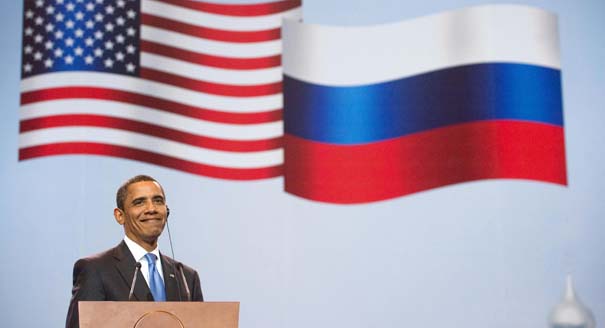
If United States and Russia fail to collaborate on urgent global issues, it could enhance the two countries’ mutual alienation, allow regional crises to run unabated, and even lead to a reconfiguration of the world’s strategic landscape.
Source: International Herald Tribune

While the two leaders are meeting in Mexico, the P5+1 group (the five permanent members of the U.N. Security Council plus Germany) will be meeting with Iranian representatives in Moscow. And, after the Houla massacre, the Syrian civil war is threatening to morph into an international crisis.
The two leaders need to meet face to face in order to define the rules of engagement between them. They did meet once before, in July 2009 outside Moscow. After that meeting, Putin gave the final green light to the Russian version of the reset in U.S.-Russian relations.Ever since, however, Putin has been using his junior partner, Dmitri Medvedev, as the point man for contacts with the U.S. president. At Los Cabos there will be no messages to pass on: Obama will be talking directly with Putin.
They have a lot to discuss. Syria and Iran stand out, due to the urgency of the expanding conflict in the former and the enormous stakes involved in mishandling the nuclear issue of the latter.
Topmost on Putin’s agenda will probably be the issue of ballistic missile defenses in Europe, whose outcome can have a major impact on Russia’s relations with the United States and NATO, and on Russia’s own defense posture.
For Obama, in view also of the continuing difficulties with Pakistan, Russia’s assistance in assuring transit to Afghanistan looks ever more crucial. There are many other topics — indeed, too many to fit into a short encounter — from the terms of trade now that Russia is finally joining the World Trade Organization, to the Magnitsky bill and its associated criticisms in the U.S. of Russia’s human rights record, and the Kremlin response of U.S. interference.
In the present circumstances, the payoff from U.S.-Russian collaboration on international issues could be surprisingly high. Should they act together rather than at cross-purposes, Moscow and Washington could help stop the carnage in Syria and open the path to a political transition in Damascus. They could help avoid the two worst outcomes in Iran: a Tehran with a nuclear bomb and a new war in the Middle East.
The reverse, however, is also true. A failure to cooperate would dramatically enhance their mutual alienation, allow regional crises to run unabated, and even lead to a reconfiguration of the world’s strategic landscape. The stakes are high, but making the right choices will be hard.
Moscow will need to revise its calculus about the likely outcome of the Syrian civil war. It will need to adopt a harsher language with its client in Damascus and begin reaching out to transitional figures who would be willing to engage in a dialogue with the opposition. This would go against the grain with those in Moscow who oppose any interference in other governments’ affairs. Moscow will also need to be more proactive with its Iranian partners, who both show disdain for Russia and use it to shield them against Western pressures.
Washington’s problem is harder. It will need to accept Russia as a co-equal player in Syria and Iran, and stop seeing Moscow as a spoiler, or even as an ally of its declared enemies. This will mean de facto dropping the option of a military intervention in Syria or large-scale aid to anti-Assad forces, all in exchange for a Yemen-style transitional formula rather than a clear regime change.
On Iran, it will mean changing the pace of the game from sprint to a long trek. Crucially, the Obama administration, unlike the Kremlin, needs to take account of domestic constraints — the presidential campaign, the opposition from Republicans in Congress, and a vociferously anti-Putin media.
Even though a full meeting of the minds at Los Cabos is highly improbable, the issues and the stakes involved will not go away. A confrontation with America should be the last thing on Putin’s wish list, given his economic agenda; ignoring Russia as a relatively small but fiercely independent strategic player will cost dearly for the United States.
The missile-defense issue will likely have to wait until 2013 and the outcome of the U.S. presidential race. Now, however, is the time for the two leaders to deal with the urgent issues, and for their advisers to start thinking through the future of the bilateral relationship. The reset has worked, but it was chiefly a means for clearing away the irritants and focusing on what is possible. Good, but not good enough, as Iran and Syria suggest.
This article originally appeared in the International Herald Tribune.
Former Director, Carnegie Moscow Center
Trenin was director of the Carnegie Moscow Center from 2008 to early 2022.
Recent Work
Dmitri Trenin
Dmitri Trenin
Carnegie does not take institutional positions on public policy issues; the views represented herein are those of the author(s) and do not necessarily reflect the views of Carnegie, its staff, or its trustees.
Despite the agreement’s uncertainty, it’s still a significant development in regional and nuclear policy.


Andrew Leber, Jane Darby Menton
“AI safety in parallel” is modest and pragmatic but vital.

Matt Sheehan

Trump is distracted and Ukraine wants Europe to step up. The continent’s leaders must find their voice and assert it in talks with Russia.

Alissa de Carbonnel
Unresolved tensions within the AfD may ultimately constrain the its potential as a leader among European and global populist forces.
Jeremy Cliffe

There is a deeply rooted assumption in post–Cold War American statecraft that overwhelming military and economic power translates directly into favorable political outcomes. But force alone is rarely enough. To meet the challenges of the mid-21st century, Washington needs a cultural shift toward a mindset that takes negotiation far more seriously.

Cecily Brewer