
• Research
  • Emissary
  • About
  • Experts
Carnegie Global logoCarnegie lettermark logo
DemocracyIran
  • Donate
{
  "authors": [
    "Douglas H. Paal"
  ],
  "type": "legacyinthemedia",
  "centerAffiliationAll": "dc",
  "centers": [
    "Carnegie Endowment for International Peace"
  ],
  "collections": [],
  "englishNewsletterAll": "asia",
  "nonEnglishNewsletterAll": "",
  "primaryCenter": "Carnegie Endowment for International Peace",
  "programAffiliation": "AP",
  "programs": [
    "Asia"
  ],
  "projects": [],
  "regions": [
    "East Asia",
    "China"
  ],
  "topics": [
    "Political Reform"
  ]
}
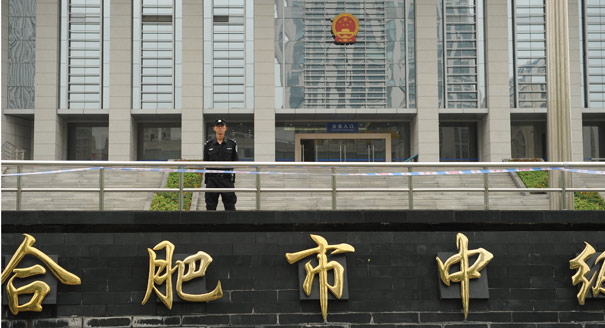
Source: Getty

In The Media

Gu Kailai And Corruption in China

Gu Kailai’s murder trial has placed a spotlight on corruption in the higher echelons of the Chinese government.

Link Copied
By Douglas H. Paal
Published on Aug 20, 2012
Program mobile hero image

Program

Asia

The Asia Program in Washington studies disruptive security, governance, and technological risks that threaten peace, growth, and opportunity in the Asia-Pacific region, including a focus on China, Japan, and the Korean peninsula.

Learn More

Source: BBC World News

Speaking on the BBC, Carnegie’s Douglas Paal discussed how Gu Kailai’s murder trial has placed a spotlight on corruption within the Chinese government. The scandal’s extensive media coverage and public interest has raised the issue of corruption as a point of law that must be dealt with, he argued, adding that the power transition in China has been sped up to give the impression that “the party has things under control.” Most officials are somehow involved in corruption, and that is unlikely to change, Paal explained. “All incentives are for officers to remain corrupt within the communist party. That’s how you take care of your support network, and until that changes, the party has every interest in not letting this investigation get out of hand,” he concluded.

About the Author

Douglas H. Paal

Distinguished Fellow, Asia Program

Paal previously served as vice chairman of JPMorgan Chase International and as unofficial U.S. representative to Taiwan as director of the American Institute in Taiwan.

    Recent Work

  • Paper
    America’s Future in a Dynamic Asia

      Douglas H. Paal

  • Q&A
    U.S.-China Relations at the Forty-Year Mark
      • +1

      Douglas H. Paal, Tong Zhao, Chen Qi, …

Douglas H. Paal
Distinguished Fellow, Asia Program
Douglas H. Paal
Political ReformEast AsiaChina

Carnegie does not take institutional positions on public policy issues; the views represented herein are those of the author(s) and do not necessarily reflect the views of Carnegie, its staff, or its trustees.

More Work from Carnegie Endowment for International Peace

  •  A machine gun of a Houthi soldier mounted on a police vehicle next to a billboard depicting the U.S. president Donald Trump and Mohammed Bin Salman, the Crown Prince and Prime Minister of Saudi Arabia, during a protest staged to show support to Iran against the U.S.-Israel war on March 27, 2026 in Sana'a, Yemen.
    Article
    Amid Iran War, Gulf Countries Slow the Pace of Reforms

    The return of war as the organizing factor in Middle Eastern politics has predictable consequences: governments are prioritizing regime stability and becoming averse to political and social reform.

      • Sarah Yerkes

      Sarah Yerkes, Amr Hamzawy

  • Commentary
    China’s Energy Security Doesn’t Run Through Hormuz but Through the Electrification of Everything

    Across Asia, China is better positioned to withstand energy shocks from the fallout of the Iran war. Its abundant coal capacity can ensure stability in the near term. Yet at the same time, the country’s energy transition away from coal will make it even less vulnerable during the next shock.


      • Damien Ma

      Damien Ma

  • Commentary
    Emissary
    In Its Iran War Debate, Washington Has Lost the Plot in Asia

    The United States ignores the region’s lived experience—and the tough political and social trade-offs the war has produced—at its peril.

      Evan A. Feigenbaum

  • Commentary
    China Financial Markets
    What GDP Means in a Soft Budget Economy Like China

    The GDP measure is an attempt to measure value creation in an economy. This measure, however, can vary greatly between economies that have disciplinary mechanisms that force them to recognize investment losses quickly and economies that don’t, and can postpone this recognition for many years.

      Michael Pettis

  • Photo of Balen Shah taking a selfie with a group of Nepali adults and children.
    Article
    A New Generation Takes Power in Nepal

    The incoming government has swept Nepal’s election. The real work begins now.

      Amish Raj Mulmi

Get more news and analysis from
Carnegie Endowment for International Peace
Carnegie global logo, stacked
1779 Massachusetts Avenue NWWashington, DC, 20036-2103Phone: 202 483 7600Fax: 202 483 1840
  • Research
  • Emissary
  • About
  • Experts
  • Donate
  • Programs
  • Events
  • Blogs
  • Podcasts
  • Contact
  • Annual Reports
  • Careers
  • Privacy
  • For Media
  • Government Resources
Get more news and analysis from
Carnegie Endowment for International Peace
© 2026 Carnegie Endowment for International Peace. All rights reserved.









