

Commentary
Judy Dempsey
{
  "authors": [
    "Judy Dempsey"
  ],
  "type": "legacyinthemedia",
  "centerAffiliationAll": "",
  "centers": [
    "Carnegie Endowment for International Peace",
    "Carnegie Europe"
  ],
  "collections": [],
  "englishNewsletterAll": "",
  "nonEnglishNewsletterAll": "",
  "primaryCenter": "Carnegie Europe",
  "programAffiliation": "",
  "programs": [],
  "projects": [],
  "regions": [
    "Europe"
  ],
  "topics": [
    "EU"
  ]
}
Source: Getty
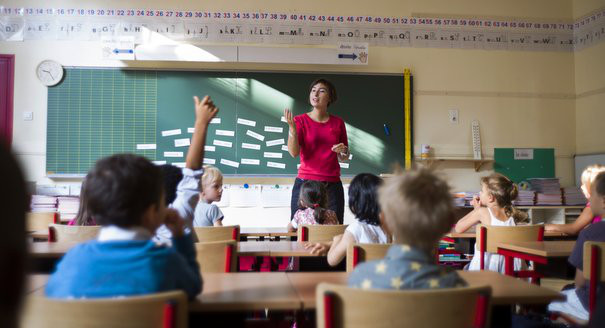
The Organization for Economic Cooperation and Development is calling for a restructuring of education that would put the emphasis on quality, not quantity, but instead European governments are chiseling away at their education budgets.
Source: New York Times

Students and teachers in Italy, Spain and Great Britain have been protesting against sharp cuts in funding.
In the case of Britain, the introduction of hefty tuition fees at universities means that would-be students will be forced either to take out loans in the hope that they get a well-paid job upon graduating or put off going to college until they can afford it.
A report from the Organization for Economic Cooperation and Development argues that now is the ideal time for governments to radically restructure the entire education sector.
But the O.E.C.D. calls for a restructuring that would invest with the emphasis on quality, not quantity. Secondary school teachers, for example, should be very well paid to attract the best, and universities should be run much more efficiently, the O.E.C.D. argues, noting the contrast with the approach in much of Asia.
Secondary school teachers in Asia are relatively well paid and enjoy a higher social standing than those in Europe, according to the O.E.C.D. Indeed, it is rare to find any Asian government cutting back on education, financial crisis or no financial crisis. Education is considered sacrosanct and the key to the region’s competitiveness.
Governments in Europe, in contrast, are chiseling away at education budgets instead of using the financial crisis to reallocate funds to education as part of an overhaul of the system.
Take the cases of Spain and Greece.
During the boom years, Spain’s regional governments went on a spending spree, building new universities and expanding campuses. This led to more young people achieving higher education. But the dropout rate and the quality of courses left much to be desired, according to the O.E.C.D. Better to focus on quality, not quantity, the O.E.C.D. recommends.
In the case of Greece, there were too many university courses that were poorly attended, and the recruitment of secondary school teachers was not rigorous enough to ensure good teaching, according to the O.E.C.D.
The case for reform in Greece is obvious. The country cannot afford to cut education resources radically, and there is one place where more money for better schools and universities could come from: the defense budget.
Greek defense spending still accounts for 2.1 percent of gross domestic product, according to NATO. After the United States, Greece is the second biggest defense spender among the 27 NATO countries in relation to its gross domestic product. That is astonishing for a country in a deep economic crisis and in need of investment in the crucial area of education.

Nonresident Senior Fellow, Carnegie Europe
Judy Dempsey is a nonresident senior fellow at Carnegie Europe
Recent Work
Judy Dempsey
Judy Dempsey
Over the past decade, China has moved from marginal player to major producer of all things batteries. The United States, Europe, and others are aiming to balance the market.

Milo McBride
Most migrants may have left Ceuta, but the effects may linger.


Alejandro Martin Rodriguez, Sarah Yerkes
Does Donald Trump want to redraw the map of the world? Historian and geopolitical thinker Stephen Wertheim tries to parse the logic behind current American foreign policy

Stephen Wertheim

As we close out another season of Strategic Europe, it is worth taking stock of the deep shifts underway.

Rym Momtaz

The hybrid warfare landscape is evolving rapidly, leaving policymakers without clear strategies. To better inform their work in addressing emerging challenges, governments must dig deeper into the underlying dynamics at play.


Raluca Csernatoni, Alicia Wanless