

Article
Marc Pierini
{
  "authors": [
    "Marc Pierini"
  ],
  "type": "legacyinthemedia",
  "centerAffiliationAll": "",
  "centers": [
    "Carnegie Endowment for International Peace",
    "Carnegie Europe",
    "Malcolm H. Kerr Carnegie Middle East Center"
  ],
  "collections": [],
  "englishNewsletterAll": "",
  "nonEnglishNewsletterAll": "",
  "primaryCenter": "Carnegie Europe",
  "programAffiliation": "",
  "programs": [],
  "projects": [],
  "regions": [
    "Middle East",
    "Levant",
    "Syria"
  ],
  "topics": [
    "Foreign Policy",
    "Political Reform"
  ]
}
Source: Getty
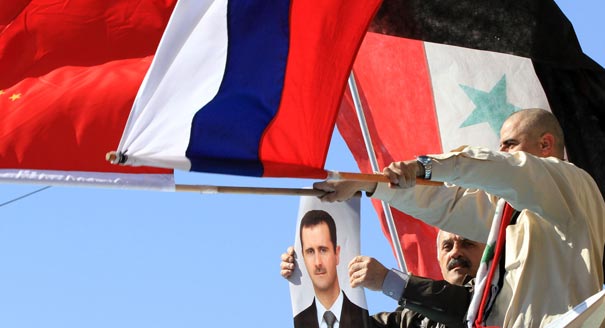
All stand to lose from the continued brutality of the Damascus regime. This alone should be a reason to act together towards a peaceful resolution of the Syrian crisis.
Source: Hurriyet Daily News

The first issue is the fallout of the Libyan crisis on Chinese and Russian diplomacy. Quite obviously, the way in which U.N. Security Council Resolution 1973 was interpreted with regard to Libya by Western members of the U.N. and by China and Russia has resulted in an unprecedented rift (three consecutive vetoes). While China primarily underlines the principle of non-intervention on which its foreign policy is based, Russia insists on the fact that a new order has emerged in the region after the Arab Spring and that policies cannot be “dictated” by the West anymore. More than specific vested interests in Syria, these are the reasons for the U.N. deadlock, in turn “legitimizing” oppression by the Damascus regime.
The second issue is that the Libyan crisis also took its toll on Western countries. The U.S. has shown an aversion to risk-taking both in Libya and in Syria, offering no ground troops. This is not election-related, but more of a long-term trend. However, it is likely that the red line issued by President Obama about the use of chemical weapons will remain whoever the next President is in January. Since 2007, France and the U.K. have shown clear strains in their military capabilities due to long-standing budgetary constraints and do not possess the capacities needed to sustain simultaneous emergencies anymore. Turkey, definitely perceived in the Arab world as part of the West, has shown restraint when it comes to combat interventions in a NATO context (Afghanistan, Libya) and finds similar constraints in the case of Syria, although it has a much higher stake this time.The third issue is that the Lisbon Treaty reorganized EU diplomacy under the influence of the “big three” (France, Germany, U.K.). Today, in a situation like Syria where a combination of instruments - sanctions, humanitarian assistance, technical assistance, diplomatic work - is required, the EU system as a whole is probably less reactive and imaginative than before. The initiative is not in Brussels anymore. But at least a clear red line was issued by the French President last Sunday to Syria, when it comes to the integrity of Lebanon.
The fourth issue is that the stakes of Iran in the Syrian crisis are extremely high. With the fall of the Damascus regime, Tehran would witness a breakdown in the “Shia Belt” (Iran, Iraq, Syria, Hezbollah) and would experience new limitations in its weapons delivery to Hezbollah. This explains Iran’s strong support to the Damascus regime. However, a red line has recently been issued to Damascus: do not use chemical weapons. Moreover, the Syrian crisis is seen by Tehran as a major “opportunity” to position itself as a major regional player. The drone intrusion over southern Israel is a clear illustration of this. What’s more, playing a key role in the Syrian revolution is a way for Tehran to introduce a counter-balancing argument in the “P 5+1” discussions on its nuclear program. Other red lines lie ahead.
Meanwhile, violence in Syria continues unabated. The state has all but collapsed and the economic, social and psychological damage is immense. The Damascus regime does not seem to listen to anyone and would probably only reluctantly offer itself for dialogue with the opposition if Russia and China pressed hard.
As tempting as the “strategy of chaos” might appear in the silence of Damascus’ “People’s Palace,” such a scenario is unsustainable. It would inevitably lead to a lasting, protracted war of attrition where a still-powerful army would struggle to score points, but would gradually lose its edge through defections, disruptions in supplies, and low morale. Meanwhile, the Islamist component of the insurgency would become stronger by the day. Under such circumstance, whether the country remains a single entity or is partitioned would be almost a secondary question.
Many questions remain open before negotiations can take place:
One common factor remains: all stand to lose from the continued brutality of the Damascus regime.
This alone should be a reason to act together towards a peaceful resolution of the Syrian crisis.
This article originally appeared in the Hurriyet Daily News.

Senior Fellow, Carnegie Europe
Marc Pierini is a senior fellow at Carnegie Europe, where his research focuses on developments in the Middle East and Turkey from a European perspective.
Recent Work
Marc Pierini
Marc Pierini
Carnegie does not take institutional positions on public policy issues; the views represented herein are those of the author(s) and do not necessarily reflect the views of Carnegie, its staff, or its trustees.

Minsk clearly expected the dialogue with Washington to yield more results, in particular the lifting of EU sanctions and permission to export potash.

Artyom Shraibman

A summer of escalation in the Black Sea has hurt Ukraine economically and is exacerbating world food security. A truce is needed—as is a broader reframing of Europe’s Ukraine strategy.

Thomas de Waal

As the U.S. stumbles in its war with Iran, we are likely to see an acceleration of its disengagement from the region.

Michael Young
Why governance of rapidly evolving technology will be distributed and complex.


Stewart Patrick, Scott Singer
It should address the shortcomings of previous crisis communication efforts and adapt to the demands of frontier AI.

Lucy Luo