

Commentary
Jamie Kwong, Toby Dalton
{
  "authors": [
    "Toby Dalton"
  ],
  "type": "other",
  "centerAffiliationAll": "dc",
  "centers": [
    "Carnegie Endowment for International Peace"
  ],
  "collections": [],
  "englishNewsletterAll": "ctw",
  "nonEnglishNewsletterAll": "",
  "primaryCenter": "Carnegie Endowment for International Peace",
  "programAffiliation": "NPP",
  "programs": [
    "Nuclear Policy"
  ],
  "projects": [],
  "regions": [
    "South Asia",
    "India",
    "Pakistan"
  ],
  "topics": [
    "Nuclear Policy"
  ]
}
Source: Getty
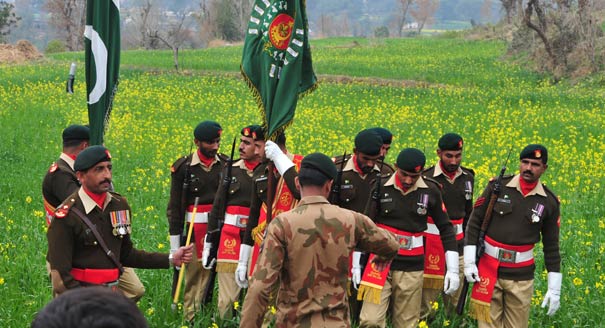
India and Pakistan need more than incremental steps toward peace and stability in South Asia—they must also make symbolic leaps.
Source: Stimson Center
In December 2011, and again in December 2012, Indian and Pakistani government experts met to discuss confidence building measures (CBMs) on nuclear and conventional military issues. At both meetings, the atmospherics were “cordial and constructive;” officials from each side conveyed their commitment to uphold past agreements and to consider additional measures. Predictably, though, the meetings produced no new agreements or any other signs of progress toward reducing long-standing tensions, neither side willing to take significant risks to move beyond the current framework. One Pakistani analyst described the talks as “reflect[ing] the overall bilateral state of play rather than being a catalyst for change.” This assessment aptly sums up the dilemma of how to pursue peace and stability in South Asia: incremental steps, designed to build trust in small bites rather than big leaps, have indeed not produced stability nor been a “catalyst for change,” yet no viable alternative approach appears to be on the table.
For over twenty-five years, India and Pakistan have sought to negotiate and implement measures to avoid conflict, reduce military tensions, improve economic ties and build the confidence necessary to normalize their relationship and, eventually, to resolve disputes like that over the territory of Kashmir that are fundamental to a lasting peace. These efforts accelerated after 1998, when the danger of military escalation took on new importance once both nations openly tested nuclear weapons and declared themselves nuclear powers. Perhaps the crowning achievement of bilateral diplomacy to institutionalize such measures was the 1999 Lahore Summit and the Composite Dialogue process that resulted. But the reality of these measures has never matched the promise.
Efforts by Pakistan and India to establish and sustain an incremental process of building stability seem to follow a predictable and cyclical pattern. The need of both parties to find means to scale back tensions during crisis or conflict, and in recent decades to assure the international community that they are responsible stewards of nuclear weapons, has tended to yield agreement on ending hostilities as well as on vague principles for resolving broader issues. As Feroz Khan has observed, “every major treaty or CBM between these countries has its origin in crisis resolution.” The 1972 Simla Agreement, for instance, both concluded the hostilities in East Pakistan and established a line of control in Kashmir. But if these agreements managed the immediate termination of conflict or crisis, they have not resolved or even greatly attenuated the underlying sources of tension. As such, once the fanfare surrounding each agreement faded and international concerns were mollified, implementation lagged. At times, the dialogue and CBM process broke down completely, or it simply sputtered along pro forma. After some months or years, another crisis arrived and undid whatever progress and momentum toward stability might have existed. Thereafter the cycle began anew. Incremental CBMs have not led to peace, and neither have moments of stability been consolidated by further steps. This rather desultory history was adeptly captured by Dennis Kux in the subtitle of a recent work on this subject: for India-Pakistan negotiations “is past still prologue?”The most glaring exception to this cycle is the Lahore summit, which created profound but momentary hope that a new course could be charted, based on a fundamental change in the terms of the Indo-Pakistan relationship. The reason that this summit, more than any other event in the nearly seventy years of bilateral relations between the two, raised hopes to new levels is that it comprised not just talk but also several symbolic acts by the leaders of both countries, acts which addressed directly and forcefully the aspirations and fears of people on both sides of the border. This symbolism seemed to augur new potential for peace and stability in a way not previously captured by treaties and other CBMs.
Today, the prevailing expert sentiment is that incremental CBMs remain the best hope for ending this cycle of crisis and mistrust. Despite a mixed record of success for this approach, it is common in track II fora to hear calls for a “Lahore II” in order to recapture and extend the gains made through CBMs in 1999. But the idea of a second Lahore agreement based only on small advances seems to miss what made that summit unique: a process that surrounds such increments with major symbolic and risky steps taken by the leaders of both countries. This essay explores the notion of incremental and symbolic steps and the prospect that these can produce a different trajectory in Indo-Pakistani relations, one characterized by sustained stability rather than a cycle of crisis, momentary progress, then stasis. Focusing in particular on the Lahore Summit, it assesses the record of incremental CBMs, mainly in the political-military sphere. Second, it discusses the symbolic component: high-visibility, leadership-driven, risk-laden measures—like the “leap of trust” taken by Prime Ministers Sharif and Vajpayee at Lahore in 1999. It weighs the considerable hurdles that stand in the way of progress, and then concludes with an argument for a new approach to stabilize relations between Pakistan and India based on a mix of small increments complemented by big, symbolic leaps that can establish a new baseline for relations. If there is one lesson to be distilled from past practices in South Asia it is that faster incremental progress can be facilitated by sustained, high-level political involvement reinforced by symbolic acts. Without such high-level involvement, there seems little prospect that these antagonists can break out of the cyclical crises that frustrate progress toward peace.

Senior Fellow and Co-director, Nuclear Policy Program
Toby Dalton is a senior fellow and co-director of the Nuclear Policy Program at the Carnegie Endowment. An expert on nonproliferation and nuclear energy, his work addresses regional security challenges and the evolution of the global nuclear order.
Recent Work

Jamie Kwong, Toby Dalton

Ariel (Eli) Levite, Toby Dalton
Carnegie does not take institutional positions on public policy issues; the views represented herein are those of the author(s) and do not necessarily reflect the views of Carnegie, its staff, or its trustees.
Congress should ask tough questions about the agreement’s more unique features and whether they advance U.S. interests or compromise them.

Jane Darby Menton

With the growth in points of friction between the great powers, organizations like the SCO will continue to play a role in the strategic adaptation of the smaller powers caught between them.

Temur Umarov
Xi, Putin, and other regional leaders are back-slapping in Bishkek, but the SCO has yet to answer the most serious questions about continental Asia's economic future.

Evan A. Feigenbaum

In any defense establishment, change is an ongoing process. However, despite the best of intentions, existing bureaucracies, bound by habit and years of socialization, have their limits in implementing transformative change.

Anit Mukherjee

Nuclear and maritime communities face a long and challenging journey to deploy commercial nuclear applications at sea.
Jamie Kwong, Toby Dalton