

Commentary
Uri Dadush
{
  "authors": [
    "Uri Dadush"
  ],
  "type": "legacyinthemedia",
  "centerAffiliationAll": "",
  "centers": [
    "Carnegie Endowment for International Peace",
    "Carnegie Europe"
  ],
  "collections": [],
  "englishNewsletterAll": "",
  "nonEnglishNewsletterAll": "",
  "primaryCenter": "Carnegie Endowment for International Peace",
  "programAffiliation": "",
  "programs": [],
  "projects": [],
  "regions": [
    "Western Europe",
    "Europe"
  ],
  "topics": [
    "Economy",
    "EU"
  ]
}
Source: Getty
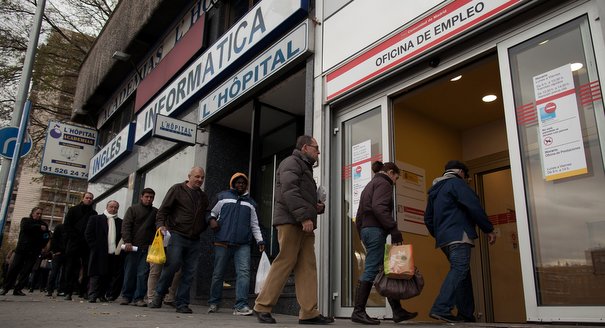
Even if the euro survives, the crisis isn't over until the periphery starts growing and people start finding jobs.
Source: Wall Street Journal

Until then, the risk of relapse triggered by domestic rifts or an external economic shock will remain high. The euro zone can fail even if the single currency survives.
I recently heard a prominent opposition politician from a stricken European country dismiss the shift in financial-market sentiment, arguing that current policies are on the road to nowhere. When I asked him how he thought it would end, he answered with the "boiling frog" allegory: If you put a frog in scalding water, he said, it will jump out. But if you place it in cold water and slowly raise the heat, it will stay put, eventually being boiled to death.In other words, even if an explosion that propels a country out of the euro is avoided, the problems remain. Like the gradually boiling frog, the periphery countries may manage to stay in the euro but remain in depression, with continued emigration and de-industrialization.
This is hardly a theoretical scenario. History is full of examples of regions within a currency union that became uncompetitive and failed to keep pace even though a large central government was there to help. Think, for example, of the Mezzogiorno in Italy, of Extremadura in Spain, or of Sertão Nordestino in Brazil, of West Virginia and Mississippi in the U.S., of the Indian state of Bihar.
Of course, there are also plentiful examples of countries with their own currency that fell behind. But Spain, Italy and Ireland, among others, were relatively successful economies that adopted the euro in the hope they would do even better—not to enter ongoing recessions or become wards of the ECB.
Instead of a region of shared and uniform prosperity, the euro zone has become a study in internal divergence. Though it was once on the way to catching up with the U.S., it is now falling farther and farther behind.
The numbers are staggering. Unemployment is at 26.8% in Greece, 26.6% in Spain, 16.3% in Portugal, 14.6% in Ireland, 11.1% in Italy—and joblessness is still rising in all of these countries. Meanwhile, the unemployment rate is 5.4% in Germany and 7.8% in the U.S.
Italy's gross domestic product has fallen by 6% since the pre-crisis peak in 2007, whereas Germany's is up 8%. In the U.S., where the world financial crisis began, GDP has surpassed its pre-crisis peak by 7%. By comparison, Europe's GDP is only 2% above its pre-crisis level.
These divergences don't simply reflect well-known differences in labor-market flexibility, business climate and government efficiency that distinguish the European periphery from the core, and the euro zone from the U.S. Rather, they mostly reflect the euro zone's shackling economic policies.
Both fiscal policy and, until recently, monetary policy in the euro zone has been incommensurate to the severity of the crisis, far more so than the policy response in the U.S. The fiscal stance in Europe remains contractionary, reflecting the inexistence of a large central government, the inability of the periphery countries to borrow, and a fiscally conservative government in Germany, where the effect of the crisis has been felt much less.
The limited monetary-policy response, which is now changing belatedly, was also the result of a conservative approach by the core, especially Germany. Certainly, monetary-policy instruments are always too blunt to respond to divergent economic trends within a large currency area. But the fear that a "transfer union" is being created surreptitiously under the cloak of monetary policy still plays a role in limiting the ECB's response.
Is there anything wrong with a little cheer, after so much doubt and agony over the endangered euro? No, except that the euro was created not for its own sake, but for the enhancement of prosperity and unity in Europe. By that standard, there is little to be celebrating about. Not yet, anyway.
Falling interest-rate spreads and improving financial markets are not enough to reignite growth and competitiveness. Continued structural, tax and institutional reforms are essential, but the momentum is faltering. In Italy, Pier Luigi Bersani's center-left party leads the polls—and has made absolutely clear its opposition to badly needed labor-market reforms. Ex-Premier Silvio Berlusconi, who wants to reverse Mario Monti's property levies, has been politically resuscitated.
In Brussels, plans for a banking union are advancing, but at a snail's pace. Proposals for forgiving official-sector debt holdings are dead on arrival. Fiscal union is not on the table. A little financial cheer, it turns out, is a dangerous thing.
This article originally appeared in the Wall Street Journal.

Former Senior Associate, International Economics Program
Dadush was a senior associate at the Carnegie Endowment for International Peace. He focuses on trends in the global economy and is currently tracking developments in the eurozone crisis.
Recent Work
Uri Dadush
Uri Dadush
Carnegie does not take institutional positions on public policy issues; the views represented herein are those of the author(s) and do not necessarily reflect the views of Carnegie, its staff, or its trustees.

The Plaza Accord was not an externally imposed punishment of Japan but part of a broader restructuring that Japanese economists and policymakers themselves recognized was necessary. Its effects were undermined, however, when Tokyo responded to the resulting slowdown with policies that exacerbated investment, credit expansion, and the very imbalances the adjustment was intended to resolve.

Michael Pettis

Before the next wave of EU enlargement takes place, the union needs to grapple with thorny questions of how power is distributed among its members.


Emil Sondaj Hansen, Ditte Brasso Sørensen

The European far right might fail to steer EU policy in the direction Russia wants, but they will create enough chaos inside Europe to benefit the Kremlin.

Dimitar Bechev

The new U.S.–Denmark–Greenland agreement will help Washington exert political, economic, and financial dominance under the guise of security. Yet, it acknowledged Copenhagen’s and Nuuk’s sovereignty on the island.

Marc Pierini

A summer of escalation in the Black Sea has hurt Ukraine economically and is exacerbating world food security. A truce is needed—as is a broader reframing of Europe’s Ukraine strategy.

Thomas de Waal