

Commentary
Sarah Chayes
{
  "authors": [
    "Sarah Chayes"
  ],
  "type": "legacyinthemedia",
  "centerAffiliationAll": "dc",
  "centers": [
    "Carnegie Endowment for International Peace"
  ],
  "collections": [],
  "englishNewsletterAll": "ctw",
  "nonEnglishNewsletterAll": "",
  "primaryCenter": "Carnegie Endowment for International Peace",
  "programAffiliation": "SAP",
  "programs": [
    "South Asia"
  ],
  "projects": [],
  "regions": [
    "South Asia",
    "Afghanistan"
  ],
  "topics": [
    "Democracy",
    "Security",
    "Foreign Policy",
    "Civil Society"
  ]
}
Source: Getty
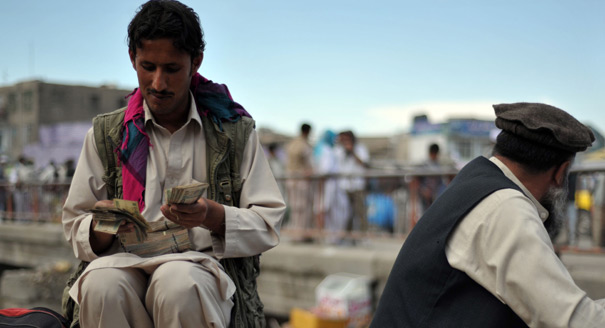
The 2010 arrest and release of the CIA’s Afghan cash deliveryman shows how dysfunctional U.S. Afghanistan policy has been.
Source: Foreign Policy
Buried in the recent New York Times revelation that the CIA has been delivering bags of cash to Afghan President Hamid Karzai is a nugget of information that tells the whole story about just how self-defeating U.S. Afghanistan policy has been. It solves some riddles that mystified a lot of us at the time -- and constitutes an object lesson for the future.
The CIA's bag man was Muhammad Zia Salehi.
In July 2010, this same Salehi was arrested by U.S.-mentored Afghan police officers, on charges of influence peddling. At the time, U.S. civilian and military officials had begun to grasp how damaging Afghan government corruption was to what they were trying to achieve in Afghanistan, and were beginning to take serious steps to counter it. Salehi's arrest was the climax of that process.It was a dramatic success, an offshoot of months of painstaking investigation into a nearly billion-dollar sinkhole in Afghanistan's top private financial institution, Kabul Bank. The decision to develop the case had been run up the U.S. interagency flagpole. Senior U.S. officials, at last sensitized to the corruption problem and anxious for a test case, had approved it and were kept informed along the way. Afghan officials, too. Karzai himself had authorized the arrest.
But before nightfall, Salehi made a phone call and Karzai reversed course, ordering his release. Charges were quickly dropped. This episode ended any serious U.S. anti-corruption efforts in Afghanistan. Which in turn ensured that all other efforts, all the sacrifice, would be in vain.
Karzai was not shy about his interference with the judicial process on Salehi's behalf. "I intervened very, very strongly," he boasted to ABC's "This Week" program a month later, citing the conditions of the arrest. "This man was taken out of his house in the middle of the night by 30 Kalashnikov-toting masked men in the name of Afghan law enforcement. This is exactly reminiscent of the days of the Soviet Union, where people were taken away from their homes by armed people in the name of the state and thrown into obscure prisons and in some kind of kangaroo courts."
Nothing of the sort happened. At the time, I sat down separately with two law enforcement officers close to the investigation and reconstructed the sequence of events. Karzai had agreed to order the arrest on the basis of a judicially-authorized wiretap that U.S. officials had played for one of his key advisors, my sources explained. Salehi's voice could be heard demanding a payoff. The Afghan attorney general signed the arrest warrant, and the interior minister detailed a special police unit to execute it.
When the Afghan police officers arrived at Salehi's house, according to the team's chief U.S. mentor, they did not storm it or break down his door; they called him on his cell phone, identified themselves, and asked him to come out. Irate, Salehi phoned a different Afghan security service, whose men rushed to the scene, exchanged shots with the arresting officers, but eventually retreated. Next, Salehi dialed up the interior minister, who explained to him that Karzai in person had approved the arrest, and Salehi had better surrender.
But U.S. embassy officials--to let Karzai "save face," as one of them explained internally at the time -- volunteered that perhaps the arrest was a bit heavy handed. U.S. officers, who had worked hard to foster professionalism in their Afghan trainees, not to mention the Afghans who had worked the case, disagreed, and expressed bitter disappointment at the fate of their hard work, and at the lack of support from the Americans who had put them up to it.
"I have seen many a U.S. arrest that was far less polite than this one," remarked the mentor, an FBI officer.
This drama unfolded less than a month after Gen. David Petraeus took command of the more than 140,000 international troops in Afghanistan. I was part of a small group of civilian advisors helping him transition in. At the top of our agenda was Afghan governance. We were convinced that the acute and abusive corruption of the Karzai government was playing a key role in motivating Afghans to join the Taliban insurgency. Without getting a handle on corruption, it would be impossible to durably pacify the country, we believed.
Several of these civilians had helped write a strategic assessment of the Afghanistan campaign for Petraeus's predecessor, Gen. Stanley McChrystal. It warned that a "crisis in confidence in the Afghan government"--largely due to this corruption--threatened the mission. I worked for McChrystal at the time, and with other members of the international military command, as well as U.S. and British rule-of-law officials and others, had helped design a comprehensive plan for countering runaway Afghan corruption and the international community's role in enabling it.
Our argument was practical: Systematic state corruption and abuse of power, we spelled out in internal planning documents, was discrediting the Afghan government. Afghans were outraged at it, and therefore increasingly susceptible to Taliban influence. The international community was becoming tainted by association. This dynamic was a key factor feeding the burgeoning violence and undermining the ability of either security or development efforts to reverse these trends. Fighting corruption, in other words, wasn't just a humanitarian or governance priority, it was key to winning the war. Without better governance, anything that might be achieved by extra U.S. troops or stepped-up special operations would be short-lived at best.
But by the summer of 2010, frustratingly little progress had been made in implementing the anti-corruption procedures we had developed. So Petraeus's team of civilian "directed telescopes," as he called us, set about updating the plan.
The result was a restatement of the argument, and a more sophisticated depiction of Afghan government corruption as the work of structured, vertically integrated criminal networks -- crime syndicates masquerading, in effect, as a government. Any approach to the problem had to be strategic, had to draw on techniques from the fight against organized crime. We expanded the toolbox of leverage that could be applied. We thought through likely risks, and ways of mitigating them. We emphasized the actions to be taken to protect and reinforce those officials who truly acted on behalf of the people, and who too often found themselves in mortal danger.
Our PowerPoint presentation spelling out this plan ran to more than 40 slides. We selected a dozen we really planned to brief, but at a meeting with the entire command staff, General Petraeus read through every one. With a calculated flourish, he marked a check on each page as he turned it over. Petraeus was on board.
Elated, the Directed Telescopes planned a command conference, at which he would explain this new approach to his subordinate officers, flown in from their headquarters around Afghanistan. We had already traveled out to some regions, to begin "socializing" the novel ideas.
But when he stood up to address the assembled brass, Petraeus seemed to skip past -- or even argue against -- the slides we had prepared explaining the new governance approach. We were stunned. What had happened? Had we misunderstood? Had he changed his mind?
For another month, we kept at it; I hammered out a detailed implementation of our general concept to be employed in Kandahar province, alongside the troop surge. But by mid-September 2010, it was clear to me that Petraeus had no intention of implementing it, or of pursuing any substantive anti-corruption initiative at all. Four months later, in an intense interagency struggle over the language of a document spelling out objectives for Afghanistan by 2015, the U.S. government, at the cabinet level, explicitly reached the same decision.
That was the moment I understood the Afghanistan mission could not succeed.
I spent weeks wracking my brain, trying to account for the about-face. Eventually, after a glance in my calendar to confirm the dates, it came to me. It was the Salehi arrest. The Salehi arrest had changed everything.
In those fervid days immediately after Salehi's release, Petraeus swung into energetic action. Karzai was blustering against the two special Afghan police teams, the Sensitive Investigations Unit (SIU), which had been developing the massive and complex Kabul Bank case, and the newer Major Crimes Task Force (MCTF), focused specifically on corruption, whose officers had executed the Salehi arrest warrant. Karzai would disband them both, he swore. Petraeus and U.S. Ambassador Karl Eikenberry rallied much of the international community in defense of the two teams, and the red line held.
Then Karzai went after the special anti-corruption prosecutors. U.K.-financed top-up salaries, bringing their pay from $200 per month to $800 (for taking on some of the most ruthless and well-funded Afghan criminals), were cancelled by an Afghan government crying interference. Prosecutors on the Salehi case were demoted, sent to the provinces. The Afghan government barred U.S. Department of Justice attorneys from mentoring their Afghan counterparts on anti-corruption cases. This time, no one stepped up. No support came from the international community.
Anti-corruption efforts in Afghanistan collapsed. Prosecutions stalled. The Afghan Interior Ministry refused to authorize further investigations by the SIU or the MCTF. "We can't find a fish little enough to go after," complained the MCTF mentor in December 2010. Petraeus turned his focus to killing insurgents. U.S. interagency guidance approved in early 2011 as part of that "objectives" document actually barred the Justice Department from helping Afghan prosecutors on anti-corruption cases. The best, most constructive and courageous Afghan law enforcement professionals were left high and dry by Washington, alone against a hostile Afghan government. A draft anti-corruption plan--in itself insufficient--was never presented to President Obama for approval.
And no wonder. U.S. officials had blundered into a circular firing squad. Salehi, the subject of the U.S. government's corruption test case, was also the U.S. government's intermediary for covert cash payments to Karzai. A secret CIA agenda was in conflict with the agenda of much of the rest of the U.S. government. And with no one able to explicitly arbitrate this contradiction, the CIA's agenda won out.
Throughout the unfolding investigation, two senior U.S. officials have told me, through Salehi's arrest and release after a few hours of police detention, CIA personnel never mentioned their relationship with him. Even afterwards, despite pressure in Kabul and Washington, the CIA refused to provide the ambassador or the key cabinet officials a list of Afghans they were paying. The CIA station chief in Kabul continued to hold private meetings with Karzai, with no other U.S. officials present.
So whom did Salehi call from his jail cell the afternoon of his arrest? Was it Karzai, as many presumed at the time? Or was it the CIA station chief?
What began as a test case on Afghan corruption, in other words, turned into a test case in U.S. foreign-policy dysfunction, raising a number of further questions of deeper import to the United States. Just how connected are CIA activities to core United States goals abroad? Or to a concerted plan for achieving them? To what extent do CIA officials set their own agenda? Is that agenda always in the U.S. national interest? How often is it at cross-purposes with the goals of the president, the department of state, even the military? What is the appropriate degree of transparency and accountability to prevent the inadvertent sabotage of other U.S. efforts and investments? Who must call these shots?
Only if senior U.S. leaders have the courage to address these questions directly, to arbitrate them clearly, and enforce their decisions, can U.S. foreign policy hope in the future to avoid the tragic waste of lives and effort that has characterized the past decade.
Former Senior Fellow, Democracy, Conflict, and Governance Program
Sarah Chayes is internationally recognized for her innovative thinking on corruption and its implications. Her work explores how severe corruption can help prompt such crises as terrorism, revolutions and their violent aftermaths, and environmental degradation.
Recent Work
Sarah Chayes
Carnegie does not take institutional positions on public policy issues; the views represented herein are those of the author(s) and do not necessarily reflect the views of Carnegie, its staff, or its trustees.

Despite public disputes over trade and immigration, the strategic partnership’s foundations remain sturdy.

Sameer Lalwani

It signals a new era of tech diffusion and warfare.

Steve Feldstein

With its public finances in shambles, the far right polling at 35 percent ahead of the 2027 presidential election, and a growing protest movement, is France’s crisis a threat to the EU’s geopolitical awakening?

Rym Momtaz, ed.

Russia’s AI-driven propaganda campaigns operate in a fragmented, chaotic, and often illogical manner. That’s not necessarily a problem for the Kremlin, though: It’s much easier to mimic genuine public debate that way.

Ilya Klishin

Ahead of a tough winter for Ukraine, Donald Trump’s swing back toward Russia bodes ill. But instead of panicking, Kyiv’s European allies are focusing on action.
Rym Momtaz