

Paper
James M. Acton, Ankit Panda
{
  "authors": [
    "James M. Acton"
  ],
  "type": "legacyinthemedia",
  "centerAffiliationAll": "dc",
  "centers": [
    "Carnegie Endowment for International Peace"
  ],
  "collections": [
    "Korean Peninsula"
  ],
  "englishNewsletterAll": "ctw",
  "nonEnglishNewsletterAll": "",
  "primaryCenter": "Carnegie Endowment for International Peace",
  "programAffiliation": "NPP",
  "programs": [
    "Nuclear Policy"
  ],
  "projects": [],
  "regions": [
    "East Asia",
    "North Korea"
  ],
  "topics": [
    "Nuclear Policy",
    "Arms Control"
  ]
}
Source: Getty
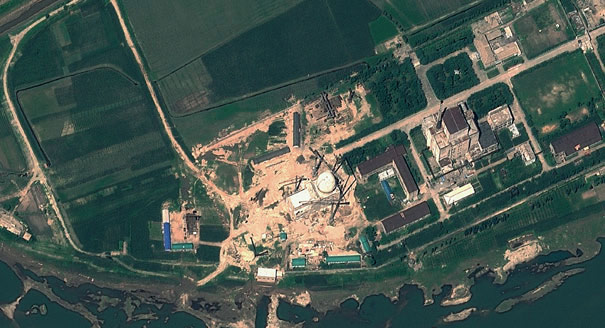
Satellite images show activity at Yongbyon nuclear complex in North Korea.
Source: Al Jazeera
Carnegie's James Acton discussed satellite images that show activity at Yongbyon nuclear complex in North Korea. Acton told Al Jazeera that the West needs to start talking again to Pyongyang. "Although this is not a surprise, it is serious," Acton said, "becasue it is yet another indication that North Korea is not going to be willing to give up its nuclear weapons program."
"Quite the contrary," Acton added, "it now appears to be intent on expanding the size of its arsenal." North Korea says it has a nuclear weapons and there is external evidence of that claim, Acton said, so this reactor is about expanding its arsenal. North Korea does not have a large arsenal at the moment so one and a half bombs worth a year is a significant expansion, Acton pointed out.
"What I think ought to happen in private," Acton concluded, "is talks with North Korea about risk reduction, about trying to make it clear to North Korea that proliferating nuclear technology or material - as it has done to Syria in the past - that there will be consequences to pay."

Jessica T. Mathews Chair, Co-director, Nuclear Policy Program
Acton holds the Jessica T. Mathews Chair and is co-director of the Nuclear Policy Program at the Carnegie Endowment for International Peace.
Recent Work

James M. Acton, Ankit Panda
James M. Acton
Carnegie does not take institutional positions on public policy issues; the views represented herein are those of the author(s) and do not necessarily reflect the views of Carnegie, its staff, or its trustees.

U.S. trading partners in Asia are closely watching the dispute for signs of how it may affect their own interests.

Barbara Weisel
Congress should ask tough questions about the agreement’s more unique features and whether they advance U.S. interests or compromise them.

Jane Darby Menton

Nuclear and maritime communities face a long and challenging journey to deploy commercial nuclear applications at sea.


Jamie Kwong, Toby Dalton
Japan’s revision of its three strategic documents reflects an intention to keep the United States engaged in the region while Japan fills any vacuums of U.S. power to preserve the Indo-Pacific order.

Ryo Sahashi

Chinese biotech companies have been on the receiving end of U.S. economic coercion. Yet their responses have differed significantly because firm and state interests are not uniformly aligned. For Washington, treating all Chinese tech firms the same, irrespective of their actual interests, risks pushing them farther into Beijing’s corner.

Xue Gong