

In The Media
Lahcen Achy
{
  "authors": [
    "Lahcen Achy"
  ],
  "type": "legacyinthemedia",
  "centerAffiliationAll": "dc",
  "centers": [
    "Carnegie Endowment for International Peace",
    "Malcolm H. Kerr Carnegie Middle East Center"
  ],
  "collections": [],
  "englishNewsletterAll": "menaTransitions",
  "nonEnglishNewsletterAll": "",
  "primaryCenter": "Malcolm H. Kerr Carnegie Middle East Center",
  "programAffiliation": "MEP",
  "programs": [
    "Middle East"
  ],
  "projects": [],
  "regions": [
    "Maghreb",
    "Algeria",
    "North Africa"
  ],
  "topics": [
    "Economy"
  ]
}
Source: Getty
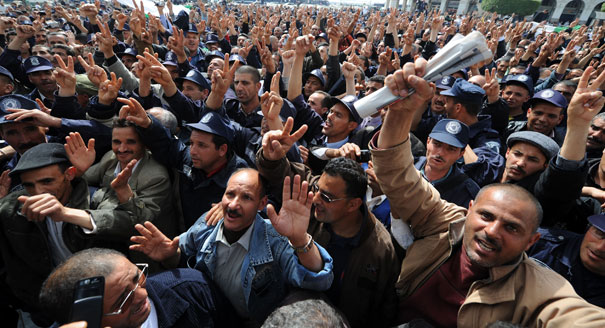
Although Algeria has the third largest oil reserves and second largest natural gas reserves in Africa, most Algerians complain of worsening social and economic challenges.
Source: Al-Hayat
Several weeks ago, Algerian Prime Minister Abdelmalek Sellal revealed that the 2015–2019 five-year plan for the country had been finalized. It follows the 2010–2014 plan, for which the government had allocated $286 billion from the public budget. With no official reports, figures on the achievements of the current plan in different economic and social sectors are conflicting. But it is possible analyze the economic progress—or lack thereof—under the plans by examining the extensive gap between the country’s natural and human resources on one hand and the economic and living conditions of many households on the other.
The largest country in Africa by land area and the tenth largest globally, Algeria holds the third largest oil reserves in Africa, behind Nigeria and Libya, with proven oil reserves estimated at 12.2 billion barrels. Algeria also holds the second largest natural gas reserves in Africa after Nigeria, and is ranked among the ten countries with the largest shale gas reserves in the world. With foreign currency reserves reaching $200 billion, Algeria is able to fund its imports for more than three years.
Despite these impressive figures, Algerian households are facing an increasing number of social and economic challenges. Most Algerians lament the declining quality of basic social services, namely education, healthcare, and access to housing. Unemployment rates are still soaring, reaching 21.5 percent among people aged fifteen to twenty-four according to official estimates. Most of the jobs created over the past decade are low-wage and unstable and offer no social coverage.For the past five years, public investment in Algeria has been more than twice that of neighboring countries such as Morocco and Tunisia. Yet Algeria has failed to achieve similar economic growth. Compared to other countries in the Middle East, Africa, Asia, and Latin America, Algeria stands out as an exception with its high public spending and modest economic growth.
Corruption plays a crucial part in widening the gap between, one the one hand, the available resources and, on the other, the modest achievements as well as the failure of the five-year plans to achieve real economic takeoff and improve social welfare for the entire Algerian society. Algeria ranked 105 out of 176 in the 2012 Transparency International Corruption Perceptions Index and came in 12 among 17 countries in the Middle East and North Africa (MENA) region.
In 2004, Algeria ratified the United Nations Convention Against Corruption, with some reservations. A law for the prevention of corruption in the public sector was enacted. A national anticorruption commission was created that same year, but Algerian President Abdelaziz Bouteflika did not appoint its seven members appointed until 2010, and the commission has yet to achieve any tangible results. The World Economic Forum’s Global Competitiveness Report 2012–2013 indicates that the Algerian judicial system is crippled by interference from the executive authority, companies, and influential individuals. In the report, Algeria is ranked 123 among 144 countries, in terms of judicial independence, trailing behind all MENA countries, with the exception of Lebanon.
The energy sector accounts for more than one-third of Algeria’s gross domestic product (GDP), two-thirds of government revenues, and 98 percent of exports. Successive governments have failed to sever the economy’s excessive reliance on the global oil and gas market, making the Algerian economy one of the least diversified: agriculture accounts for only 8 percent of the GDP, while the manufacturing industry accounts for 5 percent. Only a few sectors contribute to economic growth, such as construction and public works.
Furthermore, the Algerian government has failed to create a legal and regulatory environment, to encourage entrepreneurship, private investment, and economic diversification, all key to long-term economic growth and stability. Most small and medium enterprises face market access barriers and limited access to funding from banks. Consequently, local and foreign investors find few incentives to launch industrial and service-related projects, which have the potential to improve the Algerian economy and its competitiveness. In the World Bank’s Doing Business 2014 report, Algeria ranks 153 out of 189 countries in terms of the ease of doing business—behind most MENA countries.
Developing the Algerian economy and enabling it to face challenges of diversification, competitiveness, and decent job creation will be difficult if the current management of economic resources is not radically changed. The five-year plans should include a clear development strategy, drafted with the participation of the private sector and civil society, instead of being a mere tool to attract voters and distribute proceeds. Public projects should be improved, and mismanagement limited by promoting governance mechanisms through monitoring and accountability. The parliament’s supervisory role should be upheld, and the legislature enabled to form fact-finding commissions to inquire into misuse of public funds. The independence of the judiciary and its role must also be strengthened. Otherwise, despite the available resources, chances of economic recovery are dim.
This article was originally published in Arabic in Al-Hayat.
Former Nonresident Senior Associate, Middle East Center
Achy is an economist with expertise in development, institutional economics, trade, and labor and a focus on the Middle East and North Africa.
Recent Work
Lahcen Achy
Lahcen Achy
Carnegie does not take institutional positions on public policy issues; the views represented herein are those of the author(s) and do not necessarily reflect the views of Carnegie, its staff, or its trustees.

Rubio’s recent visit brought welcome attention, but more capital requires governance changes that may be a hard sell for regional governments.

Jennifer B. Murtazashvili

China has showcased its engineering prowess with small modular reactor demonstration projects. But turning these technological achievements into commercial success will be a greater challenge.

Tong Zhao

Despite public disputes over trade and immigration, the strategic partnership’s foundations remain sturdy.

Sameer Lalwani

With its public finances in shambles, the far right polling at 35 percent ahead of the 2027 presidential election, and a growing protest movement, is France’s crisis a threat to the EU’s geopolitical awakening?

Rym Momtaz, ed.

Russian strikes are weakening the economy sustaining Ukraine’s war effort. Closing the growing funding gap will require more European support and politically contentious reforms in Kyiv.

Balázs Jarábik