

Commentary
Judy Dempsey
{
  "authors": [
    "Judy Dempsey"
  ],
  "type": "legacyinthemedia",
  "centerAffiliationAll": "",
  "centers": [
    "Carnegie Endowment for International Peace",
    "Carnegie Europe"
  ],
  "collections": [
    "Europe’s Eastern Neighborhood"
  ],
  "englishNewsletterAll": "",
  "nonEnglishNewsletterAll": "",
  "primaryCenter": "Carnegie Europe",
  "programAffiliation": "",
  "programs": [],
  "projects": [],
  "regions": [
    "Russia",
    "Europe",
    "Western Europe",
    "Germany"
  ],
  "topics": [
    "Foreign Policy",
    "EU"
  ]
}
Source: Getty
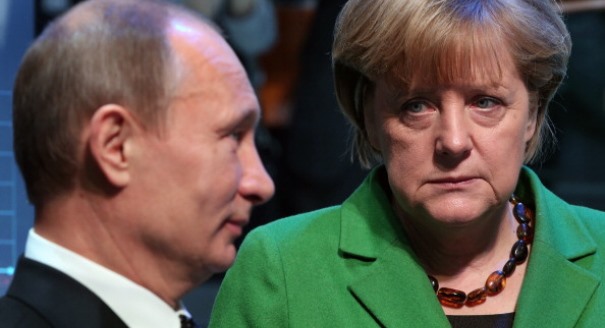
Angela Merkel’s tough stance on Russia has created a sense of unity within the EU toward the Kremlin—and, for once, between Europe and the United States.
Source: New York Times
Under Chancellor Angela Merkel, Germany has been taking a hard line on Russia: Ms. Merkel has repeatedly criticized attempts by President Vladimir Putin to keep Russia’s neighbors away from the European Union, and she has been outspoken about the Kremlin’s muzzling of the media, the banning of nongovernmental organizations and the spread of corruption.
Clearly, Mr. Putin is not pleased. Yet it is not Moscow that presents the biggest challenge to Ms. Merkel’s line on Russia. It will be her new coalition partners in Berlin, the Social Democrats, and in particular the new foreign minister, Frank-Walter Steinmeier.
This is bad news both for Europe and for the United States: Ms. Merkel’s tough stance has created a sense of unity inside the European Union toward the Kremlin, and, for once, between Europe and the United States. Any attempt by the Social Democrats to undermine that unity would be exploited by Mr. Putin.Germany’s hard line on Russia isn’t limited to the chancellor’s office. Germany’s president, Joachim Gauck, announced earlier this month that he would not be attending the official opening of the Winter Olympics next year in Sochi, Russia. Although his post is largely ceremonial, the fact that a German president would snub his Russian counterpart signals a major shift between Moscow and Berlin.
Around the same time, Guido Westerwelle, then the foreign minister, went to Kiev, Ukraine, to witness the huge anti-government demonstrations. He stood alongside the former world heavyweight boxer Vitali Klitschko, one of the leaders of Ukraine’s opposition. The crowds loved it. By all accounts, President Viktor Yanukovich’s office was furious.
Nor is this a new position: When Ms. Merkel was first elected chancellor in 2005, she surprised her European Union counterparts by speaking out about Russia’s violation of human rights, an issue rarely touched on by previous chancellors; her immediate predecessor, the Social Democrat Gerhard Schröder, had described Mr. Putin as “an impeccable democrat.”
Ms. Merkel pursued a two-pronged strategy toward Germany’s eastern neighbors: criticizing Russia, but also working hard to mend relations with Germany’s most important eastern and European Union neighbor, Poland. After centuries of distrust and hatred, relations between Warsaw and Berlin are now blossoming, which Russia had not expected.
And yet this hard line could be challenged under Mr. Steinmeier, who last headed the Foreign Ministry during Ms. Merkel’s “grand coalition” of 2005 to 2009. Then, the Chancellery and Foreign Ministry were often at loggerheads over Russia. This time around, if Mr. Steinmeier fails to understand Mr. Putin’s policies, Germany’s allies can expect even more tensions.
Indeed, the tensions between Ms. Merkel’s center-right Christian Democrats and the center-left Social Democrats over Russia were already obvious during recent coalition discussions over foreign policy. The section of their draft agreement on Russia exposed big differences between the two sides.
One of the Christian Democrat’s foreign policy experts, Andreas Schockenhoff, had inserted tough language about Russia’s deteriorating human rights record and the need to support pro-democracy movements. The Social Democrats pushed back, softening the language. They also inserted phrases about supporting the modernization of the Russian economy, maintaining a special bilateral partnership and recognizing that Russia was an indispensable partner for tackling big security issues.
The parties’ differences over values, interests and obligations are now a recipe for renewed conflict between the Chancellery and the Foreign Ministry, with consequences that affect Europe’s position as a whole. After all, when it comes to European policy toward Russia, it is Germany’s voice that counts the most.
Yet many Social Democrats still cling to the concept of “Ostpolitik,” or Eastern policy. Forged in the 1960s by the Social Democratic Chancellor Willy Brandt, that policy was based on dialogue and détente toward East Germany and the Soviet Union, rooted in the belief that trade and contacts with them would erode the Communist system over time. In the end, it was the people’s power, and the policies of Mikhail Gorbachev, not Ostpolitik, that triggered the collapse of Communism.
Despite that, many Social Democrats still believe that a modern-day version of Ostpolitik offers the best approach for fostering change and democracy in Russia. Many also believe that Germany is duty-bound to have a special relationship with Russia because of Adolf Hitler’s brutal war against the country.
Ms. Merkel and Mr. Gauck see the relationship differently. Perhaps their upbringings in Communist East Germany has shattered all illusions about former K.G.B.-turned leaders like Mr. Putin being capable of embracing democracy. After all, in the 1950s Mr. Gauck’s father spent four years in a Soviet labor camp, returning a broken man.
Ms. Merkel’s critics say her policies toward Russia will damage trade ties; in fact, bilateral trade is at an all-time high. They also accuse her of not taking Russia seriously as a foreign policy player. But Ms. Merkel has worked hard — though in vain — to persuade Mr. Putin to help stop the civil war in Syria or resolve the “frozen conflict” in the Transnistria region of Moldova, to no apparent avail.
This is not to say that Ms. Merkel can’t incorporate parts of the Social Democrats’ position, or that a hard line is always the best idea — rejecting some of Russia’s obvious shortcomings does not constitute a strategy. In the long run, the focus of German and European efforts must be on bringing about change in Russia’s government and state institutions.
That is no easy task, and doing so requires, above all, political unity. A fractured German foreign policy toward Russia, and the accompanying fissures that it would create, may soon appear at precisely the worst time.
This article was originally published in the New York Times.

Nonresident Senior Fellow, Carnegie Europe
Judy Dempsey is a nonresident senior fellow at Carnegie Europe
Recent Work
Judy Dempsey
Judy Dempsey
Carnegie does not take institutional positions on public policy issues; the views represented herein are those of the author(s) and do not necessarily reflect the views of Carnegie, its staff, or its trustees.

The European far right might fail to steer EU policy in the direction Russia wants, but they will create enough chaos inside Europe to benefit the Kremlin.

Dimitar Bechev
Washington needs to recognize that influence in the Western Hemisphere comes from presence, delivery, and reliability. It also must recognize that while the United States remains the key external actor, it no longer operates in a permissive environment and cannot presume deference from regional players who have other options, namely China.
Juan S. Gonzalez

Minsk clearly expected the dialogue with Washington to yield more results, in particular the lifting of EU sanctions and permission to export potash.

Artyom Shraibman

A summer of escalation in the Black Sea has hurt Ukraine economically and is exacerbating world food security. A truce is needed—as is a broader reframing of Europe’s Ukraine strategy.

Thomas de Waal
Why governance of rapidly evolving technology will be distributed and complex.


Stewart Patrick, Scott Singer