

Commentary
Dmitri Trenin
{
  "authors": [
    "Dmitri Trenin"
  ],
  "type": "commentary",
  "centerAffiliationAll": "",
  "centers": [
    "Carnegie Endowment for International Peace",
    "Carnegie Russia Eurasia Center"
  ],
  "collections": [],
  "englishNewsletterAll": "",
  "nonEnglishNewsletterAll": "",
  "primaryCenter": "Carnegie Russia Eurasia Center",
  "programAffiliation": "",
  "programs": [],
  "projects": [],
  "regions": [
    "Russia"
  ],
  "topics": [
    "Security"
  ]
}
Source: Getty
The war the terrorists are waging against Russia is for real, and their threats are not empty. Sochi is probably highest on the terrorists’ hit list, and Moscow is another prime target. However, for the time being, the terrorists have focused on some of the softer targets in the south of Russia.
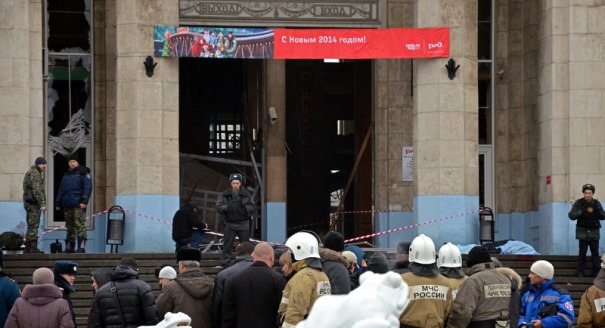
On Sunday and Monday, suicide bombers struck again in Volgograd. The last time they hit the city on the Volga, last October, they managed to kill six. The grim total of the recent attacks is at least five times as high.
Add the car bombing in Pyatigorsk, where three people died on Friday.
The war the terrorists are waging against Russia is for real, and their threats are not empty. The immediate timing of the blasts is meant to spoil the nation’s New Year’s celebrations, traditionally the height of the festive season in Russia. There is also a clear link to the Winter Olympics, due to begin in Sochi on February 7.
Sochi is probably highest on the terrorists’ hit list. Moscow is another prime target. Disrupting the Games and wreaking havoc in the capital would greatly undermine Russia’s prestige, precisely what the terrorists want.
For the time being, and maybe in preparation for bigger strikes, the terrorists have focused on some of the softer targets in the south of Russia. Soft, but not unimportant. Volgograd, formerly Stalingrad, a symbol of Russia's tragedy and triumph in World War II, has been singled out by the terrorists precisely because of its status in people's minds. Their aim was to hurt Russia’s pride, as well as its people.
As the terrorists kill and maim dozens, their larger aim to terrorize so many others—including those outside Russia, hoping that they will now stay away from the Olympics.
It looks like it will be difficult and trying few weeks, but the trials will not end next February. The Sochi Games will come and go—with the level of security hopefully permitting a safe Olympics—but the war the terrorists are waging against Russia will continue. Be ready for the long haul, but eventually terror will fail.
Former Director, Carnegie Moscow Center
Trenin was director of the Carnegie Moscow Center from 2008 to early 2022.
Recent Work
Dmitri Trenin
Dmitri Trenin

Are Germany’s economic, industrial, and political struggles becoming a liability for the EU’s ability to rise to the geopolitical moment?

Rym Momtaz, ed.

Russia’s ruling party would have benefited from Putin appearing as its distant patron, but as an active frontman imposing his views on the public, he has done nothing but harm both the party’s election campaign and the ruling system overall.

Andrey Pertsev

China’s police training infrastructure construction projects provide benefits to recipient countries, promote China’s image as a major global security provider, and are likely to reinforce alignment between Beijing’s security priorities and those of countries in the Global South.


Cameron Waltz, Sheena Chestnut Greitens, Kim Nguyen, …
They face an uphill climb, but they could draw on a strategy that other diplomats have used in the past.


Shana Tabak, Alejandro Martin Rodriguez

European Commission President Ursula von der Leyen is about to give her annual address on the state of the EU. Here’s what she won’t—but should—say.
Rym Momtaz