

Research
- +5
Alper Coşkun, Fatih Ceylan, Tacan İldem, …
{
  "authors": [
    "Sinan Ülgen"
  ],
  "type": "legacyinthemedia",
  "centerAffiliationAll": "dc",
  "centers": [
    "Carnegie Endowment for International Peace",
    "Carnegie Europe",
    "Malcolm H. Kerr Carnegie Middle East Center"
  ],
  "collections": [
    "Turkey’s Transformation"
  ],
  "englishNewsletterAll": "ctw",
  "nonEnglishNewsletterAll": "",
  "primaryCenter": "Carnegie Europe",
  "programAffiliation": "EP",
  "programs": [
    "Europe"
  ],
  "projects": [],
  "regions": [
    "Middle East",
    "Europe",
    "Türkiye",
    "Iran"
  ],
  "topics": [
    "Political Reform",
    "Democracy"
  ]
}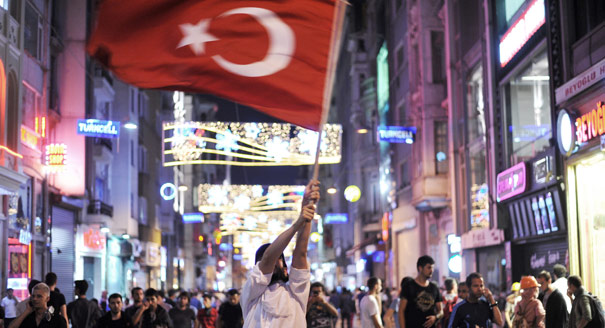
Source: Getty
The sooner the Turkish political class is able to reach a consensus on the indispensability of a reform agenda, the sooner the country can return to long-term political stability.
Source: Financial Times
Until last month, one could not be blamed for thinking that nothing was rotten in the state of Turkey. The combined effect of government pressure, ubiquitous self-censorship and the conflicts of interest of media owners made reporting on corruption a taboo for the Turkish press. But this was shattered by recent allegations of high-level corruption within Prime Minister Recep Tayyip Erdogan’s government. The gravity of the allegations have already led to the resignation of four ministers and arguably represent the biggest threat to Mr Erdogan after 11 years of unchallenged rule.
The irony is that Mr Erdogan’s party had come to power in the wake of a failed decade of politics dominated by corruption and nepotism. His AK party had won a popular mandate with its anti-corruption rhetoric. Even the name of the party – “ak” means clean in Turkish – reflects that. It now seems that it was unable or unwilling to eradicate Turkey’s cycle of corruption-induced political crisis.This failure points to an endemic problem with Turkey’s democracy – and is relevant to many other less- mature democratic polities. High- level corruption in Turkey is primarily linked to the financing of politics. In years past, arbitrary decisions were used to distribute economic rent and to nurture affluent allies that could be relied on to finance politics.
With liberalisation and the elimination of several discretionary policy instruments – such as import permits or production licences – the financing of politics shifted to construction. The awarding of public works to government-friendly groups, amendments to zoning laws to favour pro-government contracting companies and the politically filtered granting of construction permits became instruments of rent distribution. It is no coincidence that many of the allegations against the government concern property. This cycle of money funnelling is a feature of Turkish politics. It is essentially how politics is financed.
The growing cost of political contest is primarily to blame for this perverse incentive to raise ever larger amounts of money. Many countries have had to address this conundrum. The debate around campaign finance reform in the US attests to the difficulties faced by mature democracies in coping with this poison to democracy. For Turkey, a complete overhaul of the system of party financing is sorely needed.
The development of an institutional capability to monitor campaign spending and enforce spending limits is essential. That is the first core lesson to be drawn from the current crisis. Such a measure would not eliminate corruption but it would at least reduce the incentives for it.
The second lesson is to invest in non-partisan institutions. Turks must stop seeing democracy as a winner-takes-all contest. Such an outlook, illustrated by Mr Erdogan’s majoritarianism, is inimical to the development of independent institutions including an impartial judiciary. But a politicised judiciary represents a structural handicap. In addition to helping to perpetuate the perception of a zero-sum democracy, it is also a barrier to any real anti-corruption effort.
The recent graft probe is actually not a sign of the independence of the judiciary in Turkey. Many observers believe that these claims surfaced as a result of the political feud between Mr Erdogan and his one-time ally, the Pennsylvania-based preacher Fethullah Gulen, whose followers have obtained influential positions within the judiciary and the police.
Turkey’s current crisis is of huge significance. It will not only determine whether Mr Erdogan’s party can continue to dominate the domestic political scene. With twin local and presidential elections slated for 2014, the shape of the country’s politics will be affected by this episode. However, the crisis has also laid bare the deficiencies of a democracy marred by cycles of corruption. A return to normalcy will require prioritising reforms to bolster the independence of a key set of state institutions and to overhaul the rules on financing politics. The sooner the Turkish political class is able to reach a consensus on the indispensability of this reform agenda, the sooner the country can return to long-term political stability.
This article was originally published in the Financial Times.

Senior Fellow, Carnegie Europe
Sinan Ülgen is a senior fellow at Carnegie Europe in Brussels, where his research focuses on Turkish foreign policy, transatlantic relations, international trade, economic security, and digital policy.
Recent Work

Alper Coşkun, Fatih Ceylan, Tacan İldem, …
Carnegie does not take institutional positions on public policy issues; the views represented herein are those of the author(s) and do not necessarily reflect the views of Carnegie, its staff, or its trustees.

The domestic impacts of how long it is taking to end the war in Ukraine have pushed the French electorate to the political extremes and compromised the country’s diplomatic capacity.

Rym Momtaz
A deep dive into the policy ecosystems behind battery development in China, South Korea, Japan, the European Union (including some of its member states), the United States, Canada, and India.


Milo McBride, Herbert Crowther, Darcie Draudt-Véjares, …

Sergei Kiriyenko used Russia’s parliamentary vote to further hone his strategy of corporate mobilization that is designed to maximize votes for United Russia.

Andrey Pertsev

Before the next wave of EU enlargement takes place, the union needs to grapple with thorny questions of how power is distributed among its members.


Emil Sondaj Hansen, Ditte Brasso Sørensen

The Horn of Africa countries are among those facing a new security calculus.


Andrew Leber, Lesley Anne Warner