

Q&A
- +1
Amr Hamzawy, Andrew Leber, Eric Lob, …
{
  "authors": [
    "Marwan Muasher"
  ],
  "type": "legacyinthemedia",
  "centerAffiliationAll": "dc",
  "centers": [
    "Carnegie Endowment for International Peace",
    "Malcolm H. Kerr Carnegie Middle East Center"
  ],
  "collections": [
    "Arab Awakening"
  ],
  "englishNewsletterAll": "menaTransitions",
  "nonEnglishNewsletterAll": "",
  "primaryCenter": "Carnegie Endowment for International Peace",
  "programAffiliation": "MEP",
  "programs": [
    "Middle East"
  ],
  "projects": [],
  "regions": [
    "Middle East",
    "North Africa",
    "Egypt",
    "Levant",
    "Maghreb"
  ],
  "topics": [
    "Political Reform"
  ]
}
Source: Getty
Democracy can flourish in the Middle East, but it will take decades and will require major political and cultural change.
Source: Tavis Smiley Show
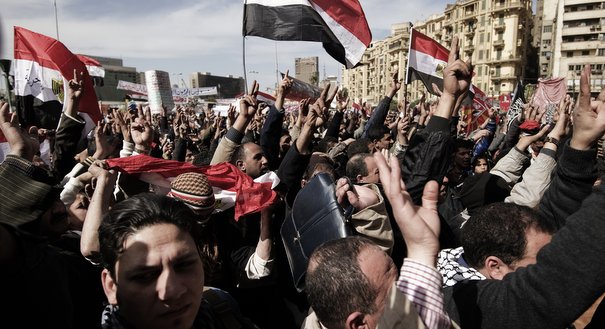
Speaking on the Tavis Smiley Show, Carnegie’s Marwan Muasher discussed his new book The Second Arab Awakening: And the Battle for Pluralism, which argues that democracy can flourish in the Middle East, but will take decades and will require major political and cultural change. Once the political space has been opened, Muasher said, it is up to the people to take it to democratic ends. People have to roll up their sleeves and work towards putting in place democratic institutions that would ensure that the results will be pluralistic systems, he argued.
In a country like Tunisia, Muasher explained, they acknowledged from the beginning that all forces of society needs to be included in the process towards democracy, whereas in Egypt, all major forces attempted to rule in an exclusionist manner.
With 70 percent of the Arab world under 30 years of age, Muasher said, the young generation believes in democracy and pluralism and the right of all forces to operate. “You have a young generation which understands what it take,” he argued, “being exposed to the outside world [and] understands what it takes to build stable and prosperous systems.”
This interview was originally aired on the Tavis Smiley Show.

Vice President for Studies
Marwan Muasher is vice president for studies at Carnegie, where he oversees research in Washington and Beirut on the Middle East. Muasher served as foreign minister (2002–2004) and deputy prime minister (2004–2005) of Jordan, and his career has spanned the areas of diplomacy, development, civil society, and communications.
Recent Work



Amr Hamzawy, Andrew Leber, Eric Lob, …
Marwan Muasher
Carnegie does not take institutional positions on public policy issues; the views represented herein are those of the author(s) and do not necessarily reflect the views of Carnegie, its staff, or its trustees.

The books, podcasts, and films that explain the world it made.
Andrew Leber

In the tenth year of his presidency, President Mirziyoyev’s system is becoming even more personalized than that of his predecessor Karimov.

Galiya Ibragimova

Amid celebrations of bilateral ties was a deeper focus on stability in the Middle East.
Amr Hamzawy

Can economic ties help contain conflict between Egypt and Israel, or do they simply postpone confrontation? Drawing on the German-Russian experience, the article examines how the gas deal creates mutual dependence, keeps channels of cooperation open, and raises the cost of conflict, without necessarily delivering lasting peace.

Nourhan Hefzy

The greater threat to Zelensky comes not from Fedorov alone, but from the convergence between the former defense minister’s political campaign and the anti-corruption investigations moving ever closer to the presidential administration.

Balázs Jarábik